
PRETTY ISN’T ALWAYS READABLE

Free Color Contrast Checker

Do your brand colors work together? Drop in your background and text colors to find out.

Contrast ratio
Pick two colors to test legibility.
Can people read this?
If your content is “pretty” but hard to read, it’s not converting — it’s disappearing.
Same colors, flipped.
Some palettes work one way but fall apart when reversed. This helps you spot it fast.

Why Color Contrast Matters for Branding

Color contrast affects whether people can actually read your brand online. If text blends into the background or strains the eye, visitors are more likely to skim, disengage, or leave — even if your design looks beautiful at first glance.

Good branding isn’t just about choosing the right colors. It’s about using them in a way that supports clarity, hierarchy, and ease of use across your website and marketing materials.

What This Color Contrast Checker Does

This free color contrast checker measures the contrast between your text color and background color using accessibility standards commonly applied to websites and digital products.

A higher contrast score means your text is easier to read on screens. Lower scores indicate that the color pairing may be difficult to read, especially for longer passages of text or smaller font sizes.

This tool gives you a quick, practical way to test whether your brand colors are working together — or working against you.

How to Interpret Your Results

If your color pairing passes the contrast check, it is generally readable for normal body text.

If it only meets the standard for large text, it may work well for headlines but feel tiring or unclear in paragraphs, captions, or buttons.

If it fails, your text may be hard to read for many users, particularly on mobile devices or in bright lighting.

A low score doesn’t mean your palette is necessarily bad. It usually means the colors need better hierarchy, different pairings, or more intentional usage.
Color Contrast vs. Color Balance

Contrast is only one part of a successful brand palette.

Two colors can technically pass a contrast test and still feel harsh, heavy, or unbalanced when used together. Likewise, colors that look great in a palette or mood board can fall apart when applied to real content like websites, emails, or graphics.

Effective brand color systems consider contrast, saturation, warmth, and how colors repeat across different elements — not just whether two colors technically “pass.”

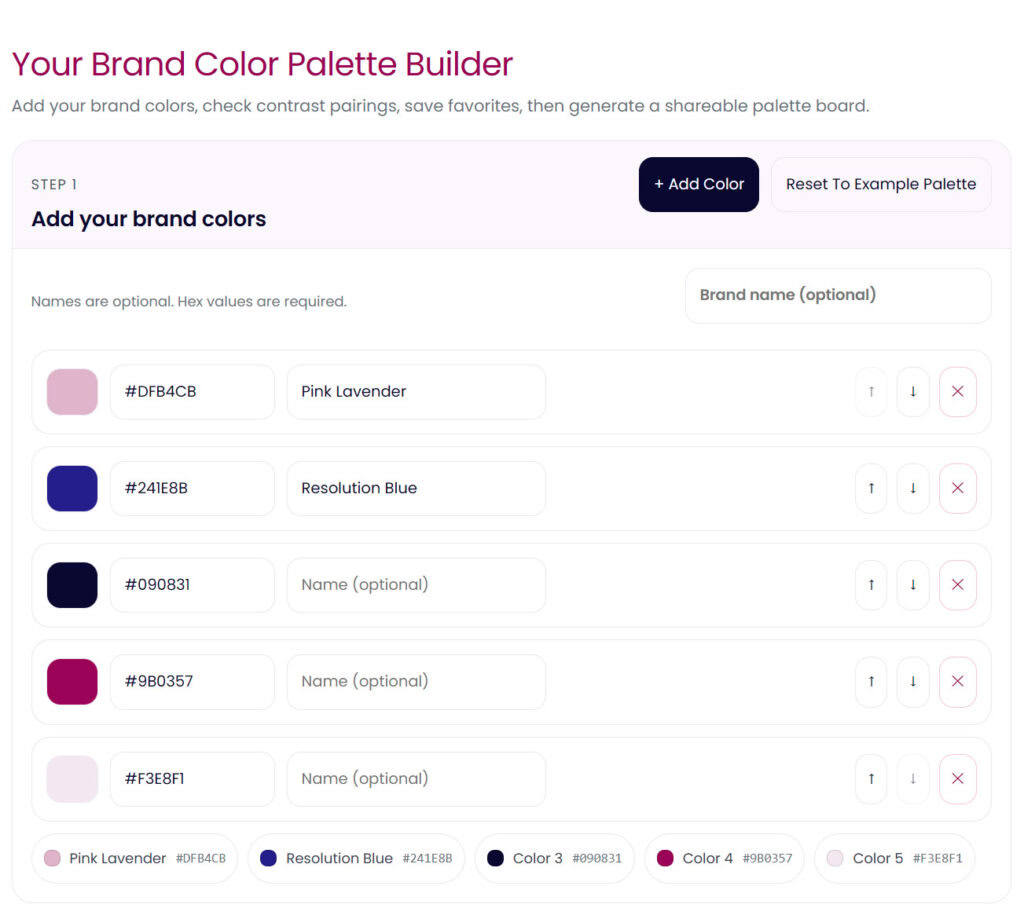
An intuitive tool for artists and designers to create personalized color palettes by adding and naming brand colors for visual branding projects.

Using Brand Colors as a System

Testing contrast is a helpful first step — but it’s only one part of building a brand palette that actually works in practice.

Most brands rely on multiple backgrounds, accent colors, and text styles. A color pairing that passes a contrast check in isolation can still feel heavy, flat, or unbalanced once it’s applied across real layouts.

Effective brand color systems consider:
– contrast and balance
– hierarchy and repetition
– how colors interact across different elements, not just pairs

This is where color decisions move beyond pass/fail checks and become a usable system.

Want to go deeper?

The Color Palette Lab is a designer-built workspace for building full brand color palettes — not just testing individual combinations.

Inside The Color Palette Lab, you can:

build and refine complete palettes
explore harmony alongside contrast
preview real color pairings in context
save and export palettes with ease

Need Help Refining Your Brand Colors?

Shopping Cart