
The Complete Guide to Astrology Houses, Signs, Planets, Aspects, and Transits
This guide to astrology covers the five core components of any birth chart: planets, signs, houses, aspects, and transits. By the end, you’ll understand not just what each one means, but how they function together — because that’s where astrology actually becomes useful.
Brand new to astrology? Start here with the free interactive tool to learn the basics of reading an astrology wheel. Don’t worry, this page is linked there so you can always come back.
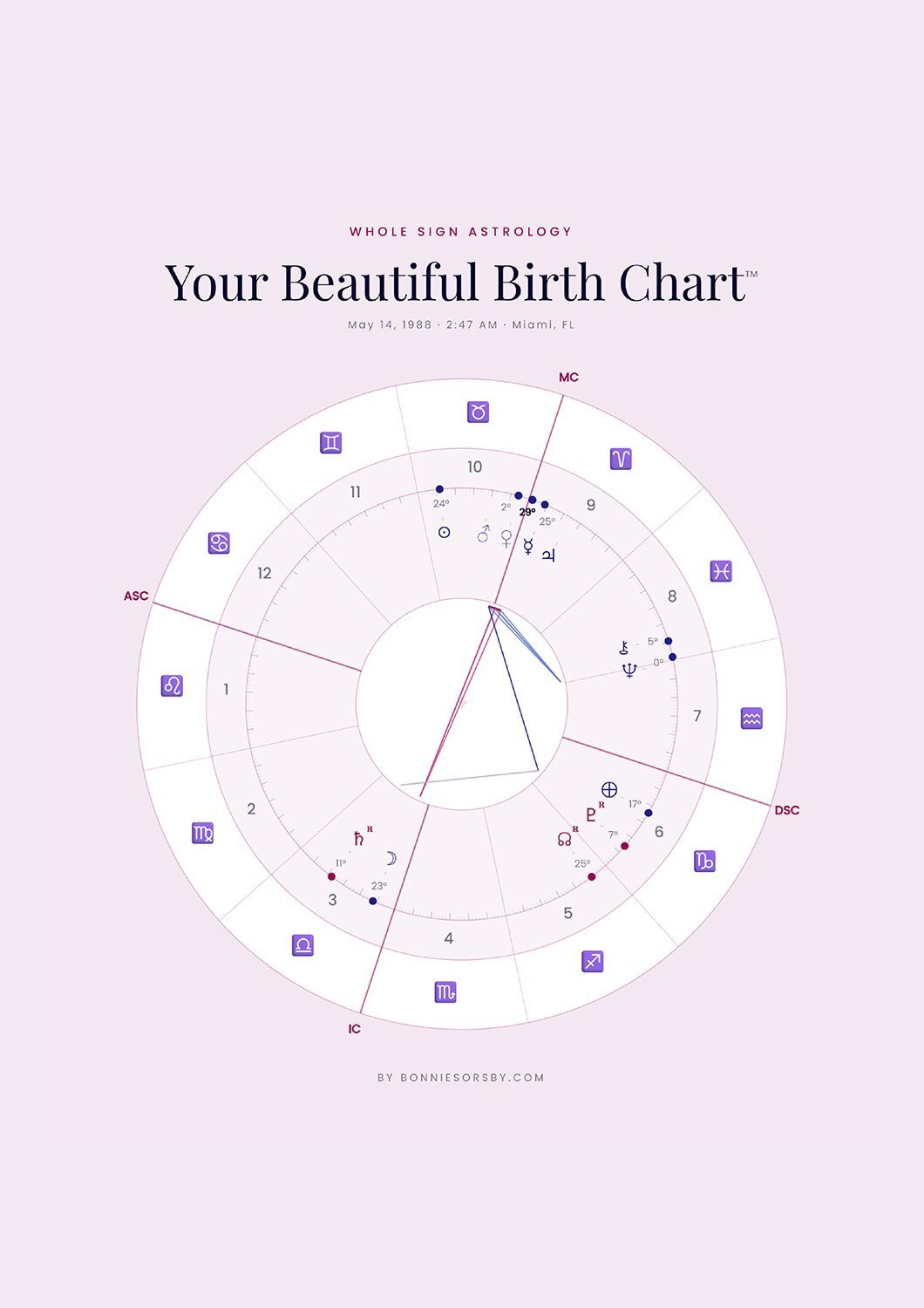
Your Birth Chart Isn’t a Puzzle. It’s a Language.
Most people encounter their birth chart the same way: someone sends them a link, they stare at a wheel covered in symbols and lines, and feel completely lost. There are numbers, glyphs, and colored lines crossing in every direction. It’s not obvious where to start.
The problem usually comes next. People learn their Sun sign, maybe their Moon sign, read a few separate descriptions, and end up with a scattered collection of traits that don’t quite fit together. It starts to feel more like a personality quiz than anything meaningful.
But astrology isn’t a collection of isolated traits. It’s a system. Every component has a specific role, and those roles interact with each other constantly. When you understand what each part is actually for, the chart stops being overwhelming and starts being readable.
What Do Planets Represent in Astrology?
The planets are the actors in your chart. Each one represents a distinct area of psychological function — a drive, a need, a type of energy that operates within you. When astrologers talk about planetary placements, they’re describing which parts of you are being expressed.
The planets answer the question: what is happening? Or more precisely, which part of me is being activated?
Planets = the WHAT. They represent different facets of who you are and how you function.
The Sun
The Sun represents your core identity and sense of self. It’s the part of you oriented toward purpose, visibility, and self-expression. Your Sun placement describes what you need in order to feel like yourself — not just who you are by default, but who you’re becoming.
The Moon
The Moon represents your emotional world, instincts, and need for security. It governs how you process feelings, what makes you feel safe, and the patterns you return to without thinking. The Moon is often more visible in your private life than your public one.
Mercury
Mercury represents how you think, communicate, and process information. It governs learning styles, conversation, curiosity, and the way your mind organizes and expresses ideas. How you talk, write, and listen all live here.
Venus
Venus represents what you value and how you relate to others. It shows up in the way you approach love, attraction, money, aesthetics, and connection. What draws you in, what you find beautiful, and how you give and receive affection all fall under Venus.
Mars
Mars represents drive, desire, and action. It’s how you pursue what you want, how you handle frustration or anger, and where your physical and competitive energy goes. Mars shows what motivates you and how you move when something matters.
Jupiter
Jupiter represents expansion, growth, and opportunity. It points to where things tend to flow more easily, where you’re naturally optimistic, and where you tend to find abundance — or overextend yourself chasing it.
Saturn
Saturn represents structure, discipline, and long-term development. It shows where you encounter the most resistance, where you’re pushed to build something real over time, and where your most durable achievements eventually come from.
Uranus
Uranus represents disruption, originality, and the urge to break from convention. It operates in areas where you resist being boxed in, where you seek freedom, and where unexpected change tends to shake things loose in order to move them forward.
Neptune
Neptune represents imagination, spirituality, and the dissolution of boundaries. It shows where you’re idealistic, where you seek transcendence, and where reality can become blurred — for better or worse.
Pluto
Pluto represents transformation, power, and depth. It operates in areas of life tied to control, loss, and regeneration. Pluto placements often describe where you’ve experienced intensity, where things have had to be dismantled before they could be rebuilt.
>> Related: How to Read Your Birth Chart: A Beginner’s Step-by-Step Guide
What Do the Zodiac Signs Represent in Astrology?
If planets are the what, signs are the how. Each zodiac sign describes a style of expression — a tone, a mode, a particular way that energy tends to move. The sign a planet occupies colors how that planet operates.
So Mars in Aries and Mars in Pisces are both Mars — both drive, desire, and action — but they go about it completely differently. Aries acts fast and directly; Pisces acts intuitively and indirectly. Same planet, different style.
Signs = the HOW. They describe the style and mode in which a planet’s energy expresses itself.
Aries
Bold, direct, and action-oriented. Aries energy moves fast and isn’t interested in waiting. It’s the sign of initiation — starting things, charging forward, and figuring out the details later.
Taurus
Patient, sensory, and deliberate. Taurus energy moves slowly and with intention. It values stability, comfort, and quality. This is the sign that builds things that last.
Gemini
Curious, quick, and adaptable. Gemini energy thrives on variety and exchange. It’s the sign of conversation, ideas, and the constant need to understand more about the world.
Cancer
Intuitive, nurturing, and emotionally aware. Cancer energy is oriented around home, family, and emotional safety. It holds memory and feeling in a way that other signs don’t always access.
Leo
Expressive, generous, and self-aware. Leo energy seeks to create, to be seen, and to lead with heart. At its best it’s warm and magnetic. The shadow is needing external validation to feel whole.
Virgo
Analytical, precise, and service-oriented. Virgo energy is interested in how things work and how they can be improved. It’s the sign of refinement, craft, and the quiet satisfaction of doing something well.
Libra
Relational, balanced, and aesthetically minded. Libra energy is oriented around fairness, beauty, and partnership. It’s always weighing — considering multiple perspectives before committing to one.
Scorpio
Intense, perceptive, and deeply private. Scorpio energy doesn’t operate on the surface. It wants to understand what’s underneath — the motivations, the hidden dynamics, the truth beneath the presentation.
Sagittarius
Expansive, philosophical, and freedom-seeking. Sagittarius energy is oriented around meaning, travel, and the bigger picture. It’s always reaching toward something just beyond the horizon.
Capricorn
Disciplined, ambitious, and strategic. Capricorn energy is oriented around achievement, responsibility, and legacy. It plays a long game, building steadily toward things that matter.
Aquarius
Independent, idealistic, and future-oriented. Aquarius energy is interested in systems, communities, and reform. It thinks in terms of the collective rather than the individual.
Pisces
Empathic, imaginative, and boundary-dissolving. Pisces energy is fluid and highly sensitive. It absorbs the emotional atmosphere around it and is often drawn toward art, healing, or spiritual practice.
What Do the 12 Houses Represent in Astrology?
The houses are the stage on which everything plays out. While planets describe what energy is operating and signs describe how that energy behaves, the house tells you where in life that energy is most active.
A birth chart has 12 houses, each corresponding to a different area of lived experience — from your daily habits to your career to your relationships. Whatever planets you have in a house become particularly relevant to that life area.
Houses = the WHERE. They represent the specific domains of life where planetary energy plays out.
1st House: Identity and First Impressions
The 1st house is the self as it presents to the world. It governs your physical appearance, personality as others first encounter it, and your instinctive approach to new situations. Planets here are highly visible — they color how you come across even before you say anything.
2nd House: Money, Resources, and Self-Worth
The 2nd house covers material resources — income, possessions, financial habits — but also the less obvious layer underneath: how you value yourself. The way you earn and spend money often reflects deeper beliefs about what you deserve.
3rd House: Communication and Local Environment
The 3rd house governs how you think and communicate on a daily basis — conversations, writing, learning, and the immediate environment around you. It also covers siblings and early education.
4th House: Home, Family, and Roots
The 4th house is the foundation of the chart. It covers your home, your family of origin, the private self you show almost no one, and the emotional baseline you operate from. It’s where you come from — and often, where you return.
5th House: Creativity, Romance, and Play
The 5th house is where you come alive. It covers creative expression, romance, children, play, and the things you do purely for the joy of doing them. Planets here show how you access pleasure and what lights you up.
6th House: Health, Routines, and Daily Work
The 6th house governs the rhythms of daily life — habits, health, work routines, and the way you maintain yourself. It’s less about career ambition and more about how you function day to day.
7th House: Partnerships and Relationships
The 7th house covers significant one-on-one relationships — romantic partners, business partners, and sometimes open adversaries. It’s also a mirror: the qualities you’re drawn to in others often reflect something unresolved or underdeveloped in yourself.
8th House: Transformation, Shared Resources, and Depth
The 8th house is the chart’s deep end. It governs shared finances, inheritance, intimacy at its most raw, and the processes of loss and transformation. It’s the house of what changes us permanently.
9th House: Beliefs, Travel, and Higher Learning
The 9th house governs worldview — philosophy, religion, higher education, long-distance travel, and the search for meaning. It’s where your mind expands beyond the immediate and begins asking bigger questions.
10th House: Career, Reputation, and Public Life
The 10th house is one of the most searched placements in astrology, and for good reason. It governs your career, public reputation, and the legacy you build in the world. Planets here often become central to how others know you professionally.
11th House: Community, Friendships, and Future Vision
The 11th house covers friendships, social networks, group affiliations, and long-term goals. It’s about belonging to something larger than yourself — the communities you seek out and what you hope to build alongside others.
12th House: The Unconscious, Solitude, and Hidden Patterns
The 12th house is the most interior of all the houses. It governs the unconscious mind, hidden fears, spiritual practice, and things that operate beneath awareness. Planets here are often less visible to others but deeply influential internally.
>> Related: What Is a Stellium? (When Multiple Planets Cluster in One House or Sign)
What Are Aspects in Astrology?
Once you have planets placed in signs and houses, the next question is: how do those planets relate to each other? That’s what aspects describe.
Aspects are the angular relationships between planets in a chart — how far apart they are in degrees. When two planets form a significant angle, they’re in conversation. That conversation can be harmonious, tense, or intensely productive depending on the aspect.
Aspects describe the internal dynamics of a personality — the places where different parts of you support each other, challenge each other, or are in ongoing negotiation.
Aspects = the dynamic relationships between planetary energies. They describe how different parts of you interact.
Conjunction (0 degrees)
Two planets sitting right next to each other in the chart. Their energies blend and amplify. This can be a source of great focus and strength, or it can mean two energies that have trouble operating independently. It depends on which planets are involved.
Trine (120 degrees)
A trine is generally considered the most harmonious aspect. The planets involved work together easily and naturally. Energy flows between them without friction. The catch is that trines can become talents you take for granted — things that come easily but aren’t always developed to their potential.
Sextile (60 degrees)
Similar to a trine but slightly more active. Sextiles represent opportunities and compatible energies that tend to produce results when you engage with them. Less automatic than a trine, but still genuinely constructive.
Square (90 degrees)
A square brings friction. The two planets involved want different things, and they push against each other. Squares are often behind recurring tension or patterns that seem to keep repeating. But they’re also the aspects most associated with drive, accomplishment, and growth born from challenge.
Opposition (180 degrees)
Two planets sitting directly across from each other in the chart. Oppositions show up as an either/or tension — feeling pulled between two legitimate needs that seem to contradict each other. The work with an opposition is learning to hold both sides rather than swinging between them.
What Are Transits and How Do They Activate Your Birth Chart?
Your birth chart is a snapshot — the planetary positions at the exact moment you were born. It doesn’t change. But the planets in the sky keep moving, and as they do, they form new angles to the positions in your natal chart. Those moving planets are called transits.
This is one of the most important things to understand about how astrology works over time: transits don’t create new traits in you. They activate patterns that are already there.
Transits are the timing mechanism of astrology. They don’t add something new — they bring what’s already in your chart to the surface.
If Saturn is transiting your 7th house right now, it’s not installing new relationship challenges from nowhere. It’s amplifying a theme that was already part of your chart’s architecture. The natal 7th house was always there. Saturn is just shining a spotlight on it.
Some transits are brief. The Moon moves through your entire chart in about a month, touching each house and planet in rapid succession. The effects are real but fleeting — a day where you feel more emotional, a morning where communication feels unusually sharp.
Other transits last months or years. Saturn, Uranus, Neptune, and Pluto move slowly enough that their transits can define entire chapters of a life. A Pluto transit to your natal Sun can coincide with a complete reconstruction of identity over several years. These aren’t events so much as eras.
Understanding transits is what takes astrology from being a static personality map to a living, dynamic tool. It’s the difference between knowing your chart and knowing how your chart is behaving right now.
>> Related: 2026 Major Transits and What They Mean for Your Chart
Why Two People With the Same Sun Sign Feel Completely Different
This is one of the most common and fair criticisms of popular astrology: if everyone born under the same sign were really alike, the system wouldn’t hold up. At the level of Sun-sign horoscopes, it often doesn’t.
But that’s because Sun-sign astrology takes one placement and treats it as the whole chart. In reality, your Sun sign is one of dozens of factors, and its expression gets shaped by everything around it.
Two people can both have a Scorpio Sun and be recognizably different. One has their Sun in the 1st house conjunct Mars — they’re intense, magnetic, and direct. The other has their Scorpio Sun in the 12th house, square Neptune — they’re private, somewhat guarded, and process everything internally before it shows on the surface. Same sign. Completely different experience of it.
This is why astrology is best understood as a system of overlapping patterns rather than a list of traits. The patterns that repeat across multiple placements are where the real signal is. When your Moon, your ruling planet, and your rising sign all point toward similar themes, that becomes something meaningful and consistent. When a single placement conflicts with several others, it creates nuance, tension, and complexity.
Reading a chart well means looking for those recurring patterns and understanding how they reinforce or complicate each other. That’s the work.
If you’d rather see how all of this plays out specifically in your chart, that’s exactly what Your Personal Pattern™ is for. It’s a personalized report that reads your birth chart as a complete system — not a list of placements, but an interpretation of how your planets, signs, houses, and aspects interact with each other. Think of it as having someone fluent in the language of your chart walk you through what it actually says. No decoding required on your end.
The System Is the Point
Astrology works because it’s a language with grammar. Planets, signs, houses, aspects, and transits each play a specific grammatical role. Planets are the subjects, signs are the verbs, houses are the settings, aspects are the relationships between characters, and transits are the unfolding plot.
When you try to read a chart one placement at a time, in isolation, it’s like reading individual words without sentences. You get fragments. When you read it as a system — looking at how the pieces interact, where themes repeat, where tensions create complexity — it starts to say something coherent.
That’s when astrology stops being a novelty and becomes a useful tool for understanding yourself and the patterns of your life. And that shift usually happens the moment you stop asking “what does this placement mean?” and start asking “what is my chart, as a whole, actually saying?”
>> Related: How to Read Your Birth Chart: A Beginner’s Step-by-Step Guide