
Astrology for Beginners
If you’ve ever looked at a birth chart and thought what am I even looking at — you’re in the right place.
Astrology can feel like a lot. There are symbols, glyphs, a wheel full of lines and numbers, and about a thousand opinions online about what it all means. But here’s the thing: the overwhelm is usually because people start in the wrong place. They get handed a list of sign keywords, or a one-line horoscope, and try to build understanding from the outside in.
This guide is going to do the opposite. We’re going to start with what astrology actually is, hand you the most beginner-friendly tools to explore your own chart right now, and then point you deeper — into the posts and resources that take each piece further.
You don’t need to memorize anything. You need a framework.
What Astrology Is
Astrology is a symbolic system that maps where the planets were at the exact moment of your birth — and uses those positions to describe patterns. Not fate. Not a fixed personality type. Patterns.
The sky at the time you were born becomes a kind of map — one that describes how you’re wired, what themes tend to repeat in your life, and what you’re here to work with. The more you learn to read it, the more you start to recognize those patterns showing up everywhere.
You don’t have to believe it perfectly to find it useful. Most people come in curious and stay because it keeps being accurate in ways they weren’t expecting.
For more on the topic of What is Astrology? You may enjoy this blog post.
The Fastest Way In: Your Interactive Birth Chart
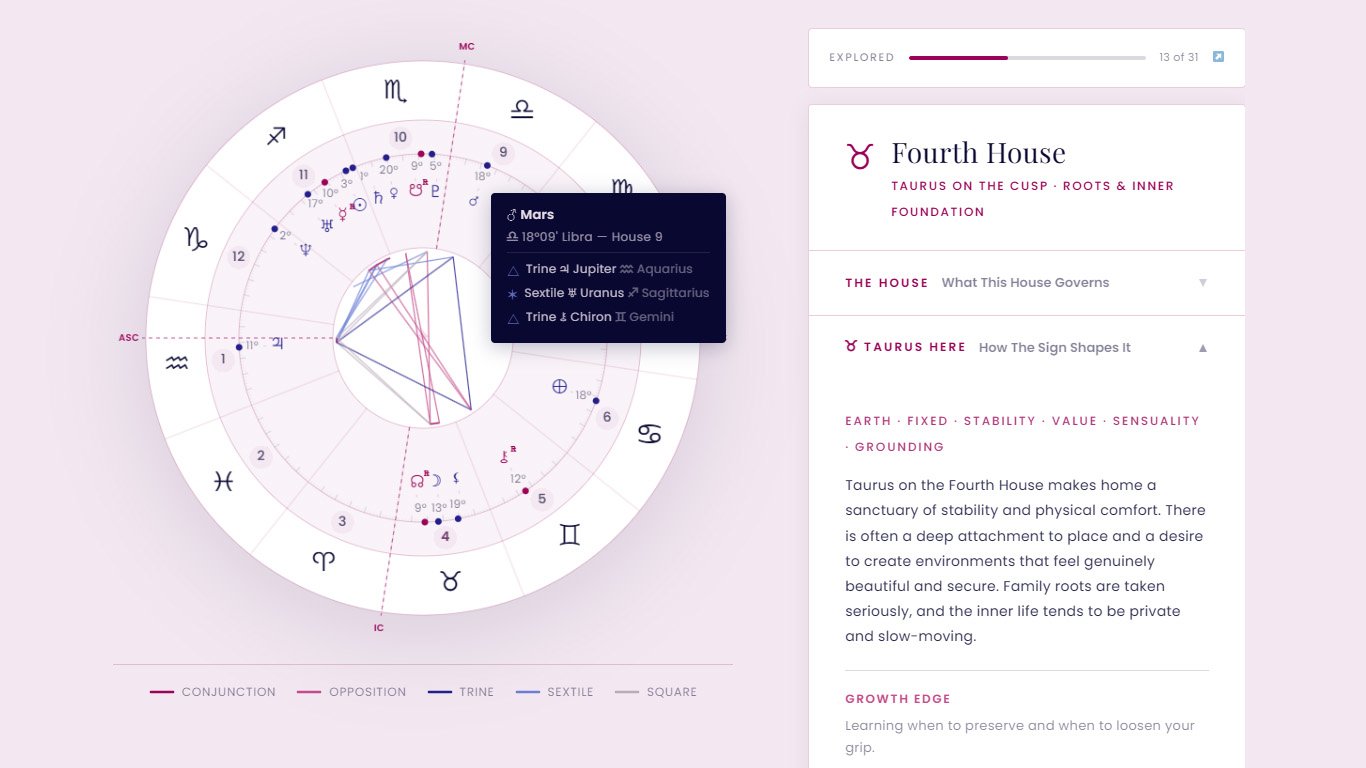
Skip the scattered learning approach. The single best thing you can do as a beginner is pull up your own chart and start exploring it — not some generic explanation of the Sun sign, but your actual chart, with the mechanics explained as you go.
Think of it as astrology or birth charts for dummies or something, but you’re definitely not a dummy. This stuff can be complex at first! However, I assure you, you will get the hang of it with this kind of guided teaching.
Your Beautiful Birth Chart™ is an interactive tool built specifically for this. It’s not just a chart generator — it’s organized to teach you how to read any chart by walking you through your own. You’ll see your placements, understand what each one means structurally, and start to recognize the specific patterns at play in your chart — all in one beautifully designed place.
It’s the fast track. Most people spend weeks trying to piece this together from scattered sources. This does it in one sitting.
→ Get your birth chart here — you’ll need your birth date, time, and location.
What Your Chart Can Tell You (And Where to Go Deeper)
Your birth chart gives you a real working picture of your wiring — how you think, what you need emotionally, where you’re driven, what you’re building toward. Your Beautiful Birth Chart surfaces those mechanics in a way that’s readable from day one.
But if you want the full interpretation — the kind that goes beneath the placements into the living pattern they create together — that’s where the readings come in.
Your Personal Pattern™ reads your chart as a system, not a list. It’s less “here’s what your Venus means” and more “here’s the pattern you keep living, why it works the way it does, and what’s actually driving it.” Deeply psychological. Specific to you.
Your Contribution Pattern™ goes into how you’re wired to create value, do meaningful work, and make an impact — the energetic signature behind what you’re here to contribute.
Your birth chart is the foundation. The readings are what happen when someone who speaks the language fluently interprets the whole thing together.
Start With Your Big Three They Say
There are 3 core placements most beginners are pointed towards. They’re called your Big Three, and together they can absolutely give you a working foundation for understanding how your energy moves.
- Sun sign — your core identity and life force. This is the one most people already know.
- Moon sign — your emotional world. How you process feelings, what makes you feel at home, what your inner life actually looks like.
- Rising sign (Ascendant) — how you move through the world and how others experience you. Arguably the most important of the three.
Most horoscopes only talk about the Sun. That’s why they so often a miss. The Moon and Rising are where a lot of the real texture lives.
Your Beatiful Birth Chart will show you all three (and so much more) — and explain what they mean in your specific chart.
But Honestly, Learn the Wheel First
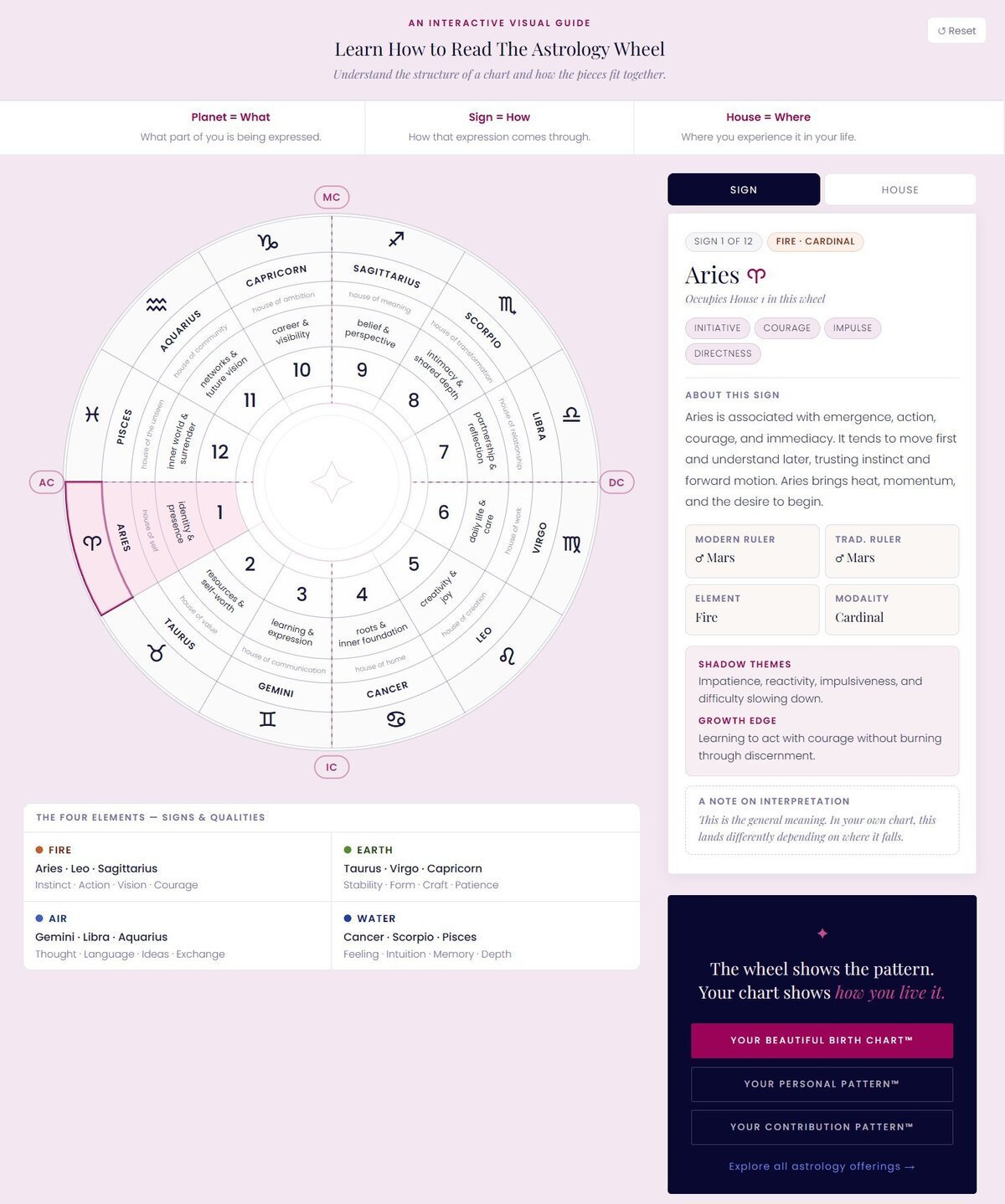
One of the biggest mistakes I think beginners make is trying to learn astrology by collecting placement meanings — before they understand the structure those meanings live inside.
The wheel is the structure. Once you understand how the 12 signs are arranged, how the houses work, and how planets move through that space — everything else you learn has somewhere to land.
→ Explore the interactive astrology wheel here — this free learning tool lets you hover through the signs and houses so the layout clicks visually before you ever start memorizing meanings. It works best on desktop, but feel free to try it on mobile.
Watch the Sky in Real Time to Learn
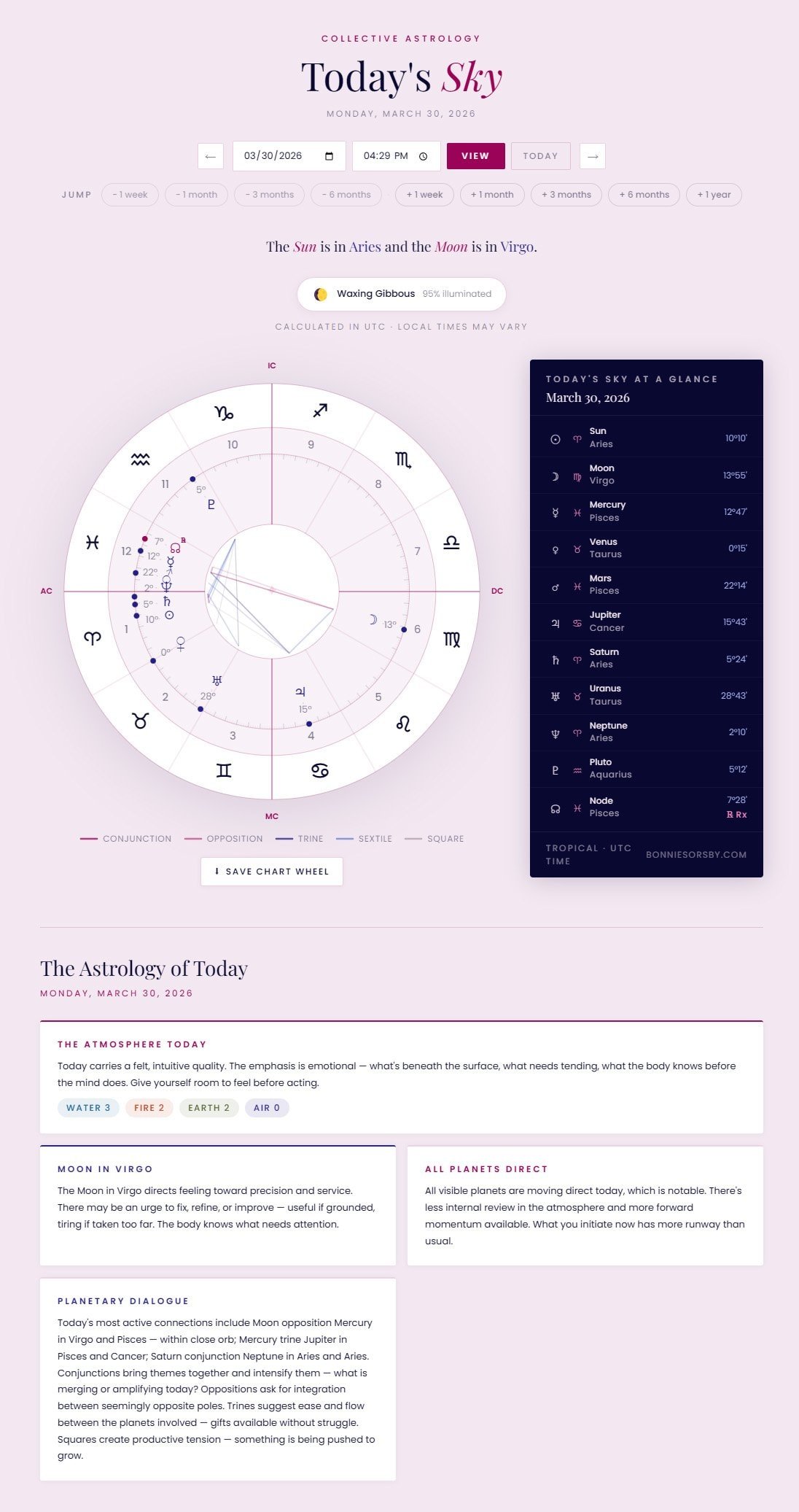
Here’s something that I really believe accelerates learning faster than any book or blog post: watching the sky actually move.
The planets are always in motion. Right now, as you read this, they’re forming patterns — patterns that astrologers call transits. These are the collective energies everyone is moving through at the same time.
When you can see what’s happening in the sky and start to notice how it correlates with what you’re feeling or experiencing — that’s when astrology stops being theoretical and starts being a live, observable system.
→ See today’s astrology in real time — this is a live chart of the current sky with daily insights and aspect interpretations. You don’t need to understand all of it right away. Simply observing can open up a lot.
Ready to Go Deeper?
Once you’ve pulled up your chart and started getting familiar with the wheel, these resources will take you further:
- How to Read Your Astrology Chart — a step-by-step guide to actually interpreting what you’re looking at in your natal chart, using the Whole Sign house system
- The Complete Guide to Astrology: Houses, Signs, Planets, and Transits — a thorough breakdown of every component and how they work together as a system
The goal isn’t to consume it all at once. It’s to keep coming back to it to find new, deeper layers and meaning. Astrology rewards observation over time more than it rewards memorization up front.
FAQ: Astrology for Beginners
Do I need my exact birth time to use astrology?
Your birth time determines your Rising sign and house placements — which are some of the most personal parts of your chart. Without it, you can still work with your Sun, Moon, and planetary signs, but you’ll be missing a significant layer. Even an approximate time is better than nothing. Be sure to check your birth certificate if you’re unsure as even minutes can change things.
What’s the difference between Western and Vedic astrology?
Western astrology (what this site uses) is tropical — it’s based on the seasons and the Sun’s relationship to the Earth. Vedic astrology is sidereal — it tracks the actual constellation positions. They use the same planets and concepts but calculate positions differently, so your placements may shift depending on the system.
Is my Sun sign really the most important placement?
Yes and no — and this is one of the biggest misconceptions in beginner astrology. Some think the Sun speaks to ~70% of our personalities. However, the Sun is one of ten planets in your chart. Your Rising sign sets the structure of the entire chart. Your Moon describes your emotional needs and instincts. Many people resonate far more with their Moon or Rising than their Sun, especially when they first start reading their chart. And when you learn how all of these parts work together to tell your whole story, that’s when the real magic can be experienced. Offers like Your Personal Pattern and Your Contribution Pattern go deeper into the synthesis of placements.
What does it mean if I don’t relate to my sign?
It usually means your chart has other dominant placements pulling strongly in a different direction. Someone with a Gemini Sun but a Scorpio Moon, Capricorn Rising, and four planets in earth signs is going to feel very different from a “typical” Gemini. The Sun is one piece. The chart is the whole story.
Can astrology predict the future?
Astrology describes patterns and timing — cycles of activation, periods of pressure, windows of expansion. It doesn’t predict fixed outcomes. Think of it less as a forecast and more as a weather system: knowing a storm is coming doesn’t tell you exactly what will happen, but it does tell you how to prepare and maybe offer a few interesting hints.
Where should an absolute beginner start learning astrology?
Pull up your chart. Look at your Big Three. Then spend time with the interactive wheel before you start reading individual placements. Structure first, meaning second — that sequence makes everything click faster.