
Decans in Astrology: A Complete Comparison of All Three Systems (With Charts)
If you’ve ever noticed that two people with the same Sun sign feel nothing alike, decans are part of the explanation.
Every zodiac sign contains 30 degrees.
Those 30 degrees are divided into three sections of 10 degrees each. These sections are called decans.
But here’s where things get both interesting, and maybe confusing…
There isn’t just one decan system.
There are multiple historical approaches, and depending on which tradition an astrologer follows, the planetary rulers assigned to each 10-degree section can differ.
This guide lays them out clearly so you can see the structure side by side.
What Is a Decan?
A decan is a 10-degree subdivision of a zodiac sign.
Each sign:
0°–9° → 1st decan
10°–19° → 2nd decan
20°–29° → 3rd decan
Each decan has a planetary ruler that modifies how that sign expresses.
Decans are one of the places astrology gets specific about why two people with the same Sun sign feel nothing alike. That principle runs through the whole chart, and the detail underneath the headline placement is usually where the repetition lives. Your Personal Pattern reads those details as one connected system and shows the themes that keep resurfacing across your relationships, your work, and your sense of yourself.
Decans add nuance. They refine the archetype. They show sub-patterns inside the sign.
Why Are There Multiple Decan Systems?
Decans originated in ancient Egyptian star calendars. As astrology developed through Hellenistic and later Renaissance traditions, planetary rulers were assigned using the Chaldean planetary order.
Modern astrology later introduced a cleaner elemental model that cycles rulers within each element.
Both systems are used today.
This post covers:
• The Traditional Chaldean System
• The Modern Triplicity (Elemental) Model
In my own work, I reference the traditional Chaldean system because it is historically grounded and structurally consistent with traditional astrology techniques.
The Three Decan Frameworks Explained
1. Egyptian Decans (Astronomical Origin)
The earliest decans were 36 star groups used in ancient Egypt to mark time. Each rose approximately every 10 days. These were not originally assigned planetary rulers.
They were astronomical divisions of the sky.
Later astrological traditions assigned planetary rulers to these 10-degree sections.
That became the Chaldean system.
2. Chaldean / Hellenistic Decan Rulers
This is the traditional planetary ruler system most commonly referenced in classical astrology and tarot correspondences.
It follows the Chaldean planetary order and assigns a planetary ruler to each 10-degree section continuously through the zodiac.
This is the system reflected in the comparison charts below.
3. Modern Triplicity (Elemental) Model
This contemporary teaching model cycles planetary rulers within each element.
Each sign’s first decan is ruled by its primary ruler.
The second and third decans follow the order of signs within the same element.
This system is cleaner visually but is not historically the original method.
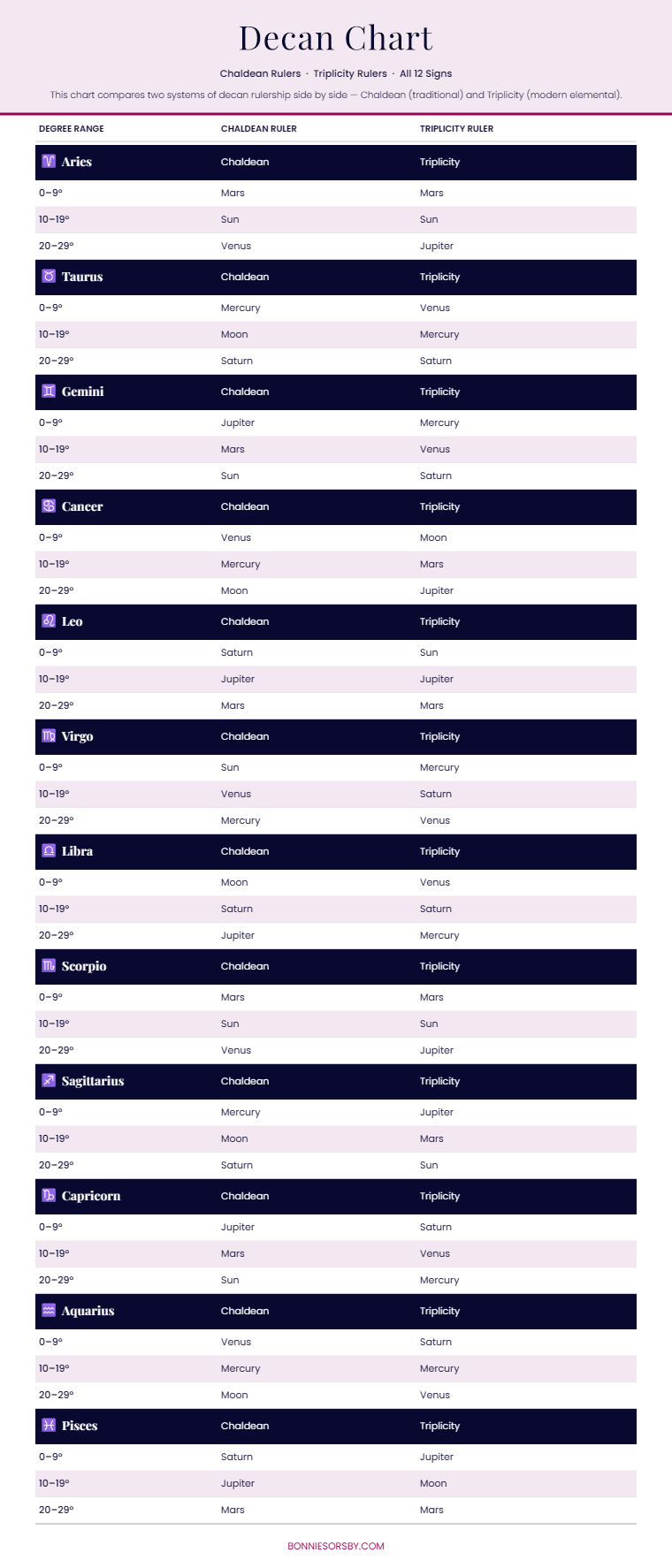
Complete Decan Chart Comparison
Below, each sign includes:
• Degree range
• Chaldean ruler (traditional)
• Triplicity ruler (modern elemental model)
Aries Decans
| Degree Range | Chaldean | Triplicity |
|---|---|---|
| 0–9° | Mars | Mars |
| 10–19° | Sun | Sun |
| 20–29° | Venus | Jupiter |
Taurus Decans
| Degree Range | Chaldean | Triplicity |
|---|---|---|
| 0–9° | Mercury | Venus |
| 10–19° | Moon | Mercury |
| 20–29° | Saturn | Saturn |
Gemini Decans
| Degree Range | Chaldean | Triplicity |
|---|---|---|
| 0–9° | Jupiter | Mercury |
| 10–19° | Mars | Venus |
| 20–29° | Sun | Saturn |
Cancer Decans
| Degree Range | Chaldean | Triplicity |
|---|---|---|
| 0–9° | Venus | Moon |
| 10–19° | Mercury | Mars |
| 20–29° | Moon | Jupiter |
Leo Decans
| Degree Range | Chaldean | Triplicity |
|---|---|---|
| 0–9° | Saturn | Sun |
| 10–19° | Jupiter | Jupiter |
| 20–29° | Mars | Mars |
Virgo Decans
| Degree Range | Chaldean | Triplicity |
|---|---|---|
| 0–9° | Sun | Mercury |
| 10–19° | Venus | Saturn |
| 20–29° | Mercury | Venus |
Libra Decans
| Degree Range | Chaldean | Triplicity |
|---|---|---|
| 0–9° | Moon | Venus |
| 10–19° | Saturn | Saturn |
| 20–29° | Jupiter | Mercury |
Scorpio Decans
| Degree Range | Chaldean | Triplicity |
|---|---|---|
| 0–9° | Mars | Mars |
| 10–19° | Sun | Jupiter |
| 20–29° | Venus | Moon |
Sagittarius Decans
| Degree Range | Chaldean | Triplicity |
|---|---|---|
| 0–9° | Mercury | Jupiter |
| 10–19° | Moon | Mars |
| 20–29° | Saturn | Sun |
Capricorn Decans
| Degree Range | Chaldean | Triplicity |
|---|---|---|
| 0–9° | Jupiter | Saturn |
| 10–19° | Mars | Venus |
| 20–29° | Sun | Mercury |
Aquarius Decans
| Degree Range | Chaldean | Triplicity |
|---|---|---|
| 0–9° | Venus | Saturn |
| 10–19° | Mercury | Mercury |
| 20–29° | Moon | Venus |
Pisces Decans
| Degree Range | Chaldean | Triplicity |
|---|---|---|
| 0–9° | Saturn | Jupiter |
| 10–19° | Jupiter | Moon |
| 20–29° | Mars | Mars |
How to Find Your Decan
- Pull your natal chart using your birth date, time, and location.
- Look at the degree of your Sun, Moon, Rising, or any planet.
- Identify which 10-degree section it falls into.
That tells you your decan.
Why Decans Matter
Decans don’t change your sign.
They modify its expression.
They show which secondary planetary influence shapes how that sign behaves in your life.
If you’re working with a structured chart interpretation approach, that secondary ruler becomes part of the pattern.
And patterns repeat.
If you want to see how your decan ruler interacts with the rest of your chart system, that’s exactly the kind of structural layering explored inside Your Personal Pattern.
Birth details in.
Clarity out.