

Website Design for Schools, Homeschool Programs, and Academies

Websites for schools and educational programs require more than good design. They need clear structure, intuitive flow, and a way for people to clearly see your programs, understand the path, and know where to start.

Educational Website Design

When you’re building a website for a school or educational program, you’re not just organizing pages—you’re organizing how people understand what you offer.

Most programs naturally have structure already. Different levels, age groups, pathways, or stages. The role of the website is to make that structure visible and easy to follow.

Instead of thinking in terms of pages, it helps to think in terms of flow.

Where does someone land first?
How do they quickly understand your programs?
What helps them recognize where they fit?


Educational website design is about creating that clarity from the beginning—so your site feels intuitive and straightforward no matter how simple or complex your offerings are.

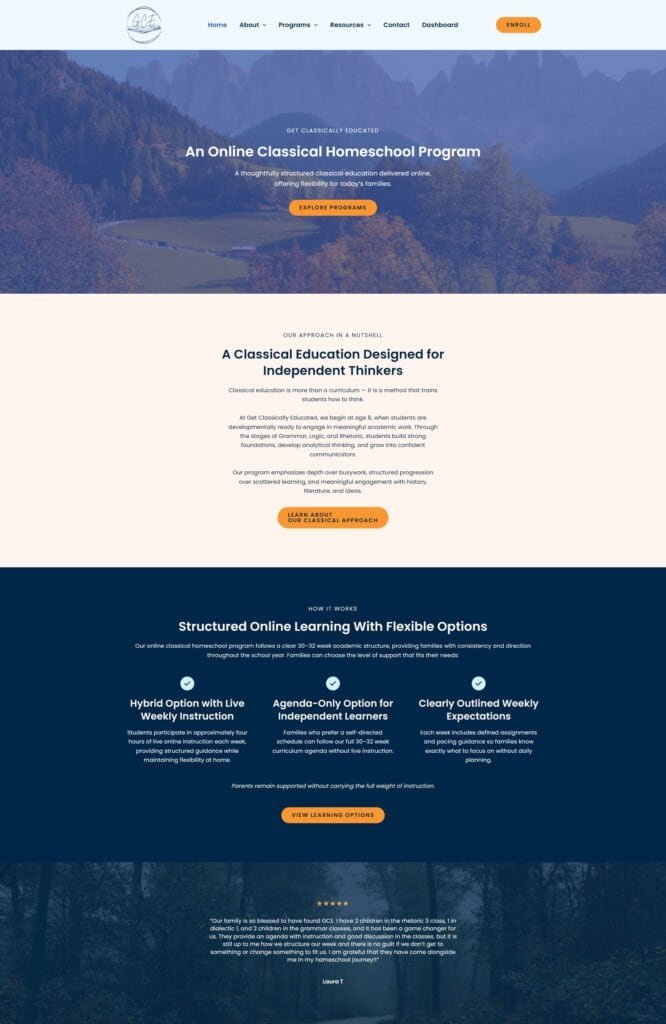
Educational website design example for a homeschool program, showing website design for schools with clear structure and navigation.

ORGANIZING YOUR OFFERS

How to Structure an Education Website

Before design, before visuals—structure has to come first. When you’re building a website for any type of educational offering, the goal is simple: make it easy for someone to understand what you offer.

Most education-based websites can be built around a few core elements:

Programs

What you offer, clearly defined.

Organization

How those programs are grouped—by level, topic, outcome, or progression.

Pathways

Different ways someone can move through your offerings.

Entry Points

Where someone starts and how they quickly find what’s relevant to them.

How to Think About Your Website

There isn’t one perfect way to structure an education website.

A woodworking school will look different from a homeschool program.
A small, in-person offering will need something different than a multi-level academy.

What matters more is understanding where you are and what your website needs to do for you.

Are you trying to be found organically?
Are you sending people directly through ads or referrals?
Are you offering one clear program or multiple options?


These things shape how your website should be built.

Where Most Education Website Design Falls Short

Most website design starts with layout.

Pages, sections, visuals, styling.

But with educational websites, that approach breaks down quickly—because the challenge isn’t how it looks, it’s how it’s organized.

If the structure isn’t clear, no amount of design fixes it.

Florida based Artist headshot looking down and away from the camera, capturing a quiet, introspective moment in the creative process

My Approach

I’m Bonnie Sorsby, a designer, strategist, artist, and homeschooling mom.

I don’t start with pages or layouts. I start with what you offer and how it’s meant to be understood.

  • What are the core programs?
  • How do they relate to each other?
  • What does someone need to see first?
  • What helps them recognize where they fit?

From there, the structure becomes clear.
Then the design supports it.

If you’re thinking about building or restructuring your website, reach out for a custom quote or start a conversation here.


Frequently Asked Questions

What should a homeschool program website include?

A homeschool program website should clearly explain what you offer, how it’s structured, and who it’s for.

That usually includes:

  • an overview of your program
  • how it’s organized (by level, stage, or format)
  • what a typical experience looks like
  • how to get started or enroll

Clarity matters more than how much you include.


How is website design for schools different from other websites?

School and education websites tend to have more structure behind them—multiple programs, levels, or pathways.

The goal isn’t just to present information, but to organize it in a way that makes it easy to understand how everything fits together.


Do I need a complex website to start an education program?

No. If you’re just getting started, a simple structure is often better. One clear program, explained well, with an easy next step is enough.

More complexity can be added as your offerings grow.


How do I organize multiple programs on one website?

Start by identifying how your programs relate to each other.

They might be grouped by:

  • level or experience
  • topic or focus
  • format or delivery
  • outcome or goal

Once that relationship is clear, your navigation and pages can reflect it naturally.


What’s the best website structure for an academy or learning program?

There isn’t one single structure that works for every academy.

The best structure reflects:

  • how your programs are designed
  • how people move through them
  • how someone decides where to start

The goal is always the same: make it easy to understand what’s offered and what to do next.


Should my education website be optimized for SEO or kept simple?

It depends on how people are finding you.

If you’re relying on search, your site needs more defined pages and content.

If you’re driving traffic directly, your site can be more streamlined.

Most websites benefit from a balance of both.


Can you help redesign an existing education website?

Yes. Whether you’re starting from scratch or working with an existing site, the process is the same—clarifying what you offer, organizing it properly, and then designing around that structure.


Do you only work with homeschool programs?

No. This approach applies to schools, academies, tutors, course creators, and any type of educational offering.

The structure adapts to the program—not the other way around.

Shopping Cart
Scroll to Top