
Why Your Birth Chart Feels Confusing (And How to Actually Understand It)
Most people are introduced to astrology in pieces.
Your rising sign. Your moon sign. Your North Node. Maybe your 10th house when you start thinking about career.
And for a while, that works. It’s interesting. It resonates in moments.
But at some point… it starts to feel confusing. Or disconnected.
You have all of this information, but it’s not actually coming together into something you can use.
And that’s usually the moment where astrology stops being about individual placements…
and starts asking you to do something different.
Synthesize. Recognize patterns.
Prefer to listen instead? This episode walks through the same ideas in a more conversational way.
Astrology Isn’t Meant to Be Read One Placement at a Time
One of the biggest reasons astrology starts to feel confusing is because we’re trying to make one placement answer a full question.
Which placement shows my path?
Which house is my career?
Where do I look for money?
It makes sense why we ask those questions.
But the chart isn’t designed to work that way.
Each part of your chart describes something specific. And it’s the way those parts interact—how they layer, repeat, and echo each other—that actually tells the story.
So when you isolate one placement and try to make it carry the weight of the whole answer…
it starts to fall apart.
Not because astrology doesn’t work—but because you’ve outgrown that level of interpretation.
Rising Sign vs North Node: Why This Feels Confusing
This is one of the most common examples I see.
People trying to figure out whether the rising sign or the North Node represents your path.
And the truth is… they’re describing two completely different things.
Your rising sign is the point where your life begins. It’s the sign that was rising over the horizon at the moment you were born, which is why it’s tied to how you meet life.
When you look at the archetype of the first house, you’re looking at Aries, ruled by Mars. There’s something initiating about it. It moves forward. It engages. It responds.
So your rising sign shows how you step into experience—and it’s something you grow into over time.
The North Node isn’t doing that.
It’s pointing to a direction of growth. Something that pulls you forward, often in ways that don’t feel natural at first.
So when you try to decide which one is “your path,” you’re already simplifying something that’s meant to be layered.
One is how you engage with life.
The other is where you’re being stretched within it.
And your path shows up in how those things repeat and interact over time—not in choosing one over the other.
Career in Astrology Isn’t One Thing
Career is another place where this gets simplified really quickly.
The 10th house gets labeled as your career… and then everything kind of stops there.
But if you look at why the 10th house carries that meaning, it starts to open up a different understanding.
The 10th House: Responsibility Over Time
The natural ruler of the 10th house is Capricorn, ruled by Saturn.
So now you’re talking about time, responsibility, pressure, and long-term commitment.
The 10th house isn’t just “what do you want to be.”
It’s what you’re willing to take responsibility for long enough that it becomes part of your reputation.
The MC: What You’re Known For
The Midheaven (MC) sits at the highest point in the chart.
So naturally, it speaks to visibility.
What people see.
What you’re known for.
How your work is perceived from the outside.
The 6th House: What You Actually Do Every Day
Then there’s the 6th house, which people tend to overlook.
This is Virgo, ruled by Mercury.
It’s the day-to-day. The repetition. The refinement. The actual work of getting better at something.
When you put these together, your career isn’t one placement.
It’s what you’re practicing in the 6th…
what you’re building and becoming responsible for in the 10th…
and what becomes visible through the MC.
And this is usually where people start to feel the gap.
Because you can understand each piece individually… but seeing how they work together is a completely different skill.
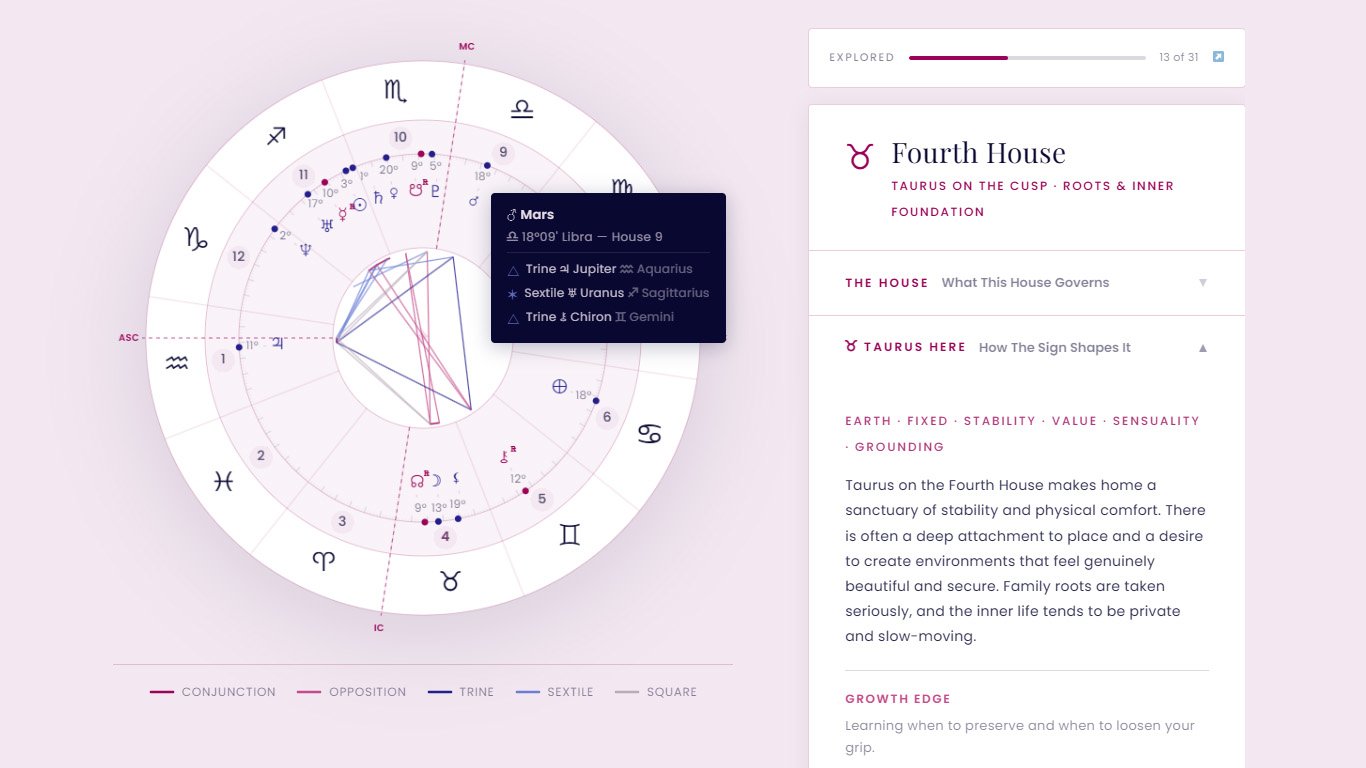
This Is Where Astrology Starts to Click
There’s a point where you move from:
collecting information about your chart
to
actually understanding how it works.
And that shift happens through synthesis.
Through pattern recognition.
Seeing what repeats.
Seeing what themes echo across different placements.
Seeing how one part of your chart supports or challenges another.
That’s where astrology becomes useful.
The 2nd House: It’s Not Just Money
The 2nd house is often reduced to money.
But if you look at its archetype, it’s Taurus, ruled by Venus—so it’s really about value.
What you hold.
What you sustain.
What you believe is worth something.
And your relationship to money tends to follow that.
Not just what you want to earn… but what you’re actually able to support and maintain over time.
Moon vs IC: Origin vs Experience
The Moon and the IC get blended together a lot, but they’re not the same thing.
The IC is your root. Your early environment. The emotional tone you were shaped within.
The Moon is how you process that.
So the IC is the origin… and the Moon is the experience.
And sometimes what feels completely natural emotionally is just what was familiar early on—not necessarily what’s aligned.
When You’re Ready to Go Deeper
This is also the point where a lot of people either deepen their understanding… or stop.
Because once you move into synthesis, you’re not just looking at signs and houses anymore.
You’re layering in aspects. Timing. Transits.
You’re starting to see how something plays out across your chart instead of in one place.
And that can feel like a lot to hold on your own.
If you’re still at the stage where you’re trying to simply see and understand your chart clearly, that’s exactly why I created Your Beautiful Birth Chart.
It gives you a clean, visual way to actually sit with your chart, learn it, and come back to it without it feeling overwhelming.
If you’re at the point where you understand the pieces but can’t quite see how they connect, that’s where Your Personal Pattern comes in.
Instead of you trying to manually piece everything together, it shows you what’s actually repeating across your chart—what themes are consistent, and where things are echoing each other.
And if you’re starting to ask how this all translates into your work, your visibility, and what you’re here to contribute…
that’s the layer explored inside Your Contribution Pattern.
It takes those same patterns and brings them into the context of your impact, your recognition, and how your work moves through the world.
The Real Shift
Astrology becomes a lot less confusing when you stop asking one placement to give you an answer…
and start noticing what repeats.
It’s not about memorizing meanings.
It’s about seeing patterns.
And once you start seeing that—
that’s when your chart actually starts to make sense.