
Why Your Birth Time in Astrology Matters (And What Changes Without It)
Astrology isn’t just about what was in the sky when you were born.
It’s about where everything was in relation to you.
And that’s where birth time becomes non-negotiable.
Your birth chart isn’t just a list of planetary placements—it’s a snapshot of the sky mapped onto the exact moment you entered the world. Not just the day. Not just the date. The moment.
That difference is everything.
Because while the planets move slowly enough to give us general themes for the day… the Earth is rotating constantly. The sky is shifting every second. And that rotation is what creates the personal structure of your chart.
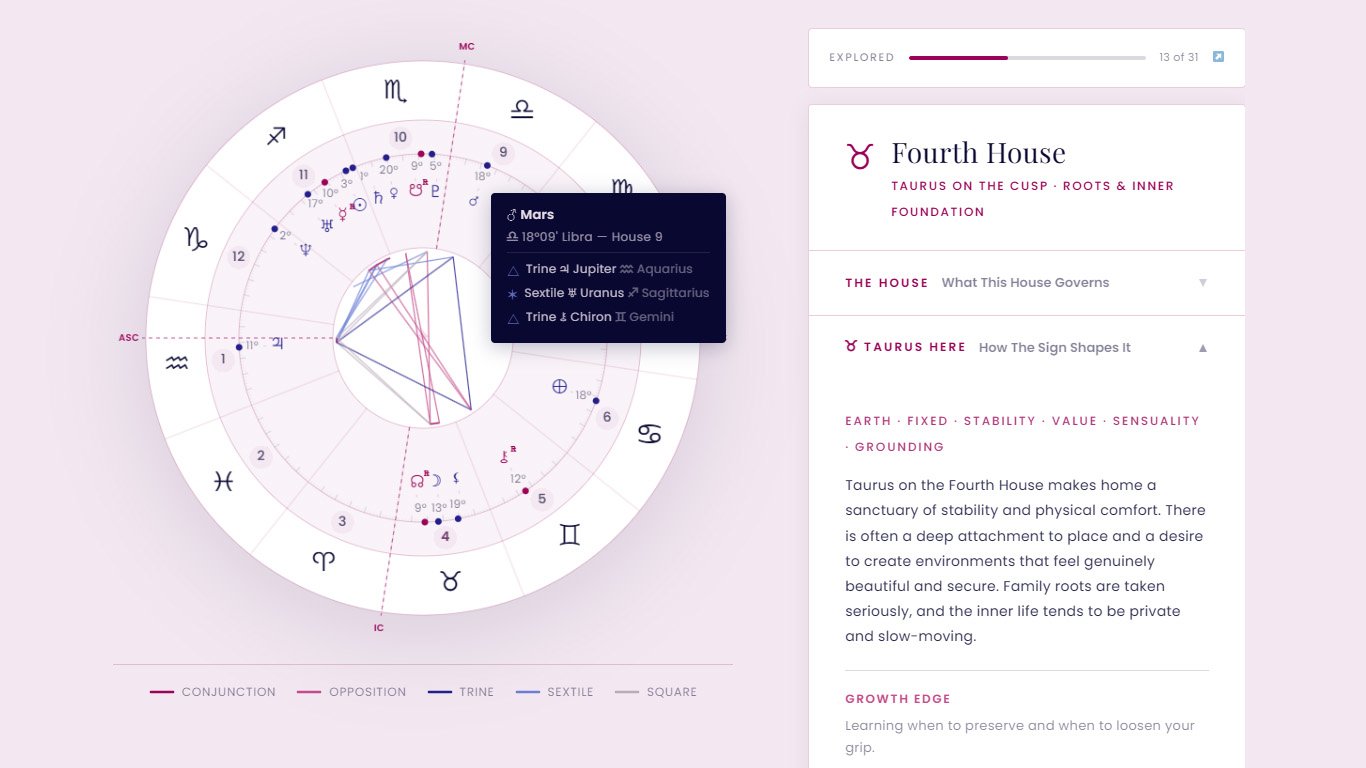
Your birth chart is a frozen moment in motion
Think of your birth chart like a photograph taken at sunrise, except the camera is the sky itself.
The planets show what energy exists.
But your birth time shows how that energy is arranged around you.
Without it, you’re missing the structure that turns astrology from “general symbolism” into something personal, specific, and surprisingly accurate.
Your Rising Sign changes everything
If there is one placement that depends most on your birth time, it’s your Rising sign (Ascendant).
This is the sign that was rising on the Eastern horizon the exact moment you were born—and it changes roughly every 1–2 hours.
Which means two people born on the same day, in the same city, can have completely different Rising signs.
And that changes:
- how you move through the world
- how others experience you
- your physical presence + instinctive responses
- and the entire layout of your chart
Because your Rising sign doesn’t just describe you.
It organizes your entire birth chart into houses.
Without a birth time, you lose the house system
This is the part most people new to astrology don’t realize or understand.
Once your Rising sign is known, the rest of your chart unfolds into 12 houses:
- identity
- money + resources
- communication
- home + family
- creativity
- work + health
- relationships
- transformation
- belief systems
- career + public life
- community
- subconscious patterns
But without a birth time?
Those areas blur together.
You still have your planets.
You still have your signs.
But you lose the map of where life happens.
If you’re new to understanding what all of the houses and signs mean, this resource is a great place to start: Learn Astrology
The Moon can even change signs in a single day
This is another overlooked detail.
The Moon shifts signs every 2–3 days.
So depending on your birth time, your Moon might be in one sign in the morning… and another by night.
That alone can completely shift emotional tone, needs, and instincts.
Sometimes even planets are on a threshold
On certain days, planets change signs or degrees.
So your birth time can determine:
- whether Venus is in one archetype or another
- whether Mars expresses itself one way or another
- even subtle differences in how outer planets are experienced personally
These are not small differences. They change interpretation.
So what if you don’t know your birth time?
First: you’re not blocked from astrology.
But you are working with a partial chart.
Here are your options:
1. Look for your birth record
Your long-form birth certificate often includes your exact birth time.
Hospitals or government vital records offices usually store it.
2. Ask family (but verify if possible)
Memory is helpful—but not precise. Even “around 3pm” can shift your Rising sign.
3. Use a solar chart
Set your chart to 12pm and work with planetary placements in signs only.
You’ll lose houses and Rising sign—but you can still read patterns between planets.
4. Chart rectification
Some astrologers specialize in reconstructing your birth time using life events. It’s interpretive, not exact—but can be surprisingly accurate.
What you can still do without a birth time
Even without the exact moment, you can still explore:
- your planetary placements
- sign-based dynamics
- aspects between planets
- repeating emotional or psychological patterns
It’s still you—just less geographically mapped.
Think of it like:
You still have the ingredients…
you just don’t yet know the full recipe layout.
Why astrologers care so much about birth time
Because astrology isn’t just symbolic storytelling.
It’s spatial.
It’s directional.
It’s built on the relationship between the Earth rotating and the sky above it.
Without birth time, we lose:
- the horizon line (Ascendant/Descendant)
- the vertical axis (MC/IC)
- and the house structure that grounds everything into lived experience
In other words:
We lose the bridge between inner life and outer life.
The takeaway
Your birth time isn’t just a detail.
It’s the moment the chart becomes yours.
Not just “someone born under Leo.”
But this specific life, lived through this specific body, moving through this specific timeline.
And when you do know your birth time?
Astrology stops being general insight.
It becomes a map.
Without a birth time, the chart is partial. With it, it becomes a map.
→ View Your Beautiful Birth Chart
FAQ Section (SEO + engagement boost)
Do I really need my exact birth time for astrology?
Yes, if you want your Rising sign, houses, and a fully accurate chart. But you can still work with planetary placements without it.
What if I only know my birth time roughly?
Even a 1–2 hour window can help narrow down your Rising sign and Moon placement.
Can astrology still work without a birth time?
Yes—but it becomes less personalized. You lose the house system, which is where timing and life areas are mapped.
Why is the Rising sign so important?
It determines your physical expression, first impressions, and the entire structure of your birth chart.
What is the most accurate way to find my birth time?
Your long-form birth certificate is usually the most reliable source.