
What Are Houses in Astrology? (And What Your House Placements Mean)
When you first look at a birth chart, the houses are often the most confusing part.
You see a circle divided into twelve sections, numbered 1 through 12, and it’s not immediately obvious what any of it means. People usually recognize their Sun sign or maybe their Rising sign, but the houses often feel like a layer of the chart that requires a bit more translation.
And that’s exactly what they are.
Houses are the structure of your birth chart. They organize your life into different areas of experience, showing where different themes often show up for you.
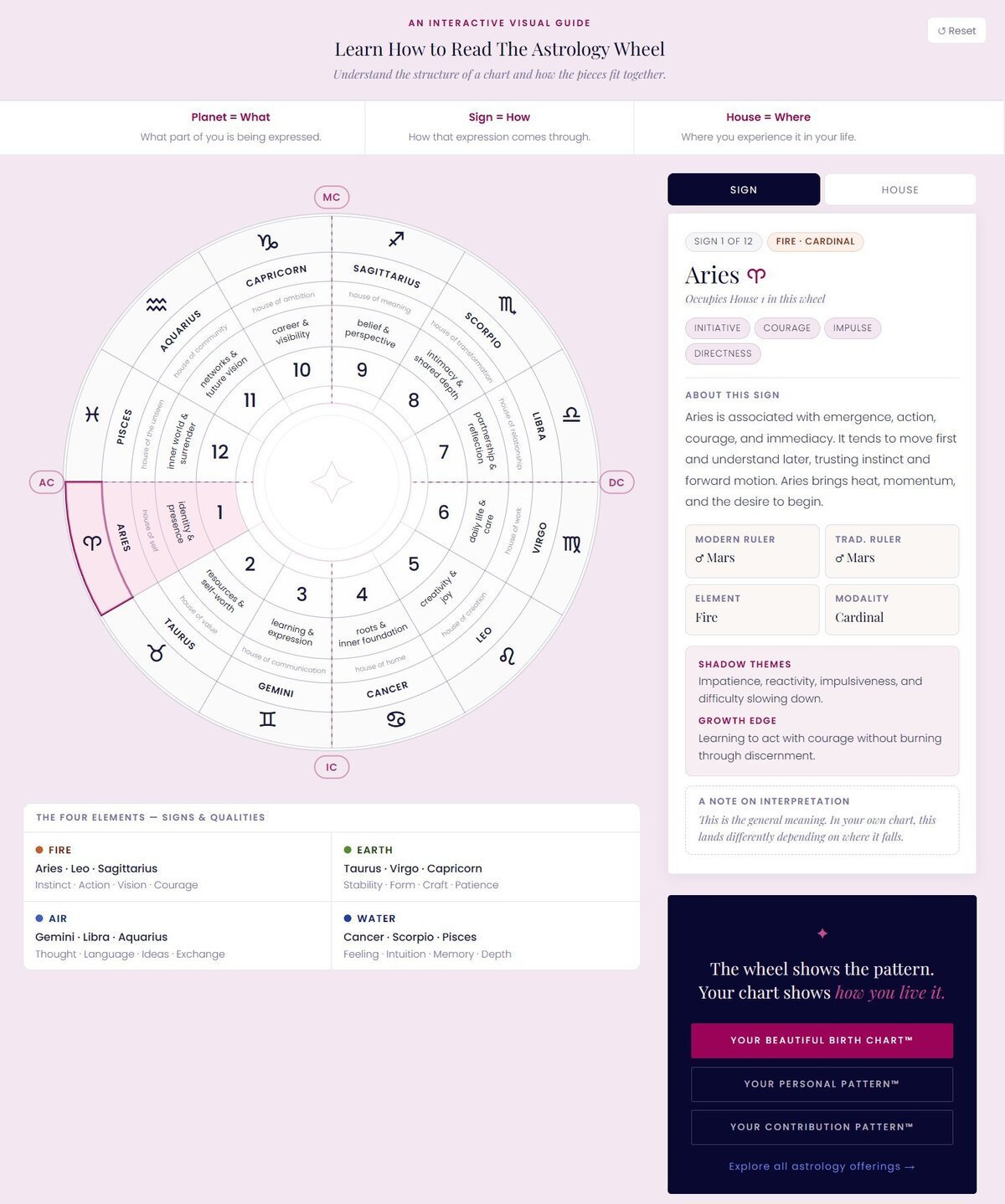
So what are houses in astrology?
In astrology, the houses are the twelve divisions of your birth chart that represent different parts of life. Instead of describing personality traits, like signs do, houses describe life areas.
So while a sign might describe how something shows up, and a planet describes what energy is involved, the house tells you where in your life that energy often plays out.
For example, one part of your chart might relate to relationships, another to career, another to home and family, and another to creativity or personal identity. Each of those areas is represented by a house.
Why houses matter in your birth chart
Without houses, astrology stays fairly abstract. You might understand traits, archetypes, or emotional patterns, but you don’t yet understand where those patterns live in your actual life.
Houses are what ground astrology into lived experience.
They help explain why certain themes show up in specific areas of your life, and why different people can have very different experiences even if they share similar planetary placements.
This is also why astrology becomes much more personal once your full birth time is known. Your Rising sign determines the entire house structure, which is why the exact moment you were born matters so much in chart interpretation.
What are my houses in astrology?
This is one of the most common questions people ask when they start looking at their chart.
Your houses are not something you choose or have individually. You don’t have one house, you have all twelve.
Your Rising sign sets the starting point of your chart, and from there, the rest of the houses unfold in order around the circle.
So your “houses” are really your personal map of life topics, arranged in a way that is unique to the exact time and place you were born.
What are house placements?
When people talk about “house placements,” they are referring to which planets fall into which houses in your chart.
This is where astrology starts to feel very specific.
For example, if Venus is in your seventh house, relationships may be a major theme in your life. If Mars is in your tenth house, your drive and energy may be strongly connected to career or public life. If the Moon is in your fourth house, emotional safety and home may be especially important to you.
These placements don’t define you in a fixed way, but they do describe where certain energies naturally often express themselves.
Why houses can feel confusing at first
Houses often feel unclear in the beginning because they don’t translate into personality traits the way signs do. They describe context instead of character.
So instead of saying “you are this kind of person,” houses are saying “this is where certain parts of your experience often unfold.”
Once you shift into that way of thinking, the chart starts to make more sense, but it takes a bit of adjustment.
What if I don’t understand my houses yet?
That’s completely normal and expected as a beginner.
Most people start with Sun signs, then move to Moon signs, and only later begin to understand Rising signs and houses.
Astrology is layered, and houses are one of the more structural layers. You don’t need to understand everything at once to begin working with your chart meaningfully.
If you’re just starting, it helps to first understand your Rising sign, because that is what organizes your entire house system.
From there, everything else begins to fall into place more clearly.
I also go deeper into how this structure works inside my Learn Astrology Hub, where you can start connecting signs, planets, and houses in a way that feels more intuitive instead of overwhelming.
And if you want to jump right in and fully understand all of your placements in an interactive guided space, Your Beautiful Birth Chart™ is the perfect place for that.
The takeaway
Houses are the framework of your birth chart.
They don’t tell you who you are. They show you where life happens for you.
Once you begin to understand your houses, astrology stops feeling like a collection of symbols and starts feeling like a map, one that reflects how your life is organized and experienced.
Astrology Houses Frequently Asked Questions
What are houses in astrology?
Houses are the twelve divisions of your birth chart that represent different areas of life, such as relationships, career, home, and identity. Each house shows where certain energies show up in your life.
What are my houses in astrology?
Your houses are the twelve sections of your birth chart, and they are determined by your exact birth time, location, and Rising sign. You don’t have one house, you have all twelve, arranged uniquely in your chart.
What house am I in astrology?
You are not in one house. Your entire birth chart contains all twelve houses. Your Rising sign determines the starting point of your house system, and the rest of the houses follow in order.
What are house placements in astrology?
House placements show which planets fall into which houses in your birth chart. They describe where different themes in your life, like love, work, or emotions, often show up.
Why are houses important in astrology?
Houses give structure to your birth chart. They show where life experiences unfold, helping astrology become more personal and specific instead of just symbolic.