
The Imum Coeli (IC) in Astrology
The Imum Coeli, or IC, is one of the four major angles in a birth chart, and it’s probably the one most people skip past in favor of the Midheaven directly across from it. It marks the most private, foundational part of the chart, tied most directly to home, family, and what genuinely makes someone feel safe.
What Is the IC in Astrology? (Imum Coeli Meaning)
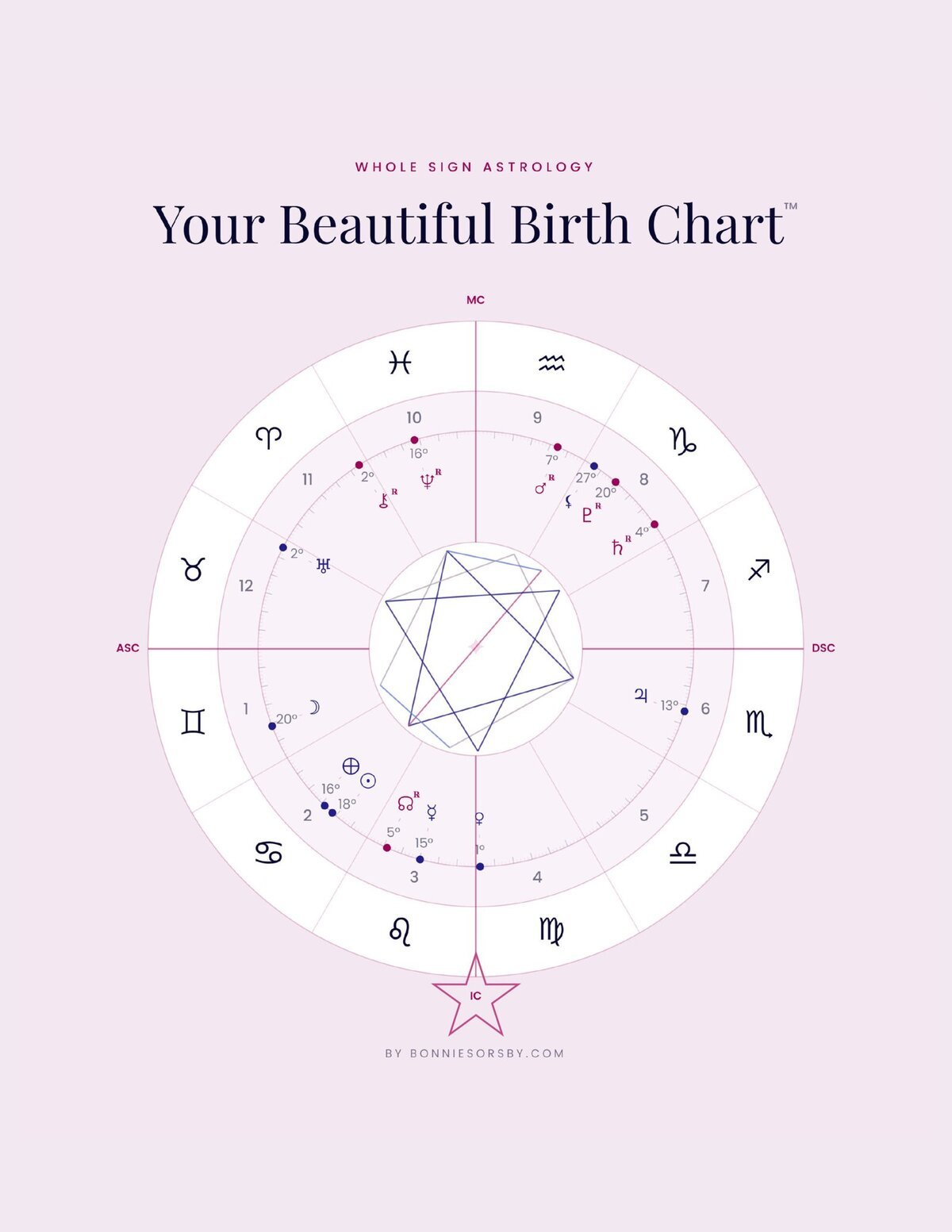
The Imum Coeli, often shortened to the IC and sometimes called the Nadir, sits at the exact bottom of the chart’s vertical axis, directly opposite the Midheaven. Where the Midheaven describes what becomes visible to other people over time, the IC describes the private foundation everything else gets built on, including home, family, and the deepest sense of what safety feels like in the body.
This point can be looked at from several different angles, and most charts benefit from considering more than one of them at once.
The IC and Midheaven: Two Halves of the Same Axis
The Midheaven and IC sit at opposite ends of the same line, which usually means they work like one continuous question.
The Midheaven asks what a person builds toward in public. The IC asks what that same person is standing on, privately, the whole time they’re building it.
Your IC is a specific degree in a specific sign, and which one changes what home has always meant for you. A Cancer IC and a Capricorn IC are looking for different things and settle for different compromises.
Your Beautiful Birth Chart gives you your placements by sign and house, your angles included, so you can find your own IC and see what sits near it.
What Is My IC Sign?
Your IC is always the sign directly opposite your Midheaven. That part is exact, so if you know your MC you already know your IC. A Capricorn Midheaven gives a Cancer IC. A Gemini Midheaven gives a Sagittarius IC.
Both angles depend on your birth time and your birth place, which is why neither one can be worked out from your sun sign or your rising sign. Pull the whole chart with the free birth chart calculator, and if your birth time is uncertain, what birth time changes in a chart covers what you lose without it.
| If your Midheaven is | Your IC is | What home often asks for |
|---|---|---|
| Aries | Libra | peace in the room, and nobody made to take sides |
| Taurus | Scorpio | privacy, and the truth told even when it costs something |
| Gemini | Sagittarius | room to roam, and a household with a horizon past the street |
| Cancer | Capricorn | structure that holds, and someone who takes it seriously |
| Leo | Aquarius | permission to be the odd one, and chosen family |
| Virgo | Pisces | softness, and space to feel it all the way through |
| Libra | Aries | a place you can be direct in, and leave quickly |
| Scorpio | Taurus | steadiness you can feel in the body, and no sudden moves |
| Sagittarius | Gemini | talk at the kitchen table, and room to change your mind |
| Capricorn | Cancer | being known without explaining yourself first |
| Aquarius | Leo | warmth, and being delighted in for no particular reason |
| Pisces | Virgo | order you can rely on, and things that work |
In whole sign houses your IC usually sits inside your 4th house, and sometimes in the sign on either side of it, so the two are worth reading together. The questions further down go into how the two differ.
The Home and Family Lens
In its most literal sense, the IC describes the conditions of the early home environment and the family patterns absorbed there, often well before there was language to describe them. I’ve gone deeper into how this connects to the wider 4th house here, since the two are closely related but not identical. The short version from the IC’s perspective is that it marks the exact point where those early patterns get encoded, while the 4th house describes the fuller room those patterns live in.
The Emotional Security Lens
There is a second layer underneath the literal one. The IC often describes what a person’s nervous system needs in order to register safety, which isn’t always the same as what their adult life looks like on paper.
This is usually most visible whenever someone has done everything they were supposed to do, the career, the relationship, the outward stability, and still feels unmoored underneath it. That gap is frequently the IC asking for something the rest of the chart was never built to provide on its own.
The IC by Element: What Usually Feels Like Home
The element on your IC usually describes how safety gets experienced and what your system needs in order to regulate. A fire IC often needs movement, inspiration, and enough freedom to feel grounded instead of restless. An earth IC usually needs consistency, stability, and a kind of embodied comfort in daily routines. An air IC frequently needs mental space, real conversation, and enough perspective to feel settled. A water IC usually needs emotional attunement and a container that can hold what it’s feeling without rushing to fix it.
None of this describes what someone’s actual house looks like from the outside. It describes the quality their system is asking for underneath it.
When the IC Gets Activated
Planets near the IC, or major transits crossing it, usually bring questions of home and foundation to the surface, sometimes through an actual move or family change, and sometimes through a feeling that something no longer feels safe or supportive even though nothing visible has changed.
A planet within a few degrees of the IC usually describes something foundational about the early home that keeps shaping the adult version of safety. Saturn conjunct the IC often points to a home built on structure, discipline, or emotional reserve, something a person later has to build their own version of authority around. The Moon conjunct the IC usually describes a home that was emotionally intense in one direction or another, deeply nurturing, deeply enmeshed, or both at different points. Pluto conjunct the IC frequently points to family material that ran deeper than anyone in the house was naming out loud at the time.
Transits to the IC itself, especially from Saturn, Uranus, or Pluto, often ask whether the current foundation can hold what’s being built on top of it, or whether it needs rebuilding first.
The IC Keeps Working Long After Childhood
One of the more common misunderstandings about the IC is treating it as something that only describes the past, a chapter that closes once childhood ends. It usually works the other way. Most adults are still renegotiating this point throughout their life, consciously or not, and it is often the missing piece when someone feels off track and cannot name why.
Read it for what the system is still asking for now.
Why the IC Matters for Pattern Work
In deeper chart work, the IC often explains why external success alone never feels like enough on its own, why certain home or family dynamics keep repeating across very different seasons of life, and why the body sometimes knows something is off long before the mind has language for it.
When This Runs Deeper Than One Season
If this is landing as more than a passing curiosity, that’s usually worth trusting. The pull toward a certain kind of foundation, or the discomfort of not having one, rarely feels random from the inside, even when it’s hard to explain out loud.
Your Personal Pattern™ exists for exactly that kind of recognition, reading your chart as a connected system so the things that have felt unsettled, foundational, or hard to name finally have language attached to them.
Explore Your Personal Pattern™
The IC and MC are one axis. The Ascendant and Descendant are the other, and together the four angles frame the whole chart.
Frequently Asked Questions About the Imum Coeli in Astrology
What is the Imum Coeli, and is it the same as the Nadir?
Yes. The Imum Coeli is sometimes called the Nadir, especially in older or more technical astrology texts. Both terms describe the same point, the lowest point of the chart, directly opposite the Midheaven.
What is the difference between the IC and the 4th house?
The IC is a calculated point, the lowest part of the chart. In quadrant systems it marks the beginning of the 4th house. In whole sign houses, which is how I read, the 4th house is simply the fourth sign from your rising sign, and the IC falls somewhere inside it, or occasionally in the sign on either side. The 4th house is the fuller area of the chart built around that point, including any planets that fall inside it. The IC describes the foundation itself, while the 4th house describes the wider room that foundation sits inside.
What does it mean when a planet is conjunct the IC?
A planet within a few degrees of the IC usually describes something foundational about the early home environment that still colors how a person experiences safety as an adult. The specific planet involved describes the flavor of that foundation, structure and discipline for Saturn, emotional intensity for the Moon, transformation for Pluto, and so on.
Does the IC only describe childhood?
No. It usually works the other way. Most adults are still renegotiating this point throughout their life, whether or not they’re doing it consciously, and it often becomes more noticeable during transition, burnout, parenthood, or any kind of healing work, and it does not fade with time.