
Personal Branding: How to Build a Personal Brand
Most people think personal branding starts with a logo.
In reality, logos, color palettes, websites, and social media profiles are simply tools. They’re how your brand is expressed.
Before any of that comes into focus, there needs to be a clear understanding of who you are, what you do, what you value, and what you want people to remember about you. The visual pieces help communicate that story, but they can’t create it for you.
The strongest personal brands are recognizable because there is alignment between the person behind the business, the message they’re sharing, and the experience they create. When those pieces work together, people begin to recognize you, remember you, and connect with what you do.
Why so Many Personal Brands Blend Right in…
Here is what I have noticed after years of working in brand strategy and design: a lot of people settle. They grab a Canva template, they copy a font pairing they saw on Pinterest, and they roll with it because it looked good on someone else. The problem is not that they have bad taste. The problem is that they can admire an aesthetic without understanding whether or not it suits them, their personality, or their business.
There are really two ways this plays out. Either someone intentionally chooses an overly curated look that has nothing to do with who they are, or they slap a label on something and carry on until they eventually feel the disconnect. And that disconnect will come. It always does. Because when the brand you have built does not match the person you are, the people you are trying to reach will feel it, even if they cannot name it.
The brands that become memorable are built from the inside out. They are specific. They feel like someone. You know when you land on a website or a feed and you get a clear sense of who this person is within seconds? That is not an accident. That is intention meeting authenticity, and it is the whole game.
Building a brand From the Inside Out
If you came to me and said you had no idea what your personal brand was, I would tell you that the answer is already inside you. The work is just excavation.
Before you touch a color palette or write a single word of website copy, you need to get honest about a few things.
Who are you doing this for?
What do you want people to feel when they interact with your brand?
What is the real goal, the actual one?
What are the things you are genuinely good at that you have maybe been underselling or folding into something smaller because you were not sure anyone would pay for them?
I use an intake form in my branding process that clients have told me was one of the most clarifying things they did for their business, and they came to me for a logo. That is not an accident. The right questions, asked in the right order, pull out things people have been sitting on without realizing it. I also have a Brand Foundations Workbook for anyone who wants to do this work before hiring anyone, or even just to get clearer on their own. I wish I had had something like that years ago. My brand still would have evolved, because this kind of work is never one and done, but it would have saved me a lot of headache and time spent course-correcting.
The hardest part of all of this is not the colors or the fonts or the website. It is the owning. The willingness to say, this is who I am, this is what I do, and I am not going to shrink that to fit a box someone else made. When you get there, everything else becomes a lot clearer.
What Color Is Doing for Your Brand
Once you have done the inner work, the visual identity becomes an expression of it rather than a decoration on top of it. And color is one of the most powerful tools in that expression.
Color is not just aesthetic. It is strategic. Every shade you choose communicates something before anyone reads a single word. It sets a mood, signals a market position, and creates an emotional impression that either pulls people in or tells them this is not for them. That is not a bad thing. A well-chosen palette that repels the wrong people is doing exactly what it is supposed to do.
When I am helping someone choose brand colors, I am not asking what their favorite color is. I am asking what they want people to feel. Warmth and approachability read differently than authority and sophistication. Playfulness reads differently than pure luxury. Deep, saturated tones carry a different weight than soft muted ones. And none of those are wrong choices, they just need to match the experience you are trying to create and the audience you are genuinely trying to reach.
Color psychology is a real thing, and if you have not thought deliberately about what your colors are communicating, it is worth the time. The goal is alignment: colors that feel like you, that speak to your audience on a deeper level, and that hold up across every place your brand shows up, from your website to your Instagram grid to your email header to the way a PDF proposal looks when a potential client opens it.
What Typography Is Doing Before Anyone Reads a Word
Typography does more heavy lifting than most people realize, and it is almost always underestimated by people building their own brands.
The fonts you choose influence how people perceive your business before they have read a single word. A classic serif can feel established and trustworthy. A clean sans-serif can feel modern and approachable. Script fonts can add personality and warmth when used with intention. Bold display fonts can create a commanding first impression when they are not overused. None of these effects are accidental, and none of them are interchangeable.
Just like color, typography creates consistency across every touchpoint: your website, your marketing materials, your social media graphics, your proposals, your content. When your typography is working correctly, people do not notice it. It just feels right. When it is off, something feels slightly wrong and they cannot quite put their finger on why they do not fully trust what they are reading.
The goal is not to choose fonts you like. It is to choose typography that supports how you want your brand to be experienced. Whether your brand is meant to feel refined, playful, creative, professional, luxurious, or approachable, typography is helping communicate that at a glance. It is one of the quietest and most consequential decisions in the whole brand-building process.
Being the Face of Your Business
Here is something that stops a lot of people cold: the idea of showing up as the face of their brand. Not hiding behind a logo, not staying safely behind the scenes, but being visibly, recognizably themselves in their business.
This is uncomfortable for a lot of people, and I understand why. It feels vulnerable. It feels like a lot of pressure. It raises questions like: what if I change? What if people do not like me? What if I am too much or not enough?
But here is the reality: people do business with people.
The more someone can see who you are, hear how you think, and get a real sense of your personality and perspective, the more likely they are to trust you enough to hire you. A faceless brand can be perfectly competent, but a personal brand that lets people in builds connection in a way that no logo or color palette alone can do.
Being the face of your business does not mean you have to share everything. It does not mean you have to be on every platform or post every day. It means showing up in a way that is recognizably you, consistently enough that people start to associate your voice, your perspective, and your presence with the work you do. It means talking about your ideas. It means letting people see how you think.
Over time, that is what builds a reputation. And a reputation is the thing that a rebrand cannot manufacture and a template cannot shortcut.
A Look Inside a Recent Personal Brand Identity Project
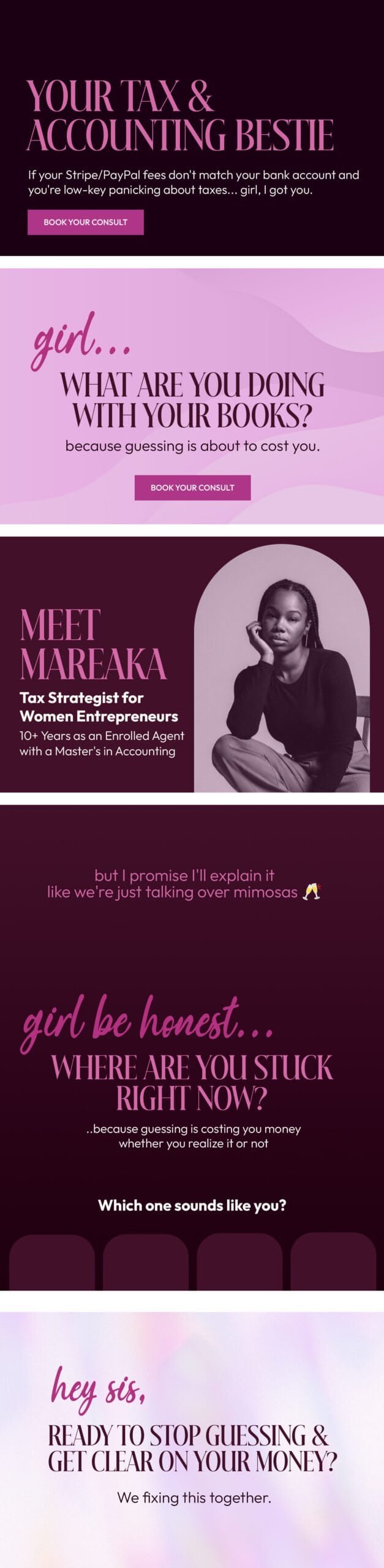
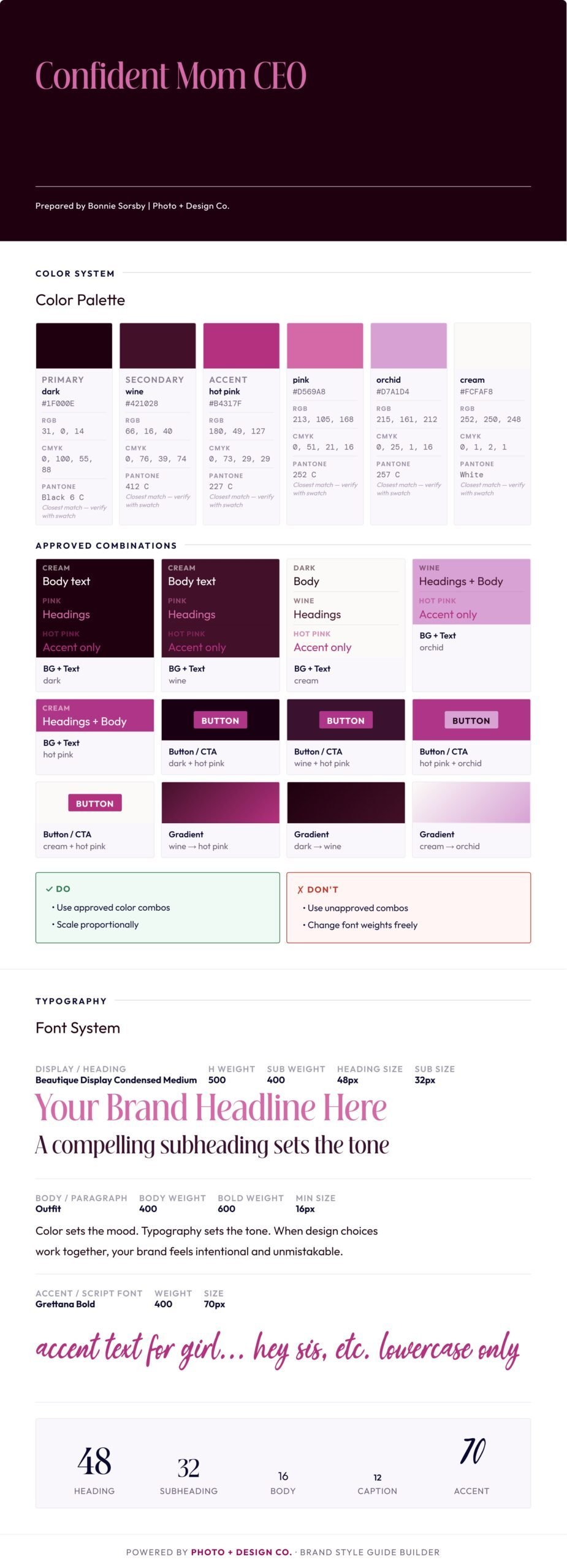
A bold and approachable brand identity created for a tax strategist serving women entrepreneurs who had already nailed her messaging. Her visuals just needed to catch up. Rich wine tones, vibrant pinks, and expressive typography help transform a traditionally intimidating industry into a brand experience that feels welcoming, trustworthy, and easy to connect with.
Your Website and Social Media Are Not the Same Tool
A lot of people treat these interchangeably, and that’s just not the case.
Social media is social. It is designed to be a place to connect, to show up in a way that is a little less formal, a little more real, a little more in the moment. That has genuine value. That is where relationships start and where people start to feel like they know you.
Your website is where you do business. When someone wants to know exactly what you do, whether your offer fits their situation, whether you are credible and professional, whether the fine print makes sense, they go to your website. It is also where you get found through search in a way that is entirely different from how social media works, because someone searching for what you do is already looking for an answer you might have.
And beyond all of that, your website is yours in a way that social media never is. Social media is borrowed ground. I have heard too many stories of people losing accounts, getting hacked, having platforms shift their algorithm in a way that wipes out years of reach overnight. Your website, properly set up and maintained, cannot be taken from you like that. If you have not prioritized building it out as a real home base for your brand, that is worth reconsidering sooner rather than later.
On Being Multi-Passionate and Still Building a Cohesive Brand
This one is close to home for me. I have been living this reality for years, and I know how much pressure there is to pick one thing, niche all the way down, and just stay in your lane. The idea is that focus makes you more findable, more referable, more clear.
And to be fair, there is truth in that. But it does not mean multi-passionate entrepreneurs cannot build strong personal brands. It means they have to work a little harder to find the through line, the thing that connects all of their interests into something cohesive, even if it is not neat.
For me, the through line is helping people understand themselves and build something that reflects who they are, whether that is through brand strategy and design, through astrology, or through the content and tools I create. The categories are different but the core is the same.
If you are feeling scattered across multiple passions and you are not sure how to bring them into a brand that makes sense, the place to start is not with the visuals. It is with the question of what all of those things have in common, what the version of you that holds all of them looks like, and who that version of you is for. When you find that, the brand starts to have a shape.
Personal Branding Is Never One and Done
The last thing worth saying is this: your personal brand is going to keep evolving, and that is not a failure. It’s just how this works.
Over the last fifteen-plus years of being self-employed, my brand has shifted every time I have learned something new, grown into a new area of my work, or gotten more honest about what I want to be known for. That is a living brand doing what personal brands do.
What I do think matters is having some intentionality behind how you present yourself at each stage, because your brand is emerging whether you are curating it or not. You are always putting something out there. The question is whether you are being deliberate about what that something is.
You can let it grow a little wild, especially at the beginning when you are still figuring things out. But at some point, it is worth sitting down with yourself and asking: does this look and feel and sound like me? Is it pulling in the people I want to work with? Is it saying what I want to say?
Want your own version of this documented and reusable? The Brand Style Guide Builder assembles it for you.
When the answer is no, that is information. And it is always a good time to start building something more you.