
The Descendant (DSC) in Astrology
A founder takes on a co-founder who handles everything they personally avoid, structure, numbers, the unglamorous parts of running a business. A different person, in a completely different context, ends up with a romantic partner who provides almost the exact same kind of steadiness. Different relationships, different stakes, but usually the same underlying pull. The Descendant is often where that pull originates.
What the Descendant Represents
The Descendant sits directly opposite the Ascendant, at the exact midpoint of the chart’s horizontal axis. Where the Ascendant describes how someone enters the world on their own, the Descendant describes what they look for once another person enters the picture, in any significant one-on-one bond.
This point can be looked at from several different angles, and most charts benefit from considering more than one of them at once.
The Descendant and the Ascendant: Two Halves of the Same Axis
The Ascendant and Descendant sit at opposite ends of the same line, which usually means they work like one continuous question.
The Ascendant asks how someone moves through the world on their own. The Descendant asks what they go looking for once they are no longer moving through it alone, whether that is a partner, a co-founder, or a close collaborator.
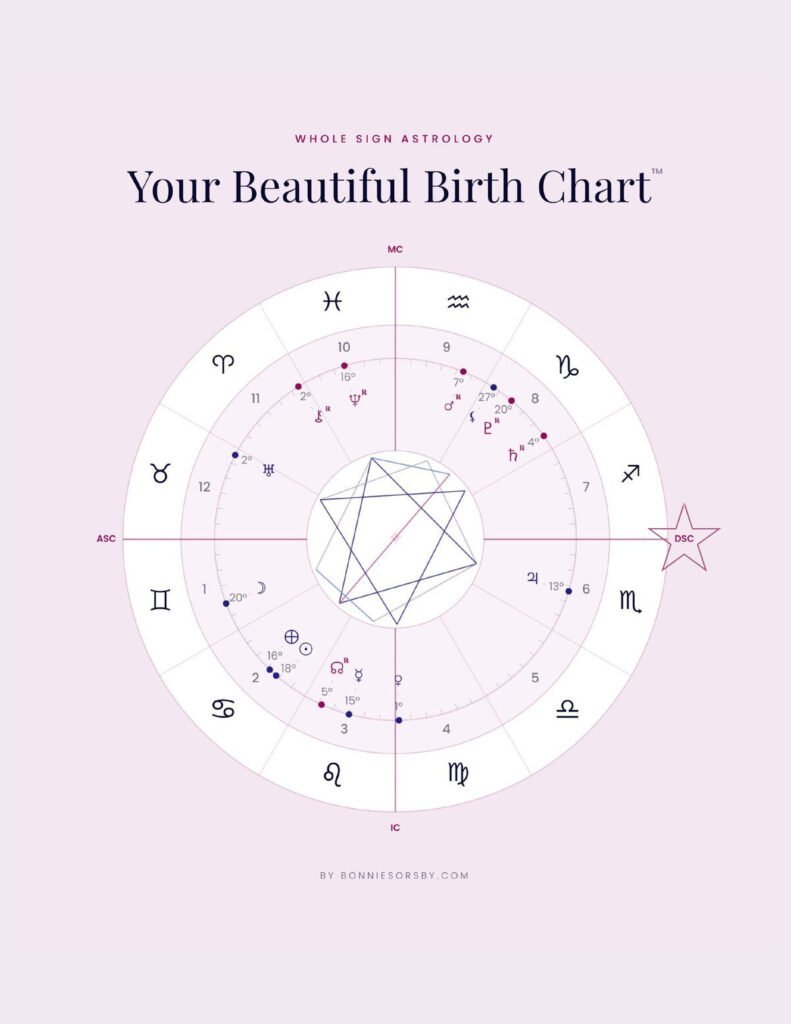
Your Descendant sits at a specific degree in a specific sign, directly opposite your rising sign. Which sign it is describes what you are drawn to in other people and what you hand over to them.
Your Beautiful Birth Chart gives you your placements by sign and house, angles included, so you can find your own Descendant and see what sits near it.
What Is My Descendant Sign?
Your Descendant is always the sign directly opposite your rising sign. If you know your rising sign, you already know your Descendant, and no further calculation is needed. Virgo rising gives a Pisces Descendant. Leo rising gives an Aquarius Descendant. The axis runs straight across the wheel, six signs on.
You do need an accurate birth time for this, because the rising sign changes roughly every two hours and the whole axis moves with it. If you are not sure of yours, why birth time matters in astrology covers what changes without it, and you can pull your chart with the free birth chart calculator.
| Your rising sign | Your Descendant | What often feels magnetic |
|---|---|---|
| Aries rising | Libra | fairness, and being asked what you want |
| Taurus rising | Scorpio | depth, and no patience for small talk |
| Gemini rising | Sagittarius | a bigger frame than yours, and the nerve to widen it |
| Cancer rising | Capricorn | steadiness, and weight carried without flinching |
| Leo rising | Aquarius | an independent mind, unimpressed by status |
| Virgo rising | Pisces | feeling first, and no need for any of it to be tidy |
| Libra rising | Aries | decisiveness, and movement before everything is agreed |
| Scorpio rising | Taurus | calm that does not wobble when things get tense |
| Sagittarius rising | Gemini | quickness, curiosity, and good conversation |
| Capricorn rising | Cancer | warmth, and a room made safe without being asked |
| Aquarius rising | Leo | expressiveness, and no fear of being looked at |
| Pisces rising | Virgo | practicality, and someone who can make the thing work |
The third column describes the quality doing the pulling. It does not name a person, and two people with the same Descendant often end up with partners who look nothing alike.
The Romantic Partnership Lens
In romantic relationships, the Descendant usually describes the specific quality someone is drawn to in a partner, the one that keeps showing up across people who otherwise look nothing alike. I have gone deeper into why that exact pattern keeps repeating here, since the psychology underneath it deserves its own space. The short version from the chart’s perspective is that the Descendant usually names the pull before anyone has consciously chosen anything.
The Business and Professional Partnership Lens
The same point applies just as directly to who someone works well with. Business partners, co-founders, and key collaborators usually fall under this same astrological territory, since the Descendant covers significant one-on-one bonds generally, and not romance specifically.
This often shows up as a founder pairing with someone who handles exactly what they personally avoid, or a creative partnership where one person’s weak spot is consistently the other person’s strength. The pull toward a particular kind of professional counterpart usually follows the same underlying logic as the romantic version, just applied to a different kind of closeness.
The Projection Lens: What Gets Mirrored Back
There is a third layer underneath both of the above. The Descendant often describes qualities a person has not yet claimed in themselves, the ones that show up as magnetic, or sometimes frustrating, in a partner or collaborator specifically because they are not yet familiar from the inside.
This is usually most visible with whatever quality keeps showing up as both the most attractive and the most aggravating thing about the people someone chooses, in love or in business. That contradiction is frequently the Descendant doing its job.
The Descendant by Sign: What Usually Feels Magnetic
The sign on the Descendant usually describes the specific quality someone finds magnetic in a partner or collaborator, whatever the underlying need driving that pull happens to be.
A Descendant in a fire sign often draws someone toward confidence, spontaneity, or a willingness to take the lead, whether that shows up in a partner or a business counterpart. A Descendant in an earth sign usually pulls toward steadiness, reliability, and someone who can be counted on in practical ways. A Descendant in an air sign frequently draws someone toward conversation, ideas, and a counterpart who can think alongside them. A Descendant in a water sign usually pulls toward emotional depth and someone who can sit inside feeling, or inside ambiguity, without needing to fix it immediately.
None of this describes who someone will end up with specifically. It describes the quality doing the pulling.
When the Descendant Gets Activated
Planets near the Descendant, or major transits crossing it, usually bring partnership questions to the surface, romantic or professional, sometimes through one specific relationship and sometimes through a pattern that finally becomes obvious across several of them.
This often shows up as a relationship or partnership beginning or ending at a moment that otherwise seems unrelated to anything happening in the rest of life, a sudden pull toward someone unfamiliar, or a long-running partnership suddenly asking for renegotiation. Saturn here usually asks whether a partnership, of any kind, can hold real commitment. Uranus here often disrupts a partnership pattern that had become outdated.
The Descendant Isn’t a Prediction of Who You’ll End Up With
One of the more common misunderstandings about the Descendant is treating it like a description of a future partner or business match, almost a checklist of traits to look for. It usually works the other way. The Descendant describes a pull. That pull can show up in a relationship or partnership that turns out to be exactly right, and it can show up in one that turns out to be a hard lesson.
Read that pull as information about the person feeling it, and about what it keeps pointing back to in them.
Why the Descendant Matters for Pattern Work
In deeper chart work, the Descendant often explains why a particular type of partner or collaborator keeps showing up despite genuinely different attempts to choose differently, why certain relationship or partnership dynamics repeat even across people who otherwise have little in common, and why someone’s most frustrating quality sometimes turns out to be the quality most worth examining in oneself.
When the Pull Feels Bigger Than One Relationship
If this is landing as more than a passing curiosity, that is usually worth trusting. The pull toward a certain kind of partner or collaborator rarely feels random from the inside, even when it is hard to explain out loud, and the fact that it keeps repeating is information.
Your Personal Pattern™ exists for exactly that kind of recognition, reading your chart as a connected system so the things that have felt magnetic, frustrating, or hard to name finally have language attached to them.
Frequently Asked Questions About the Descendant in Astrology
What does the Descendant represent in astrology?
The Descendant represents what a person looks for in close partnership of any kind, romantic relationships, business partnerships, and other significant one-on-one bonds. It often points to qualities a person finds magnetic in others, sometimes ones they have not yet claimed in themselves.
Does the Descendant apply to business partners, or only romantic relationships?
Both. The Descendant covers significant one-on-one bonds in general, which includes business partners, co-founders, and key collaborators. The same underlying quality that draws someone toward a certain kind of partner usually shows up in who they work well with too.
What is the difference between the Descendant and the Ascendant?
The Ascendant describes how a person moves through the world on their own, including first impressions and instinctive approach. The Descendant, sitting directly opposite, describes what that person looks for once another person enters the picture. They form one axis, which is why reading either one on its own tells you half the story.
Why does the same type of partner or business collaborator keep showing up in my life?
This is often connected to the sign and condition of the Descendant, which describes a consistent quality a person is drawn to across very different relationships and partnerships. Recognizing the pattern usually starts with looking at several relationships together, romantic and professional, instead of any single one on its own.