
Jupiter Return in Astrology
Every twelve years, Jupiter returns to the exact degree it occupied the moment you were born. This is called the Jupiter return, and it marks the completion of one full Jupiterian cycle and the beginning of the next. Of all the planetary returns, Jupiter’s is the one people often feel most recognizably: a loosening, an opening, a sense that something that had been contracted or stalled is moving again. What’s most worth exploring is what you want to do with it.
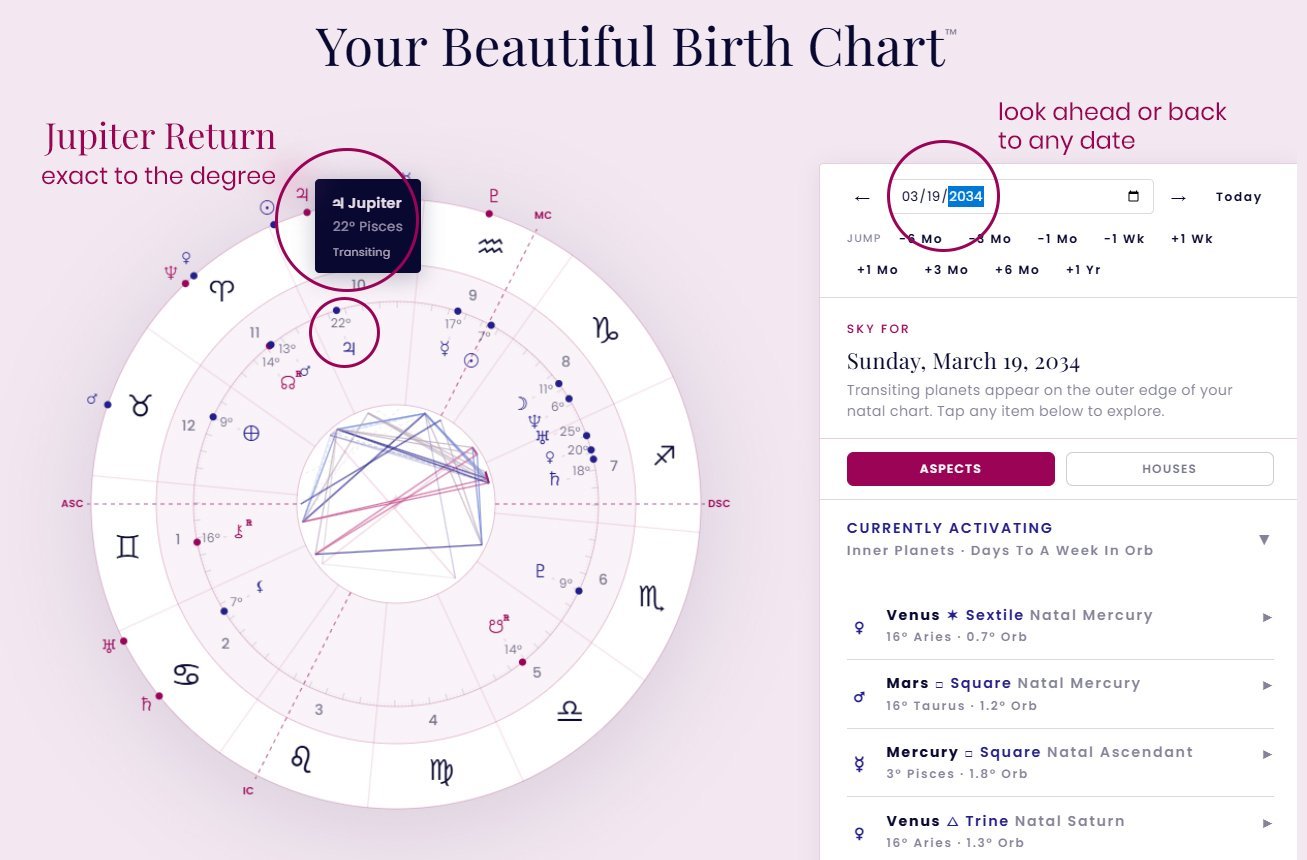
What Is a Jupiter Return?
A Jupiter return occurs when transiting Jupiter, moving through the zodiac at its natural pace of roughly one sign per year, arrives back at the exact position it held in your natal chart. Because Jupiter takes approximately 11.86 years to complete one full orbit of the Sun, most people experience their Jupiter return around the ages of 12, 24, 36, 48, 60, and 72, with each return lasting several months as Jupiter moves through that degree, sometimes stationing and moving backward before completing the return.
The return is not a single day but a window, and in some cases Jupiter will pass over the natal degree three times due to retrograde motion, which often extends and deepen the themes of that particular return. The full Jupiter return period is generally considered to span the year or so surrounding the exact return, and the house Jupiter is transiting during that window is as significant as the natal Jupiter sign and house.
What Jupiter returns often bring is less a specific external event than a shift in the quality of possibility. The feeling of expansion, of things opening up, of faith being renewed after a period of contraction, is recognizable across most people’s accounts of their Jupiter returns even when the outer circumstances vary widely. The luck that Jupiter is associated with often becomes more available during a return year, because the person often becomes more genuinely open to receiving what is being offered.
The Jupiter Return Ages: What Each One Tends to Bring
Because each Jupiter return arrives at a completely different stage of life, the expansion it offers looks and feels different each time. The same planet, the same natal position, twelve completely different chapters.
The First Jupiter Return: Around Age 12
The first Jupiter return arrives at the threshold between childhood and adolescence, one of the more vertiginous transitions a person makes. The world is expanding whether the twelve-year-old wants it to or not: the social world grows more complex, the intellectual world opens up, the first real questions about identity and belonging begin to surface. Jupiter here is the planet of natural curiosity and philosophical wondering making its first real claim on the developing self. This return rarely feels like luck in the way later returns do; it is more the first encounter with the sheer size of the world outside the immediate family.
The Second Jupiter Return: Around Age 24
The second Jupiter return often arrives just as the early adult chapter is establishing itself, or failing to. By 24 most people have moved through the first attempts at building an independent life, and that age also opens a 1st house profection year, which puts the focus squarely back on you, and the Jupiter return often brings either a genuine expansion of what is working or a clear signal that something needs to change. It can be a year of real opportunity in the career or education realm, of meaningful new connections, or of a philosophical reorientation that shifts the direction of the next twelve years. The shadow here is the overconfidence of early adulthood, the way that Jupiter’s optimism can tip into a certainty that the future will sort itself out without any particular effort.
The Third Jupiter Return: Around Age 36
The third Jupiter return is the one people often find most significant in retrospect. By 36, enough life has been lived to have a real relationship with what has and has not worked, and the expansion Jupiter brings at this point often has more genuine depth to it. This is often a return that prompts real reassessment: of the career, the relationship, the way the life has been built so far and whether it is the life that was wanted. For some people it is a year of genuine breakthrough. For others it is a year of necessary disruption that makes the breakthrough possible later. The midlife reckoning that often gets attributed to the early 40s frequently has its true beginning in the Jupiter return at 36.
The Fourth Jupiter Return: Around Age 48
The fourth Jupiter return arrives in the territory that follows the midlife reckoning, and for many people it carries a quality of genuine authority and earned wisdom. By 48, the philosophical questions that Jupiter represents have been lived with long enough to produce something real: a clearer sense of what matters, a more settled relationship to belief, a capacity for generosity that comes from having received and lost things of value. The expansion here is often quieter but more substantial than the earlier returns, about contributing, teaching, and building something that will outlast the moment.
The Fifth Jupiter Return: Around Age 60
The fifth Jupiter return coincides with one of the significant threshold passages of later life: the beginning of what some traditions call elderhood, the point at which the emphasis naturally shifts from building to offering what has been built. Jupiter at 60 often brings a quality of genuine philosophical richness and the opportunity to share what has been learned in a form that others can use. There is often a renewed sense of possibility here that surprises people who expected the later decades to be primarily about contraction. The wisdom function of Jupiter, which was always present, often comes forward most fully at this return.
The Sixth Jupiter Return: Around Age 72
The sixth Jupiter return is the one that arrives with the full weight of a long life behind it. The expansion available at 72 is about the perspective that only a full Jupiterian cycle of cycles can produce: the long view, the capacity to hold contradiction and paradox, the philosophical spaciousness that comes from having lived through enough to know what endures and what does not. For many people this return carries a quality of genuine spiritual deepening and a renewed engagement with the questions that Jupiter has always pointed toward.
What Your Jupiter Return Activates in Your Chart
The return ages above describe the general arc. What makes your Jupiter return specific to you is the house Jupiter is moving through during the return window and the aspects it is making to your natal planets along the way.
If Jupiter is returning through your 10th house, the expansion of that return year often concentrates in the career and public life. If it is returning through your 4th, the home and the private foundations of the life are where the opening is most likely to happen. If transiting Jupiter is making a conjunction to your natal Venus during the return, the relational dimension of the year carries particular Jupiterian weight. If it is squaring your natal Saturn, the expansion is likely to meet real resistance before it can find its footing.
None of this happens in isolation, either. Other transits are moving through your chart at the same time, some amplifying the Jupiter opening and some creating the friction that makes the expansion meaningful rather than simply easy. The full picture of what a Jupiter return year holds for a specific chart requires seeing everything that is activated during that window.
Your Beautiful Birth Chart includes a transits section where you can look ahead and behind at any date range you choose, including the full window of your Jupiter return. You can see when the exact return hits, what other transits are moving through at the same time, and what the coming months and years hold across the whole chart. The ability to look forward from any date, not just the present moment, is what makes it genuinely useful for planning rather than just reflecting.
How to Work With Your Jupiter Return
The Jupiter return is not something that simply happens to you. It is an opening, and what gets built in that opening depends significantly on what you bring to it.
The most useful thing to do in the lead-up to a Jupiter return is to get honest about what you want to expand. Jupiter amplifies what is already in motion, which means arriving at the return with a clear direction often produces much more than arriving at it passively and waiting to see what shows up. The return year rewards people who are already reaching toward something.
It is also worth being deliberate about the philosophical and relational quality of the return year. Jupiter governs belief and meaning as much as it governs luck and abundance, and the question of what you believe to be true about your life and its possibilities often becomes more consequential during a return. The faith or the cynicism you bring to the year often shapes the experience of it more than in most other periods.
The shadow worth watching for is the inflation that Jupiter always carries. Return years can generate genuine overconfidence, the sense that everything is finally going right and that the momentum will simply continue without tending. Promises made during Jupiter return years sometimes outrun the actual capacity to fulfill them. The expansion is real, and it is also not permanent; what gets built during the return year needs to be able to stand on its own when Jupiter moves on.
Frequently Asked Questions About the Jupiter Return
How do I know when my Jupiter return is?
A birth chart calculated with your exact date, time, and place of birth will show your natal Jupiter sign and degree. Your Jupiter return occurs when transiting Jupiter reaches that same degree. Because Jupiter moves through roughly one sign per year, you can track its current position and calculate when it will return to your natal degree. The transits section of Your Beautiful Birth Chart can show you the exact dates of your Jupiter return as part of the full transit picture.
Is the Jupiter return always positive?
Jupiter return years often feel expansive and generative, and for most people they are genuinely positive periods. But Jupiter expands what it touches, which means if the underlying conditions heading into the return are difficult or misaligned, the return can expand that difficulty before it expands the resolution. The return is most clearly positive for people who arrive at it with genuine intention and are already moving in a direction that serves them.
What if I missed my Jupiter return?
You did not miss it exactly, it’s happening whether you consciously work with it or not. The year surrounding the exact return carries the Jupiter energy most strongly, but the beginning of a new twelve-year Jupiter cycle is still fully available after the exact degree has passed. The new cycle is underway regardless of whether the exact return date was consciously marked.
What is the difference between a Jupiter return and Jupiter transiting my 1st house?
These are related but different. A Jupiter return is when transiting Jupiter reaches the exact natal Jupiter degree, regardless of which house that falls in. Jupiter transiting the 1st house is when Jupiter moves through the first house of your chart, which often brings expansion to the self-presentation, confidence, and new beginnings. Depending on your chart, these may happen simultaneously or at completely different times.
How long does a Jupiter return last?
The exact return, the moment Jupiter hits your natal degree, is a single day, but the energy of the return is generally felt throughout the full year Jupiter spends in the natal sign. If Jupiter retrogrades back over your natal degree, you may experience two or three exact hits, which often extends and deepen the themes of that return. The full Jupiter return window is broadly considered to span from the first hit of the natal degree to Jupiter’s departure from the natal sign.