
The 8 Pointed Star
The 8 Pointed Star is not a symbol with a single meaning. It is a symbol with many meanings that converge, arising independently across civilizations and millennia, all pointing toward something similar: the Queen of Heaven, the nature of abundance, the geometry of the cosmos, the cycle that ends only to begin again at a higher register.
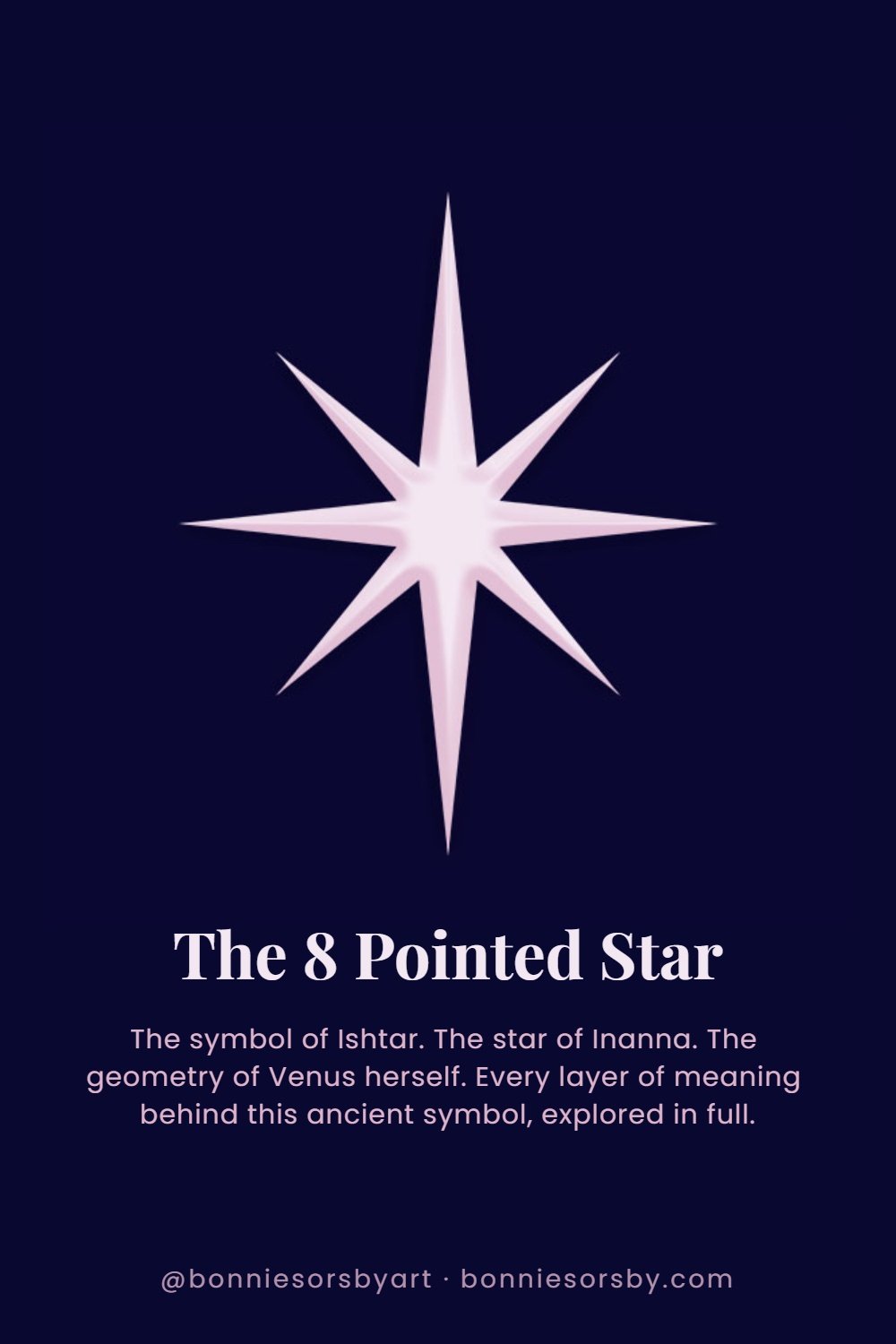
Ishtar and the Star of Heaven
The eight-pointed star is, at its oldest traceable root, the star of Ishtar. It appears on Mesopotamian cylinder seals, on cuneiform tablets, on the walls of temples, and most famously on the Ishtar Gate in Babylon, the great blue-glazed entrance commissioned by Nebuchadnezzar II in the sixth century BCE and now held in the Pergamon Museum in Berlin. Eight-pointed stars cover its surface in repeating rows of golden yellow against brilliant lapis lazuli, the symbol of the goddess for whom the gate was named stamped into its very architecture.
Ishtar was the Akkadian and Babylonian goddess of love, beauty, desire, war, and sovereignty. She was one of the most widely worshipped deities in the ancient Near East, a figure of tremendous and explicitly paradoxical power: the goddess who held love and war, tenderness and ferocity, in the same hands simultaneously. She was called the Queen of Heaven, the Light of the World, the Morning and Evening Star. The eight-rayed star was her symbol because it was also the symbol of the planet Venus, which the Mesopotamians identified with her: the bright wandering star that appears first as the morning star, disappears, and returns as the evening star, embodying the cycle of disappearance and return that Ishtar herself enacted in her mythology.
The eight points are ancient and debated in their precise origin, but they speak to Venus’s role in Mesopotamian cosmology as the most visible and significant of the wandering stars. To see the eight-pointed star was to invoke Ishtar. To invoke Ishtar was to call in the full range of what she governed: love in its gentlest and most consuming form, power in its most uncompromising expression, the beauty that does not diminish but commands.
Inanna and the Descent
Before Ishtar, there was Inanna. She is the Sumerian antecedent, the earlier form of the same goddess arising from the oldest written civilization on Earth, and her mythology is among the oldest recorded in human history. The hymns to Inanna composed by Enheduanna around 2300 BCE are the earliest known authored literature in the world: poems written by a named human being, addressed to a goddess whose story was already ancient.
Inanna descends to the Underworld. This is the story at the center of her mythology, and it is one of the most psychologically and spiritually rich narratives that has survived from any ancient culture. She descends to visit the Great Below, the realm ruled by her sister Ereshkigal, and at each of the seven gates she must surrender one of her adornments: her crown, her earrings, her necklace, her breastplate, her gold ring, her lapis lazuli measuring rod, her royal robe. Gate by gate, she is stripped of every symbol of her power and status. She arrives in the Underworld naked. She is killed. She hangs on a hook.
After three days she is resurrected through the intercession of the god Enki, who sends emissaries bearing the food and water of life. She rises and ascends back through the seven gates, reclaiming each adornment as she goes. She returns to the world above transformed: not the same Inanna who descended, but one who has passed through the full darkness and come back carrying something that only that passage could produce.
The story is not simply about death and return. It is about the willingness to surrender everything that defines you in order to encounter what lives beneath all of it. The stripping at each gate is not punishment; it is the price of genuine initiation. Inanna goes willingly. She goes prepared. She goes knowing that the only way to rule the full world, upper and lower, is to know the full world from the inside.
This mythology is why the eight-pointed star carries the weight it does. It is not merely a beautiful geometric form. It is the symbol of the goddess who descended into the place where nothing survives and came back anyway, who held sovereignty over both light and darkness because she had been both. The star of Ishtar is the star of the one who returned.
It is also worth naming the thread that connects Inanna to another figure whose mythology lives in a different corner of this site. Lilith, in her own tradition, is the woman who refuses to diminish herself and is cast out for it. Inanna descends voluntarily and rises transformed. The energy is related and distinct: both are figures of feminine power that refuses containment, one through refusal, one through descent. They are neighboring ones, and the eight-pointed star sits at the intersection of both.
The Star of Lakshmi
The same eight-pointed form appears in Hindu tradition as the symbol of Lakshmi, the goddess of abundance, prosperity, grace, and beauty. The connection to Ishtar is not direct; the traditions arose independently and carry different textures. But the convergence of the same geometric symbol onto goddesses of abundance and beauty across completely separate cultures is itself worth sitting with. Something in the eight-pointed star keeps arriving at the feminine principle of wealth and grace regardless of which tradition is doing the arriving.
In the Ashtalakshmi tradition, Lakshmi is understood to have eight forms, each governing a different dimension of abundance. Adi Lakshmi is the primordial form, the source from which all else arises. Dhana Lakshmi governs material wealth and prosperity. Dhanya Lakshmi governs the abundance of the harvest and of food. Gaja Lakshmi governs power and the strength of elephants. Santana Lakshmi governs fertility and the wealth of progeny. Dhairya Lakshmi governs courage and the inner wealth of fortitude. Vijaya Lakshmi governs victory and success. Vidya Lakshmi governs the abundance of knowledge and wisdom.
Eight forms. Eight dimensions of what abundance means when it is understood fully rather than reduced to its most obvious material expression. The eight-pointed star in Hindu iconography carries all of them simultaneously, not just the version of prosperity that counts money but the whole range of what a genuinely rich life contains: food, courage, knowledge, children, victory, grace, and the primordial source beneath all of it. This is an understanding of abundance that the ancient world held with much more sophistication than the reductive version that often circulates today.
Sacred Geometry and the Octagram
Geometrically, the eight-pointed star is an octagram: two squares overlaid on the same center, rotated forty-five degrees from each other. This construction is simple and the symbol it produces is striking, but what matters most is what the geometry means rather than how it is made.
The square in sacred geometry represents the earthly, the material, the four directions and four elements: earth, air, fire, water. It is the geometry of the manifest world. When two squares are overlaid and rotated to create the octagram, the resulting eight points reach simultaneously toward all eight directions, toward the four cardinal points and the four cross-quarters between them. The symbol covers the full compass of the world. It is the geometry of total orientation.
The octagon, the eight-sided shape that the octagram both contains and implies, is historically understood as the mediating form between the square and the circle, between earth and heaven, between the material and the divine. This is why octagonal forms appear in sacred architecture across traditions with no connection to each other: in Islamic tilework and domes, in baptismal fonts in early Christian churches, in Buddhist stupas. The eight-sided form is the threshold shape, the one that holds you in the transition between two states.
In Islamic geometric art, the eight-pointed star is one of the most pervasive and developed forms, appearing in the intricate geometric tilework of mosques and palaces across centuries and continents. It is not decorative in the merely ornamental sense; it carries the theological understanding that geometry reflects the divine order of the cosmos, that to construct the eight-pointed star correctly is to participate in the structure of reality itself.
The Number Eight
Seven is the number of completion. Seven days of creation, seven classical planets visible to the naked eye, seven gates of the underworld through which Inanna passed. Seven is the full cycle, the thing that runs all the way through. Eight is what comes after. Eight is not the continuation of the same sequence but the arrival at a new register: the same scale begun again at a higher octave.
The musical octave is perhaps the most precise expression of this. Eight notes complete the scale. The eighth note is not the end; it is the same note as the first, vibrating at exactly twice the frequency. The completion and the new beginning are the same event. You arrive at eight and find yourself back at one, but changed, elevated, at a different pitch of the same truth.
This is why eight carries the energy it does across traditions with no direct connection to each other. The infinity symbol, the lemniscate, is the number eight rotated onto its side: the cycle that never terminates but turns endlessly back through itself. The I Ching contains eight trigrams, the foundational combinations of broken and unbroken lines from which all sixty-four hexagrams and all of existence are understood to arise. The eightfold path in Buddhism describes not a linear progression but a wheel, a set of principles that are practiced simultaneously and return to themselves continuously. Eight limbs of yoga in the Ashtanga tradition. Eight auspicious symbols in Tibetan Buddhism.
The pattern is consistent across traditions far too distant from each other to have shared a source: seven completes, eight begins again. The eight-pointed star is the symbol of that threshold, the moment of return that is also the moment of new beginning, the place where the cycle turns.
The Eight-Year Venus Cycle
There is a bridge between the ancient star of Ishtar and the mathematical structure of the cosmos, and it runs through Venus.
Over the course of approximately eight years, Venus traces a five-pointed star in the sky as seen from Earth. This is called the Rose of Venus. It arises from the precise mathematical relationship between Venus’s orbit and Earth’s: five Venus synodic cycles align almost perfectly with eight Earth years and thirteen Venus years, and the five points of conjunction that result form a pentagram in the sky. The pattern is not approximate; it is one of the more exact orbital resonances in the solar system, embedded in the mathematics of the planets themselves.
The Rose of Venus connects the most ancient symbol of the goddess to the actual behavior of the planet that bears her name. Ishtar’s star has eight points. The Venus cycle that produces the Rose turns on an eight-year axis. Whether the ancient Mesopotamians understood the precise mathematics of this is debated, but they observed Venus carefully and they knew her cycles. The eight-pointed star may have encoded an understanding of Venus’s periodicity that we are only now recovering the language to describe.
What the eight-pointed star and the Rose of Venus share is the underlying idea: Venus returns. The pattern holds. The cycle turns through its full expression and comes back to where it began, having traced something beautiful in the process. The goddess descends and rises. The morning star becomes the evening star and then the morning star again. Eight years, eight points, the same truth wearing different geometry.
astro curious? 👀
The Venus thread running through this symbol runs through your chart too. Start wherever you like:
- Where Venus sits for you → free birth chart
- What Venus means by sign and house → Venus in astrology
- The five-petal pattern it traces over eight years → the Rose of Venus
- Read the whole chart yourself → Your Beautiful Birth Chart
Why This Symbol
The eight-pointed star became the icon of this site through the same process by which most genuine things arrive: not through deliberate selection but through recognition. The research came afterward, as it often does. What it confirmed was not a surprise.
The symbol of the goddess who holds love and war, tenderness and sovereignty. The star of the one who descended all the way through and came back transformed. The geometry of eight directions, of the threshold between earth and heaven, of the cycle that completes only to begin again at a higher register. The mathematical signature of Venus herself, woven into the orbital resonance of the solar system.
Inanna was the piece that settled it. She arrived before she was fully understood, the way she tends to. A book purchased on an impulse, barely opened, sitting on a shelf doing something. That is how she works: she is already there before you have finished deciding to go looking for her. The eight-pointed star works the same way. People are drawn to it before they know why. When they find out why, they recognize something they already knew.
This is the lens through which the astrology on this site is practiced: not as a system of definitions but as a language for the kind of self-knowledge that descends before it rises, that strips away before it restores, that returns the thing it took in a form you could not have imagined before the passage. The eight-pointed star stands at the threshold of that work. It always has.
Frequently Asked Questions About the Eight-Pointed Star
What is the eight-pointed star called?
The eight-pointed star has several names depending on the tradition. Geometrically it is called an octagram. In the Mesopotamian tradition it is the Star of Ishtar or the Star of Inanna. In Hindu tradition it appears as the Ashtalakshmi yantra or lotus. In Islamic geometric art it is sometimes called the Khatam Sulayman or the star of Solomon. The same form carries different names across different traditions while remaining recognizably the same symbol.
What is the difference between Inanna and Ishtar?
Inanna is the Sumerian form of the goddess, arising from the earliest written civilization, dating to at least 3500 BCE. Ishtar is the Akkadian and Babylonian form, a direct cultural and linguistic descendant of Inanna who was adopted as Mesopotamian civilization evolved. They are in most essential respects the same goddess across different eras and languages: the Queen of Heaven, the goddess of love and war, the figure identified with the planet Venus. Inanna’s mythology is slightly older and in some ways more psychologically complex in the forms that have survived; Ishtar’s is more widely known in the popular imagination through references to the Ishtar Gate and Babylonian tradition.
Is the eight-pointed star the same as the Star of David?
No. The Star of David is a hexagram, a six-pointed star formed by two overlapping triangles. The eight-pointed star is an octagram, formed by two overlapping squares. They are related in that both are formed by overlaying two versions of the same shape at a rotated angle, but they are distinct symbols with distinct meanings and distinct traditions behind them.
What does the number eight mean spiritually?
Across many traditions, eight represents the threshold between completion and new beginning. Seven is the number of completion, the full cycle. Eight is what arises after: the same thing at a higher frequency, the octave, the return that is also a beginning. The infinity symbol is eight on its side. In numerology, eight is associated with abundance, power, and cycles. In Buddhism, the eightfold path describes the complete set of principles for a liberated life. In the I Ching, eight trigrams generate all of existence. The consistency of eight across unconnected traditions points to something in the number itself that human beings have repeatedly recognized as significant.
What is the connection between the eight-pointed star and Venus?
The connection runs through both mythology and astronomy. In mythology, the eight-pointed star was the ancient symbol of Ishtar and Inanna, both of whom were identified with the planet Venus as the morning and evening star. In astronomy, Venus traces an approximately five-pointed star over an eight-year cycle as seen from Earth, a pattern called the Rose of Venus that arises from the orbital resonance between Venus and Earth. The number eight is embedded in Venus’s cycle even though the geometric shape the cycle produces is a pentagram rather than an octagram. The eight-pointed star and the Rose of Venus are different expressions of the same underlying relationship between this planet and this number.