
Pantone Birth Chart Color Palette vs. Your Big 3 Color Palette
The viral Pantone birth chart palettes are color moodboards that assign a swatch to your astrological placements, most often your Sun, Moon, Rising, and Venus signs. If you are not sure what those placements mean yet, my walkthrough of how to read your chart covers each one.
The problem is, a lot of the viral results are not especially pretty.
Some combinations come out muddy, overly muted, or visually disconnected, which makes sense when colors are being assigned as individual swatches without much attention to how the full palette works together. And because the trend is spreading through independent Pantone-inspired generators, not an official Pantone tool, the quality and methodology can vary quite a bit.
Seeing that made me wonder what would happen if the palette were treated as an actual palette rather than four separate zodiac colors. That is what led me to build Your Big 3 Color Palette, focused on the Sun, Moon, and Rising signs most people already know, with each color adjusted by the way the three placements interact and a little interpretation built in.
Here is how the two approaches compare, and why mine is about creating a color story that works as a whole. And yes, if you want to use it for branding, you can totally use it for inspiration but there’s a lot more involved there than just picking pretty colors If that’s where you’re heading, using your birth chart to build a brand palette is the longer version of what else goes into it..
If you want to see the placements behind a palette like this, Your Beautiful Birth Chart gives you your Sun, Moon and rising by sign and house, with the rulers and aspects that shape how the three combine.
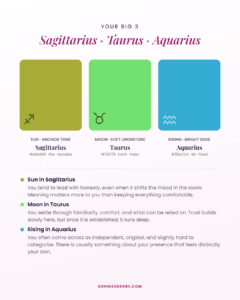
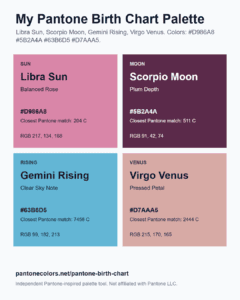
Side-by-side comparison of correct Sagittarius Sun placement from Your Big 3 Color Palette next to an incorrect Libra Sun result from a Pantone-style generator for the same birth date
Why Color Palettes Are Such a Satisfying Way to See Your Chart
There’s something immediately intuitive about color. Before you read a single description, you react to a palette, whether it feels warm or cool, soft or bold, calming or electric. That instant, pre-verbal response is probably a big part of why this trend keeps spreading. It takes something abstract, an astrological chart full of symbols and sign names, and turns it into something visual, personal, and instantly shareable. You don’t need to understand astrology to feel something when you look at four colors and know they’re supposed to be you.
What the Pantone Birth Chart Palette Trend Is
Over the past few years, astrology creators have been sharing color palettes based on birth chart placements, and the concept has recently exploded again across Threads and TikTok. The most common version uses four placements: Sun, Moon, Rising, and Venus, sometimes called the “Big 3 + Venus” format. People find their four signs, match each one to a swatch, and screenshot the results as a single collage image. Four signs in a collage is a different thing from a full chart image, and it’s worth knowing what a full birth chart gives away before you post one of those.
I ended up catching this wave in real time. After sharing my own Big 3 Color Palette on Threads, more than 20,000 people visited my site over the weekend, hundreds joined my email list, and the post quickly filled with people comparing palettes, debating colors, and asking how the system worked. Some loved theirs immediately. Some were deeply offended by the green. A few cropped my watermark out with impressive precision. The whole thing became a surprisingly useful little study in how personal color feels, even when the tool itself is meant to be playful.
That response also made the difference between the two approaches much clearer. The viral generators are mostly built to give you four swatches quickly. Mine was built to treat the colors as a palette, with the three placements influencing one another and a little interpretation attached to each result.
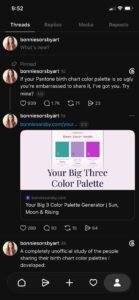
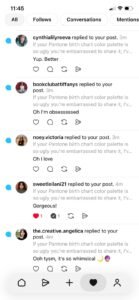

If you want to try the four-color version that’s currently circulating, you’ll need your Sun, Moon, Rising, and Venus sign on hand. You can pull all four from your free birth chart here on the site.
Why Your Big 3 Color Palette Uses Three Placements Instead of Four
When I built Your Big 3 Color Palette, I made a deliberate call to leave Venus out and stay with the original three: Sun, Moon, and Rising. It was a deliberate design decision, and here’s the reasoning behind it.
Sun, Moon, and Rising, often called your Big Three, are the placements almost everyone already has some familiarity with, even people who are brand new to astrology. Most people know their Sun sign without looking anything up. A decent number know their Moon. Rising takes an actual birth chart to find, but once you have it, all three placements are sitting in one place and the palette generates immediately. Adding Venus means a fourth lookup for a placement plenty of casual chart readers have never needed before, which raises the barrier to finishing the palette instead of abandoning it halfway through.
The bigger difference is what happens after the colors generate. My version gives each placement a defined role in the palette instead of only a label. Sun becomes your anchor tone, Moon becomes your soft undertone, and Rising becomes your bright edge, and each one comes with a short line of interpretation explaining what that placement is describing about you. A Sagittarius Sun doesn’t just get assigned olive green. It gets a sentence about leading with honesty even when it shifts the mood in the room, so the color has meaning attached instead of sitting there as decoration.
That’s the trade I made on purpose: fewer placements, more context per placement.
Birth Chart Color Palette Plus A Counterbalance
The palette doesn’t stop at three colors, either. Once your Big 3 generates, the tool reveals a second layer: a counterbalance palette built from three complementary placements that bring elements and energies into the mix that aren’t already present in your original three. It’s an optional way to see your chart from outside the frame it usually gets read in, six colors total instead of four, without ever needing a Venus lookup to get there.
You can also shift the intensity of the finished palette up or down. It may feel a little like increasing or softening saturation, but technically it adjusts more than that. The control lets you move the colors toward something bolder, softer, brighter, or more muted until the palette feels more like you.
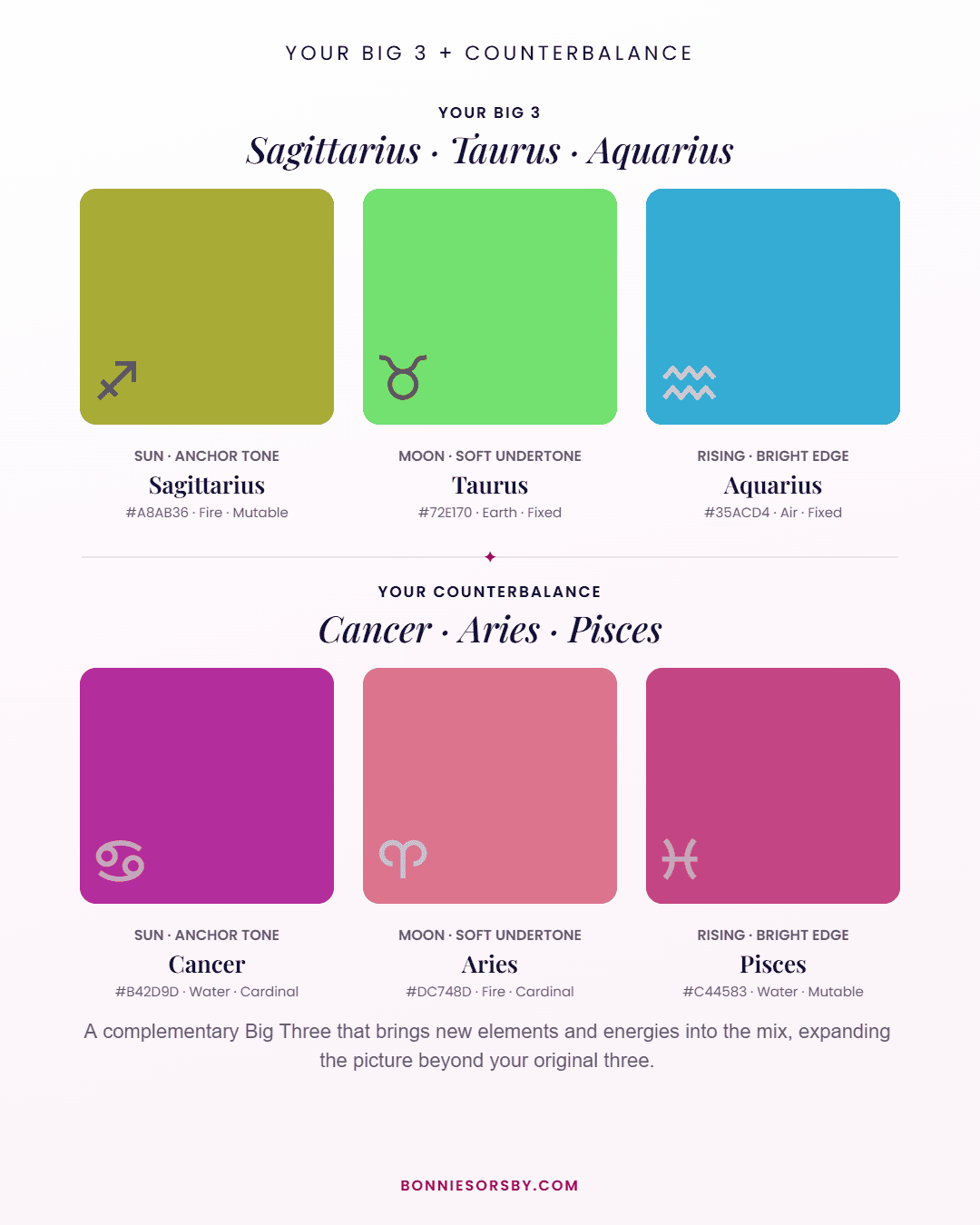
If you don’t know your Rising sign yet, you can find it and your full chart with the free birth chart tool, or explore how all three sit together inside Your Beautiful Birth Chart™, which shows your placements by sign and house and lets you move through transits with date navigation.
Your Big 3 Color Palette vs. the Big 3 + Venus Format: Which One to Use
They’re just designed with different goals in mind. Both are original, entertainment-focused color mappings, not official readings, and both are meant to be simply fun.
Choose the Sun, Moon, Rising, Venus format if: you already know all four placements, you want a palette specifically built for aesthetics and love language (Venus governs beauty and attraction in a chart, so it adds a style-and-taste layer the other three don’t cover), and you’re comfortable working from a tool where the placements are labeled but not explained.
Choose Your Big 3 Color Palette if: you want to get to a finished palette faster, you’re newer to your own chart and don’t have four placements memorized yet, you want the palette to teach you something about the placement while it’s generating the color, or you’re curious to see a counterbalance palette that expands your original three into six colors. My version was built for that second group specifically, the people who want a moodboard and a little bit of self-recognition in the same scroll.
Either way, you’re working from the same starting material. Sun, Moon, and Rising sit underneath both trends. Venus is simply the layer one version adds and the other intentionally leaves out.
If this is the first time you’ve pulled up your Sun, Moon, and Rising together, the palette is a fun place to start, but it’s genuinely just the surface. Those three placements are the doorway into a much bigger structure: houses, aspects, and the way all of it interacts as one system instead of three separate labels. Your Beautiful Birth Chart™ lets you explore your natal placements by sign and house, see your aspects, and move through past and future transits with forward and backward date navigation, so you can go from “here’s my color” to understanding where that color is coming from.
Whether you end up with three colors or four, the fun isn’t really the palette itself. It’s seeing your birth chart from a completely different perspective. Sometimes color makes a pattern jump out in a way words never could.
Try Your Big 3 Color Palette →
FAQ
What is a Pantone Birth Chart Palette?
It’s a color moodboard trend that matches a Pantone-style swatch to astrological placements, usually Sun, Moon, Rising, and Venus, so a chart can be represented visually instead of just described in text. The format has cycled through Twitter, Threads, and TikTok multiple times over the past few years, and the current wave is the biggest yet.
Do I need my exact birth time to get an accurate palette?
You need it for your Rising sign specifically, since Rising changes roughly every two hours and requires both birth time and location to calculate correctly. Sun and Moon signs are less sensitive to exact time, though Moon can still shift signs within a single day for some birth dates. If you don’t have your birth time handy, an approximate time is still better than guessing, but check it against a birth certificate when you can.
What’s the actual difference between the Pantone Birth Chart Palette trend and Your Big 3 Color Palette?
The Pantone Birth Chart Palette trend typically uses four placements: Sun, Moon, Rising, and Venus. Your Big 3 Color Palette uses three: Sun, Moon, and Rising, which are the placements most people already have some familiarity with. It also adds a short interpretive line for each placement, so the palette explains what it’s representing instead of only showing a color.
Is any of this affiliated with Pantone?
No. Neither the viral trend nor any generator built around it, including mine, is affiliated with, endorsed by, or sponsored by Pantone LLC. Pantone is a registered trademark, and these tools use original, astrology-inspired color mapping for entertainment and design purposes only.
Can I use Your Big 3 Color Palette for real branding or design work?
You can use it as a starting point for mood and direction, but a palette built for astrological meaning isn’t the same as a palette tested for contrast, accessibility, or real-world application. If you want to develop a personal palette into something usable, the Color Palette Playground is a free way to keep exploring color combinations, and The Color Palette Lab™ is built for testing and refining a palette until it holds up.
If the real-world application you have in mind is a website, my guide to how to choose website colors covers how many colors a site needs and what job each one does.
Where do I find my Sun, Moon, and Rising signs if I don’t already know them?
Your free birth chart will show you all three placements at once. From there, you can head straight to Your Big 3 Color Palette to generate your colors, or go deeper into your full chart with Your Beautiful Birth Chart™.