
Uranus in Astrology
Uranus is the planet of disruption, individuality, and sudden awakening, the point in a birth chart that describes where a person breaks from convention and refuses to stay small to keep others comfortable. Most people meet Uranus before they can name it. It shows up as the moment a decision you didn’t plan gets made anyway, the friendship or job or belief that ends without warning, the flash of clarity that arrives sideways instead of in a straight line. If you have ever looked back at a turning point in your life and thought I didn’t see that coming, but somehow I already knew, that’s Uranus. It doesn’t build slowly the way Saturn does. It arrives, and then you’re already different.
What Uranus Represents in a Birth Chart
Uranus rules Aquarius and governs innovation, individuality, rebellion, and the urge to break from anything that has calcified into convention for its own sake. Where Saturn asks you to build within structure, Uranus asks what happens when the structure stops serving the person inside it. It is the planet of the unexpected: sudden insight, sudden change, sudden freedom. Its placement in the chart, by sign and house, points to where a person resists being boxed in and where change often arrives fast instead of building slowly.
Uranus takes roughly 84 years to complete a full orbit, moving through each sign for about seven years. Because of that pace, Uranus sign placements are generational. Everyone born within the same seven-year window shares a Uranus sign, which is why Uranus describes a collective mood as much as a personal trait. The house it occupies is where the individual signature comes in. Two people with Uranus in the same sign will experience its disruption in entirely different areas of life, depending on the house.
In evolutionary astrology, Uranus works alongside Saturn and Pluto as one of the chart’s transformation points, though its role is distinct from both. Pluto dismantles from the root. Saturn builds what comes after. Uranus is the interruption itself, the lightning strike that makes the old shape impossible to keep living inside. If you’re newer to reading your chart, the learn astrology hub is a useful place to build vocabulary before going deeper into a placement like this.
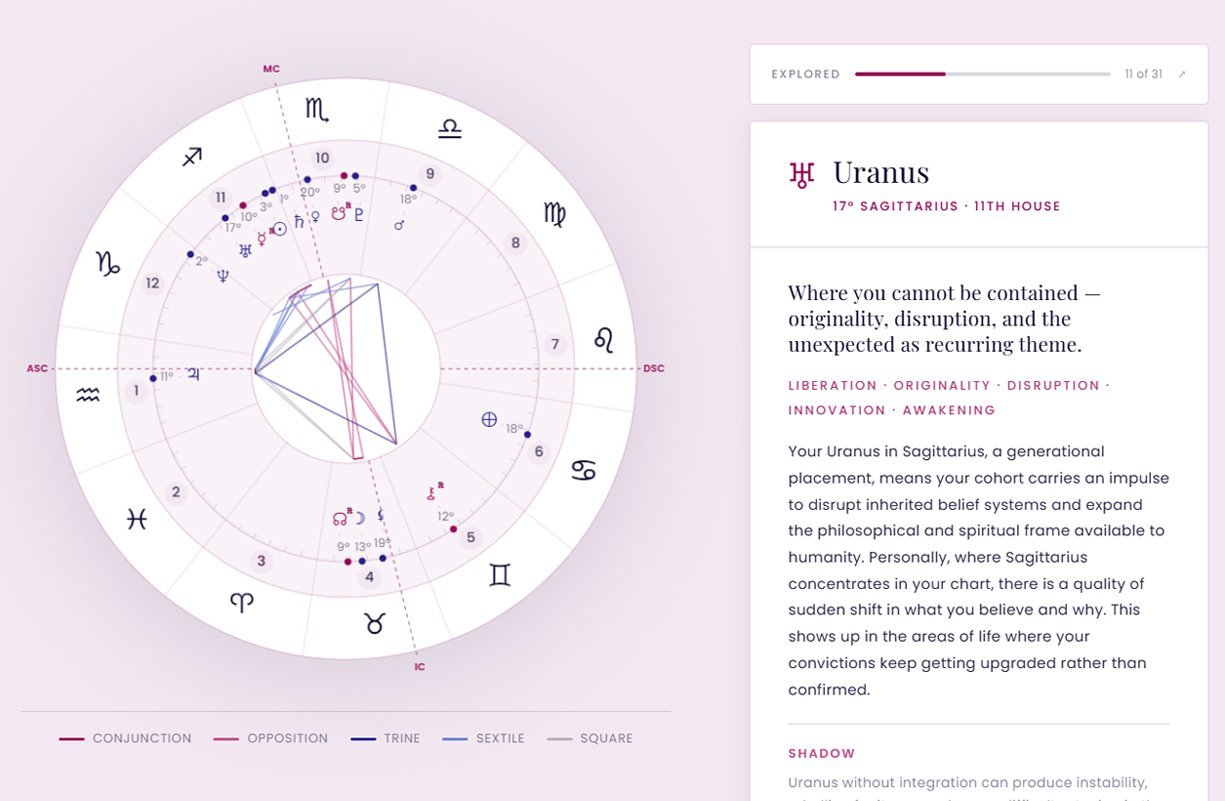
As an Aquarius rising myself, Uranus sits in a particular seat for me since it rules my first house, my chart ruler, the planet whose condition colors how the rest of the chart expresses. My own natal Uranus falls in Sagittarius in the 11th house, which has meant a lifelong pull toward belief systems, communities, and futures that don’t yet have a name. That combination doesn’t wait for permission. It finds the edge of a group or a philosophy and asks what’s next before everyone else is ready for the question. If Uranus is your chart ruler too, you may already recognize that particular restlessness, the sense of belonging most fully to what hasn’t been built yet.
Uranus in the Signs
Uranus by sign describes the generational flavor of disruption, the collective lens through which an entire cohort experiences change, individuality, and rebellion against convention. Everyone born in the same roughly seven-year window carries this placement.
Uranus in Aries
Uranus in Aries brings disruption through bold, impulsive action. This generation often breaks from convention through independence, initiative, and a refusal to wait for permission before acting.
Uranus in Taurus
Uranus in Taurus disrupts material values, resources, and the systems built around money and security. This placement often coincides with generational shifts in how wealth, land, and stability are defined.
Uranus in Gemini
Uranus in Gemini accelerates communication, information exchange, and the way ideas move through a culture. This is a generation shaped by rapid shifts in language, media, and technology. If this is your placement, Uranus in Gemini by Rising Sign breaks down what this current transit means for you personally, beyond the natal generational signature.
Uranus in Cancer
Uranus in Cancer disrupts the emotional foundations of home, family, and belonging. This generation often reshapes what safety and domestic life look like, breaking from inherited family structures.
Uranus in Leo
Uranus in Leo brings disruption through individuality, creative self-expression, and a demand to be seen on one’s own terms. This generation often redefines what leadership and personal authority look like.
Uranus in Virgo
Uranus in Virgo disrupts systems of work, health, and daily routine. This placement often coincides with generational upheaval in how people relate to labor, service, and the body.
Uranus in Libra
Uranus in Libra brings disruption to relationships, partnership models, and ideas of fairness. This generation often challenges traditional structures of marriage, commitment, and balance.
Uranus in Scorpio
Uranus in Scorpio disrupts power structures, intimacy, and collective taboos around sex, death, and shared resources. This generation often exposes what has been hidden.
Uranus in Sagittarius
Uranus in Sagittarius brings disruption through belief, philosophy, and the pursuit of expanded truth. This generation questions inherited belief systems and pushes toward new ideologies, education models, and ways of understanding meaning.
Uranus in Capricorn
Uranus in Capricorn disrupts institutions, authority, and long-standing structures of power. This generation often dismantles systems that were built to last but no longer hold.
Uranus in Aquarius
Uranus in its home sign amplifies its own themes directly: innovation, individuality, community, and collective progress. This generation often carries an unusually strong instinct toward reform and forward motion.
Uranus in Pisces
Uranus in Pisces disrupts spirituality, collective imagination, and the boundary between the individual and the whole. This generation often reshapes what mysticism, art, and shared consciousness look like in a given era.
Uranus by sign describes the collective weather everyone born in that window is standing in. Your own experience of it depends entirely on where Uranus sits in your personal chart, by house and by aspect. Your Beautiful Birth Chart lets you explore your natal Uranus by sign and house, see its aspects to the rest of your chart, and move through current and future transits with forward and backward date navigation, so you can see exactly when Uranus is activating your own placements.
Uranus in the Houses
While the sign shows the generational flavor of Uranus, the house is where the personal story lives. This is the part of your chart where disruption, individuality, and sudden change show up in lived experience.
Uranus in the 1st House
Uranus here shapes identity itself. Sudden reinvention, an unconventional presentation, and a strong resistance to being defined by others are common threads.
Uranus in the 2nd House
Uranus here brings volatility or sudden shifts around money, resources, and self-worth. Income may arrive through unconventional means, and financial stability often comes through embracing change instead of resisting it.
Uranus in the 3rd House
Uranus here disrupts communication, thought patterns, and the immediate environment. Ideas arrive quickly and unconventionally, and this placement often produces original thinkers and early adopters.
Uranus in the 4th House
Uranus here shakes the foundation of home and family. Sudden moves, unconventional family structures, or a need to break from inherited patterns of “home” are common.
Uranus in the 5th House
Uranus here brings disruption to creativity, romance, and self-expression. This placement often produces an unconventional creative voice and a resistance to predictable forms of pleasure or performance.
Uranus in the 6th House
Uranus here disrupts daily routine, work, and health. Sudden changes in job, an unconventional relationship to the body, or a need for variety in daily structure are common.
Uranus in the 7th House
Uranus here brings unpredictability to partnership. Relationships may begin suddenly, end suddenly, or simply require far more freedom and space than conventional partnership models allow.
Uranus in the 8th House
Uranus here disrupts intimacy, shared resources, and the psychological underworld. Sudden transformation, unconventional approaches to sex and money with others, and abrupt endings that clear space for depth are common.
Uranus in the 9th House
Uranus here disrupts belief systems, higher education, and worldview. This placement often produces a restless intellect, drawn to unconventional philosophies and sudden shifts in what a person believes to be true.
Uranus in the 10th House
Uranus here brings volatility to career and public reputation. Sudden career changes, an unconventional professional path, and a resistance to traditional authority structures are common.
Uranus in the 11th House
Uranus here is at home, since Uranus rules the 11th house naturally. This placement strengthens the pull toward community, collective causes, and future-oriented thinking, often bringing sudden shifts in friendship groups or the causes a person aligns with.
Uranus in the 12th House
Uranus here disrupts the unconscious mind, spiritual life, and anything hidden from view. Sudden insight, unexpected spiritual awakening, and a need for solitude to process change are common.
If parts of this are landing as recognition, pay attention to that. Uranus shows where disruption keeps finding you, but the transit is rarely the whole story. Your Personal Pattern helps you see the deeper system connecting your Uranus placement to the rest of your chart, so the pattern of sudden change stops feeling random and starts making sense as part of something you’ve always been carrying.
Uranus Transits: Opposition, Return, and the Timing of Awakening
Uranus moves slowly enough that its transits mark entire chapters of life instead of passing weather. Three moments matter most.
The Uranus opposition happens around ages 39 to 42, when transiting Uranus reaches the exact degree opposite its natal position. This is often called a midlife awakening, and the label holds up. It’s the point where a life built in the first half meets a demand for authenticity that the original structure may not have accounted for. Careers, marriages, and long-held identities can all come under real pressure here, because Uranus is asking whether the life still fits the person living it.
The first Uranus square happens around ages 20 to 21, often coinciding with the disruptions of early adulthood: leaving home, changing direction, breaking from family expectation for the first time in a real way. The second Uranus square arrives around ages 61 to 63, a later disruption that often has more to do with reclaiming individuality after decades of responsibility than with rebellion for its own sake.
The full Uranus return happens around age 84, when Uranus completes its entire orbit and returns to its natal position. Fewer people live to experience it fully, but for those who do, it often brings a late-life clarity and a return to the specific individuality the person carried at birth.
To see exactly when Uranus is activating your own chart, the transit calendar tracks upcoming planetary movements, and Your Beautiful Birth Chart overlays those transits directly onto your natal placements so you can see the timing against your own Uranus specifically.
FAQ
What does Uranus represent in astrology?
Uranus represents disruption, individuality, innovation, and sudden change. It rules Aquarius and describes where a person breaks from convention, resists being boxed in, and experiences change that arrives quickly instead of gradually.
What is a Uranus opposition and when does it happen?
A Uranus opposition occurs around ages 39 to 42, when transiting Uranus reaches the exact degree opposite its natal position. Often described as a midlife awakening, it frequently brings pressure on careers, relationships, and identities that no longer reflect who a person has become.
What house is Uranus naturally associated with?
Uranus is the natural ruler of the 11th house and Aquarius, which is why themes of community, collective causes, and future-oriented thinking connect closely to Uranus regardless of where it falls in an individual chart.
How is Uranus different from Saturn?
Saturn builds structure slowly, through discipline and time. Uranus interrupts structure suddenly, through insight and disruption. Where Saturn asks what you’re willing to build, Uranus asks what needs to break so something more authentic can exist.
Does everyone born around the same time have the same Uranus sign?
Yes. Because Uranus spends about seven years in each sign, everyone born within that window shares the same Uranus sign. This makes Uranus a generational placement, while the house it occupies in an individual chart is what makes its expression personal.
What does it mean if Uranus is my chart ruler?
If Uranus rules your rising sign, meaning you have Aquarius rising, Uranus becomes an especially significant placement, since its house and sign color how the rest of your chart moves through the world. This often produces a stronger-than-average identification with independence, reform, and the discomfort of staying somewhere that no longer fits.