
Are Zodiac Signs Accurate? Zodiac Sign Stereotypes
Zodiac sign accuracy depends on which layer of astrology someone means: the single sun sign used in horoscope columns and quick-scroll content, or the full birth chart built from an exact birth date, time, and location. Both are real, but they answer very different questions, and most of the frustration people feel toward astrology starts with mistaking one for the other. If you’ve ever read a horoscope for your sign and thought this isn’t me at all, or scrolled past a Reel confidently sorting every Scorpio into one box, that confusion usually means you were handed the smallest possible slice of astrology.
Where Zodiac Sign Accuracy Comes From
Your zodiac sign, in the way most people use the phrase, refers to your sun sign: the sign the sun was passing through on the day you were born. It’s the easiest placement to calculate, which is why it became the placement newspapers built horoscope columns around back in the 1930s, and why it’s still the placement most content defaults to today.
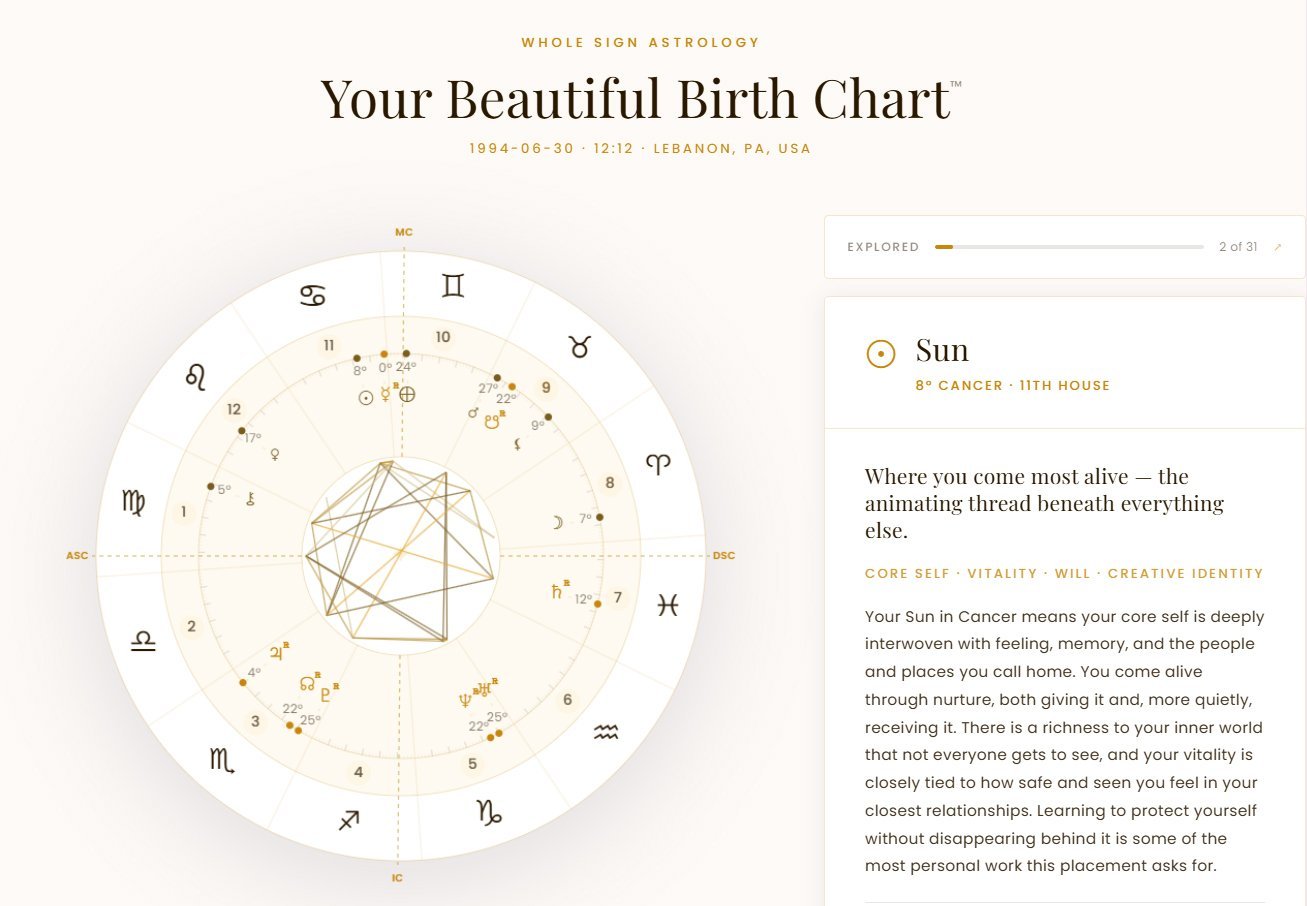
But a birth chart holds far more than a sun sign. The moon, the rising sign, Mercury, Venus, Mars, and every other point in the sky at the moment of birth all land in a specific sign and house, and all of them shape a person’s personality, timing, and patterns. Your Big 3, meaning your sun, moon, and rising signs together, already produce a far more accurate picture than the sun sign on its own. Add houses, aspects, and rulerships, and you get a chart with a genuinely unique fingerprint, even for people born on the same day. If you want to see this in your own chart, you can pull your free birth chart and look at everything sitting alongside your sun.
So when someone asks whether zodiac signs are accurate, the honest answer is that a single sign was never built to carry that level of accuracy alone. It’s one instrument in a full orchestra. Judging astrology by a sun sign column is like judging an orchestra by listening to one violin play for three seconds.
Why Instagram and TikTok Astrology Leans on Stereotypes
Short-form platforms did something valuable for astrology: they took a subject that used to live in expensive one-on-one readings and dense textbooks and put it in front of millions of people for free. That’s worth acknowledging, and it’s part of why so many readers who now want a full chart reading found their way in through a fifteen-second video about Mercury retrograde.
But the format has a hard ceiling. A Reel runs fifteen to sixty seconds. A caption gets skimmed in half a second. An algorithm rewards whatever gets the fastest reaction, and the fastest reaction comes from broad, punchy, instantly recognizable statements: Scorpios are secretive, Geminis are two-faced, Virgos are uptight. None of that is a full birth chart. It’s a caricature built to travel fast, and it travels fast precisely because it’s simple enough for a stranger to recognize themselves, or their ex, in under a second.
The people making that content aren’t doing anything wrong. The format simply can’t fit a birth chart, with its dozen planets, twelve houses, and web of aspects, into a caption limit. Something has to get cut, and the sun sign is the easiest, most recognizable piece to keep.
The Problem With Zodiac Astrology on Social Media
The cost shows up in three predictable ways.
The first is mistaken identity. Someone reads a sun sign description that doesn’t fit, decides astrology is nonsense, and never learns that their moon or rising sign was likely explaining the mismatch the whole time.
The second is the stereotype hardening into a personality cage. Scorpio gets flattened into secretive and vindictive, when Scorpio in a chart is really about depth, intensity, and emotional honesty, expressed completely differently depending on the rest of the placements around it. Leo gets flattened into attention-seeking, when the same energy in a different chart shows up as generosity, warmth, and creative confidence. Gemini gets flattened into two-faced, when the same placement is often just genuine curiosity and the ability to hold more than one idea at once. A stereotype takes one possible expression of a sign and presents it as the only one.
The third is fear. A retrograde becomes a warning instead of a review period. A Saturn return becomes a countdown to disaster instead of a maturity marker every adult moves through. Content built for reaction spreads the version of astrology that scares people fastest, even when it strays furthest from what a chart shows.
This is simply what happens when a symbolic language built for depth gets compressed into a format built for speed.
Where to Go From Here
The fifteen-second version works as a doorway, and doorways are useful. The mistake is stopping there and assuming the doorway is the whole house.
If a stereotype has ever made you feel boxed in, or a horoscope has ever felt like it was talking about someone else entirely, that’s worth taking seriously as information instead of treating it as proof astrology doesn’t work. Your Beautiful Birth Chart shows your placements by sign and house, so you can see your sun sign next to your moon, your rising, and everything else that was happening in the sky the moment you were born. That’s where the caricature ends and the chart underneath it begins.
Zodiac Sign Accuracy FAQs
Are zodiac signs accurate?
Sun signs describe one placement in a much larger chart, so they’re accurate as far as they go, but incomplete on their own. A full birth chart, including the moon, rising sign, and every other placement, gives a far more complete picture of a person than a sun sign alone.
Why doesn’t my zodiac sign describe me?
Usually because your moon sign, rising sign, or another concentration of placements in your chart expresses more strongly in daily life than your sun sign does. Pull your free birth chart to see the full picture behind the mismatch.
Is TikTok and Instagram astrology accurate?
Some of it is genuinely well researched, and some of it is oversimplified for engagement. The format itself, short captions and fast video, makes it hard to hold the nuance a birth chart contains, regardless of the creator’s skill. Treat social content as an entry point instead of the finished picture.
Why do zodiac sign stereotypes feel true sometimes?
Stereotypes usually start from something real. A Scorpio placement is genuinely connected to depth and intensity, for instance. The distortion happens when that one trait gets presented as the entire personality instead of one thread in a much larger chart.
Is astrology just horoscopes?
Horoscopes based on the sun sign alone are one small application of astrology. The wider practice includes the full birth chart, transits, synastry between two charts, and more, all built from the exact date, time, and place someone was born.
What’s the difference between pop astrology and a birth chart reading?
Pop astrology generalizes to twelve groups based on sun sign. A birth chart reading is calculated from the exact time and place of birth and accounts for the moon, rising sign, houses, and aspects unique to that person, producing a picture specific to one individual instead of one twelfth of the population.