
Birth Chart Interpretation Made Simple
Birth chart interpretation is the practice of reading your planets, signs, houses, aspects, and transits together to understand how your energy moves, instead of pulling one placement out and treating it like the whole story. Most people never get taught how to do this. They get handed a Sun sign description, maybe a Moon sign if they’re lucky, and are left to guess at everything else. That’s not interpretation. That’s a fragment.
This isn’t another post explaining what a planet, sign, or house is. If you need that groundwork first, how to read your astrology chart for beginners covers the structure of the wheel and what each piece means. The learn astrology hub will visually teach you the lay of the land. This post picks up from there: it’s the method for combining those pieces into one coherent read, plus a full worked example so you can see the process in action instead of just hearing it described. If you’re already feeling overwhelmed, Your Beautiful Birth Chart will make this so easy and do the interpreting for you.
If you want to follow along on your own chart, pull up your free birth chart before you keep reading.
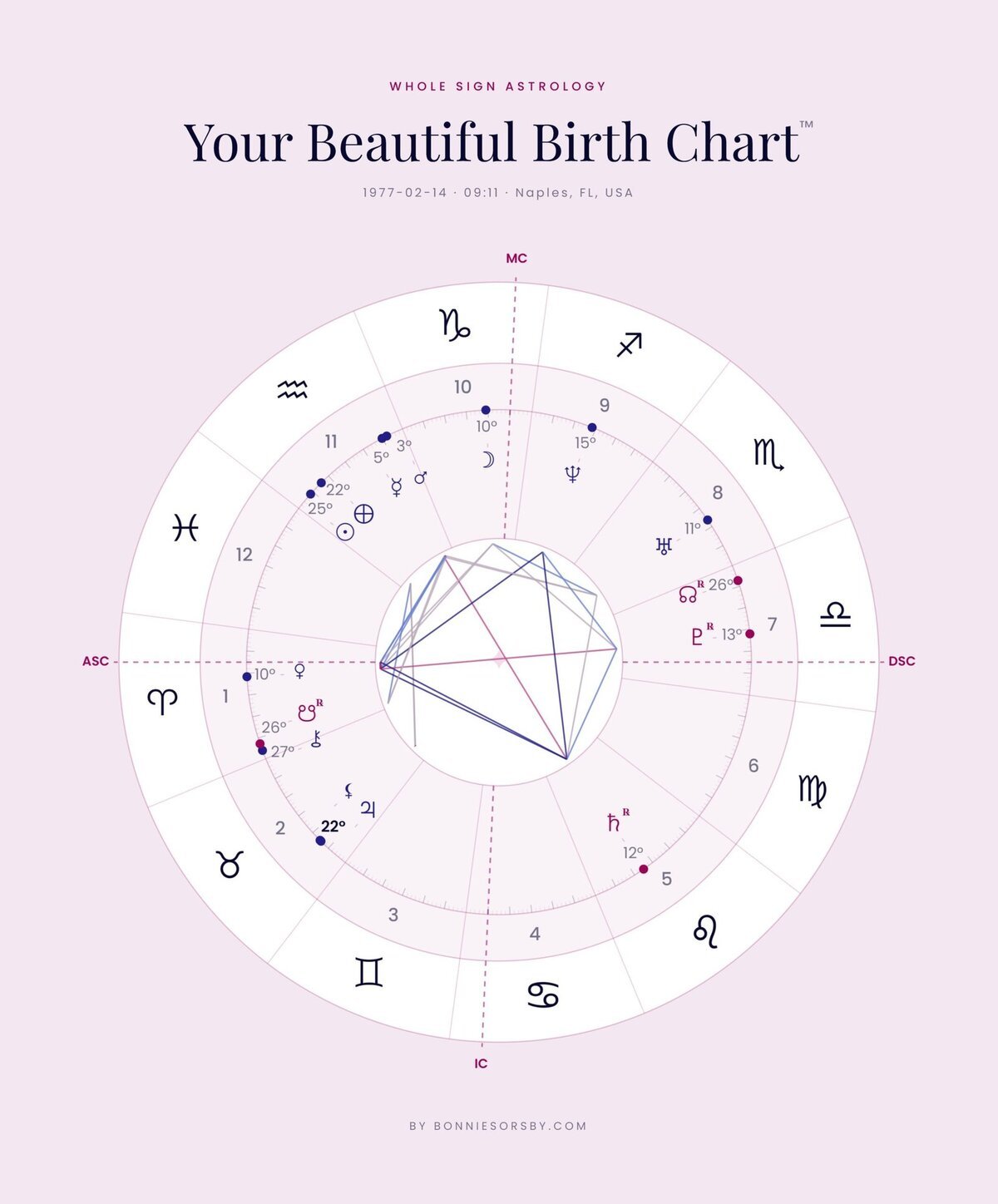
Why Birth Chart Interpretation Feels Harder Than It Should
The most common mistake in astrology is reading one placement at a time and treating it as a complete answer. Someone learns what Venus in Scorpio means on its own, and stops there, disconnected from everything else in the chart. But no placement lives alone. Your Venus is in a sign, and it’s also in a house, and it’s also making aspects to other planets, and it’s also getting activated by whatever is transiting right now. Strip away any one of those layers and you’re not interpreting a chart. You’re reading a keyword.
I go deeper into why this happens in why your birth chart feels confusing. This post is the practical follow-up: the actual layering process, demonstrated on a real example, so the method is something you can repeat on your own chart instead of just understand in theory.
The Interpretation Method, In Brief
Every placement answers three questions at once: what (the planet), how (the sign), and where (the house). Aspects add a fourth layer, how placements interact with each other. Transits add a fifth, what’s currently activating all of it.
This site works in whole sign houses, which means your rising sign sets the entire structure of your chart and determines which house every planet falls into. A lot of beginner astrology content tells you to read for your Sun, Moon, and rising sign as if they’re interchangeable lenses for the same information. They’re not. Your rising sign is the only correct lens for house placement. Reading your houses from your Sun sign instead will give you a chart that isn’t yours. Your Beautiful Birth Chart has your rising sign built into every house read, so it’s already anchored correctly. If you’d rather find and learn your rising sign yourself first, the rising sign guide walks through what each one means and how to find it.
That’s the framework. Here’s what it looks like applied to an actual placement.
A Worked Example: Interpreting One Placement Start to Finish
Let’s say your chart has Mars in Scorpio in the 8th house, square your natal Saturn, and Pluto is currently transiting that same 8th house.
Start with the planet and sign. Mars is drive, assertion, and how you go after what you want. In Scorpio, that drive doesn’t announce itself. It’s intense, strategic, and slow to reveal its full hand. This Mars doesn’t chase in the open. It waits, calculates, and moves when it’s sure.
Add the house. The 8th house governs shared resources, intimacy, transformation, and what gets hidden or held back. Mars here means that intensity and drive get channeled into deep, often private territory: money you don’t discuss openly, relationships that go past the surface fast, or a pull toward whatever is taboo, complex, or emotionally loaded.
Layer in the aspect. A square between Mars and Saturn adds friction. Saturn restricts, structures, and demands patience. Mars wants to act. Squared to Saturn, this Mars often feels blocked, like the drive is real but something (an internal rule, a fear of losing control, a history of being told to hold back) keeps stalling the follow-through. That tension marks the exact place where discipline and desire are negotiating with each other.
Read the transit. Pluto transiting the 8th house intensifies whatever already lives there. For this person, that means the Mars-Saturn tension around intimacy, shared resources, or control gets pushed to the surface during this transit. Old patterns around withholding, power, or trust are likely to demand attention now.
Put it together. The generic keyword was “Mars in Scorpio means intensity.” The interpretation is a specific person whose drive runs deep and private, gets structurally blocked by an internal need for control, and is currently being pressured by Pluto to face that block directly. That’s what interpretation produces: a read that’s specific to one chart, built from five layers instead of one.
This is the process Your Beautiful Birth Chart walks you through on your own placements: sign, house, aspects, and transits with forward and backward date navigation, so you can run this same layering on every planet in your chart instead of doing it manually one placement at a time.
Common Birth Chart Interpretation Mistakes
Reading the Big Three and stopping there. Sun, Moon, and rising give you a foundation. A chart has ten planets, twelve houses, and a full network of aspects. Stopping at three placements is like reading the first paragraph of a book and assuming you know the plot.
Using your Sun sign to read your houses. Only your rising sign determines house placement in whole sign houses. Skip this step and every house-based read you do afterward will be wrong.
Treating a transit as fate. A transit describes what’s being activated. The same Saturn transit lands differently depending on what it’s aspecting natally and how someone chooses to work with the pressure.
Skipping aspects entirely. A placement without its aspects is half the story. If you’ve only looked up sign and house meanings, you’re missing the layer that usually explains why two people with a similar chart live very different lives.
Trying to memorize meanings instead of learning the method. You don’t need to memorize what every planet in every sign in every house means. You need a repeatable process for figuring it out. That’s the difference between interpretation and recitation.
Putting It Together
Interpretation is a process you run on one placement at a time until the whole chart starts talking to itself. Sign, house, aspect, transit, in that order, on every planet you want to understand.
Your Beautiful Birth Chart was built to walk you through that exact process on your own chart: every placement by sign and house, every aspect, and every transit with date navigation, so you’re learning to interpret instead of just staring at a wheel.
If you’d rather have someone else do the synthesis for you, that’s a different tool for a different reader state. Your Personal Pattern reads your chart as a connected system and hands you the pattern already assembled, for when you want the insight without doing the layering work yourself.
FAQ
What does it mean to interpret a birth chart?
Interpreting a birth chart means reading your planets, signs, houses, aspects, and transits together to understand how your energy moves. Looking up the meaning of one placement on its own isn’t interpretation. A full interpretation considers what a placement is (the planet), how it expresses (the sign), where it shows up in your life (the house), how it interacts with other placements (aspects), and what’s currently activating it (transits).
How is this different from just learning what each planet means?
Learning what each planet, sign, and house means is the vocabulary. Interpretation is the grammar, how those pieces combine into a specific sentence about one specific chart. You can know every definition and still not know how to interpret, the same way knowing every word in a language doesn’t mean you can speak it fluently.
Why do I need my rising sign to interpret my houses correctly?
In whole sign houses, your rising sign sets the entire structure of your chart. It determines which sign rules each house, which in turn determines where every planet falls. Using your Sun sign or any other placement to read your houses will give you an inaccurate chart, since only the rising sign anchors the house system.
Do I need to interpret aspects, or can I just look at sign and house?
You can get a partial read from sign and house alone, but aspects are often where a chart’s real story shows up. Two people can share a Moon sign and have completely different emotional experiences because one has a hard aspect to that Moon and the other doesn’t. Skipping aspects means missing the layer that usually explains the difference.
How is interpreting a transit different from interpreting a natal placement?
A natal placement is fixed at birth. A transit is the current position of a moving planet forming a new angle to that fixed placement. Interpreting a transit means identifying which house it’s moving through and which natal placements it’s aspecting, then reading that activation against the birth chart that’s already there.
What’s the fastest way to start interpreting my own chart?
Start with your rising sign, since it anchors your entire house system. From there, work planet by planet: note the sign, note the house, check the aspects, and check what’s currently transiting it. Your Beautiful Birth Chart walks through this placement by placement, including aspects and transits, so you’re learning the method on your actual chart instead of a generic example.