
Whole Sign Houses Explained: The Oldest House System
Whole sign houses are a system of dividing the birth chart into twelve houses where each house corresponds to exactly one zodiac sign, beginning with the rising sign as the first house. There is no math involved beyond counting signs forward from the Ascendant. Whatever sign rises at the moment of birth becomes the entire first house, all thirty degrees of it, and every sign after that becomes the next house in order around the wheel.
If you have spent any time comparing your chart across different astrology apps and noticed a planet living in a different house depending on which one you used, whole sign houses are usually the reason. It is one of the more disorienting moments in learning astrology, watching a placement you thought you understood suddenly belong to a different area of life. Understanding whole sign houses clears that confusion up quickly, and for many people, it becomes the framework that finally makes the chart feel like a coherent story instead of a scattered list of parts.
Whole Sign Houses in Astrology
Every birth chart divides the sky into twelve houses, and each house governs a different area of lived experience: identity, resources, communication, home, creativity, work, partnership, and so on. Planets describe what is happening. Signs describe how it happens. Houses describe where it plays out. The house system is simply the method used to draw those twelve divisions.
In whole sign houses, that division follows the signs themselves, with no calculation involving time or latitude required. The Ascendant, the exact degree rising at birth, still matters as a sensitive point in the chart. It just does not function as a house cusp the way it does in other systems. Instead, the entire sign containing the Ascendant becomes the first house. If your Ascendant falls anywhere in Scorpio, Scorpio governs your whole first house, Sagittarius becomes your second, Capricorn your third, and the pattern continues around the chart in order.
This produces a house system with a clean and unmistakable structure. Every house is exactly thirty degrees. No sign is split between two houses, and no house contains parts of two different signs. Each area of life gets one clear ruling sign, which makes the chart read as a unified system built from twelve equal, cleanly defined zones.
Learn more about what each house governs in the Learn Astrology hub.
You may also enjoy this post: What is Astrology, really?
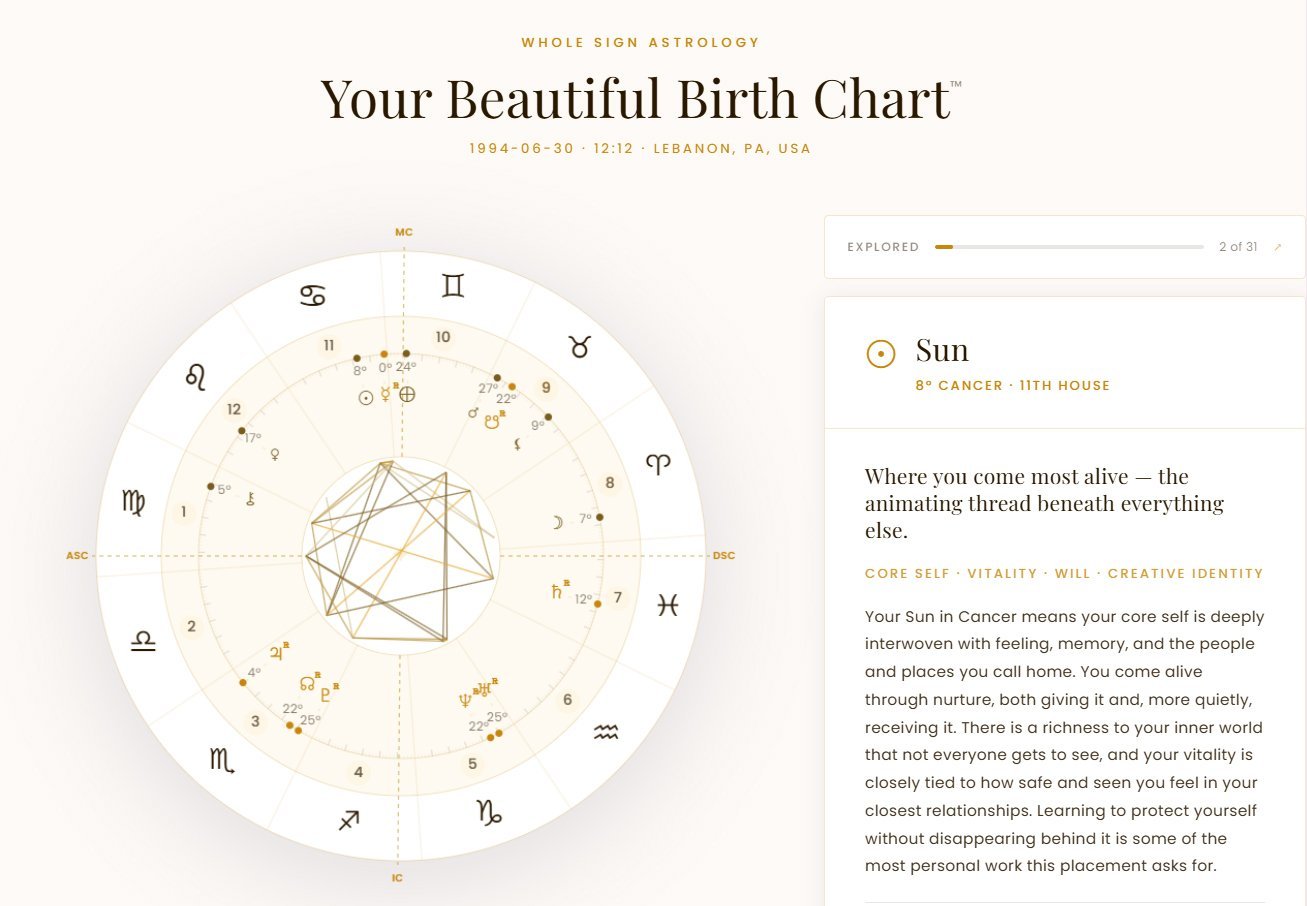
Where Whole Sign Houses Come From
Whole sign houses are the oldest known house system in the Western astrological tradition, developed in Hellenistic Greece and used by the earliest chart astrologers on record. For centuries, this was simply how a chart was built. Later systems, including Placidus and other time based methods, developed much more recently as astrologers began experimenting with mathematically dividing the sky using birth time and latitude.
Whole sign houses fell out of common use for a long stretch of the twentieth century, when Placidus became the default in most published astrology books and, eventually, most software. Over the past few decades, whole sign houses have seen a significant revival, largely through the return to traditional and Hellenistic techniques. A growing number of contemporary astrologers, myself included, have come back to whole sign houses because of what the structure reveals about long term patterns, planetary rulership, and how consistently a theme shows up across a person’s life.
Why the Structure Matters
The value of whole sign houses is not that they are simpler. It is that they are structurally coherent. Because each house holds exactly one sign, the ruler of that house is immediately clear. If Scorpio governs your first house, Mars and Pluto are your first house rulers, full stop. There is no ambiguity about which planet is doing the ruling, which matters enormously when tracking rulership chains, life themes, or how one house connects to another through its ruling planet.
This clarity extends to timing techniques as well. Traditional methods like annual profections, a technique that activates a different house each year of life in sequence, depend on clean, evenly divided houses to function the way they were designed to. Whole sign houses were the framework these techniques were built inside of, so using them together often produces the coherent, repeatable results traditional astrologers describe.
There is also something to the felt experience of reading a whole sign chart. Because the houses map directly onto the signs, the chart reads more like a story that moves in order from one house to the next, each one picking up where the last left off. Many people describe placements suddenly making more practical, embodied sense once they view them through whole sign houses, especially around long running themes in career, home, or relationships that never quite tracked cleanly under a different system.
You might enjoy this post on How to Read Your Astrology Chart for Beginners if you’re new to astrology.
What Whole Sign Houses Are Not
Whole sign houses are not a simplified version of a more advanced system, and using them is not a sign of being new to astrology. They are a complete, historically grounded method with their own internal logic, used by traditional and Hellenistic astrologers for the entirety of Western astrology’s early history and by a large and growing number of practicing astrologers today.
They are also not the only valid way to build a chart. Other house systems, particularly time based systems like Placidus, highlight different layers of the same chart and can bring their own kind of nuance, especially around subtle internal timing. Depth in astrology comes from interpretation and lived experience. I go into that comparison in more detail in my post on whole sign versus Placidus houses, if you want to see the two systems set directly against each other.
Whole Sign Houses and the Tropical Zodiac
Whole sign houses answer the question of how the chart gets divided into twelve areas of life. That is a separate question from which zodiac the chart uses in the first place, tropical or sidereal. Most Western astrologers, including anyone using whole sign houses within the Western tradition, work from the tropical zodiac, the earth centered system anchored to the solstices and equinoxes instead of the current position of the constellations. Whole sign houses and the tropical zodiac are two separate architectural choices that happen to pair naturally, and understanding both gives you a much fuller picture of what is shaping your chart before a single planet or sign even enters the conversation.
How to Read a Chart Through Whole Sign Houses
Reading a whole sign chart starts with identifying your rising sign, since that sign becomes your first house and sets the order for everything after it. From there, each house follows the natural order of the zodiac starting from your Ascendant sign, regardless of where that sign falls relative to Aries. Someone with Cancer rising has Cancer as their first house, Leo as their second, Virgo as their third, and so on, the same sequence every chart follows, just starting from a different point in the wheel.
Once the twelve houses are mapped to their signs, you place each planet according to the sign it occupies. A planet in Virgo automatically belongs to whichever house Virgo governs in that particular chart. This is different from other systems, where a planet’s house placement depends on its exact degree relative to a mathematically calculated cusp. In whole sign houses, the sign is the house, which is precisely what makes the system so consistent to work with over time.
If you want to see this mapped onto your own placements instead of working through it in the abstract, pull up your free birth chart and look at how your houses line up sign by sign. Seeing your own Ascendant sign anchor the whole structure often makes the logic click far faster than reading about it in the abstract ever could.
Everything above describes how whole sign houses work as a system. What it reveals inside your own chart is a different matter entirely, and that is where the framework earns its keep. Your Beautiful Birth Chart maps your placements by sign and house using this same whole sign structure, so you can see exactly which sign governs each house in your chart, check your aspects, and move through past or future transits with forward and backward date navigation. If this post gave you the general logic, Your Beautiful Birth Chart is where you find out what it looks like for you.
Frequently Asked Questions
Are whole sign houses more accurate than Placidus?
Neither system is more accurate than the other. They answer different questions using different logic, one based on sign division and one based on time and latitude. Whole sign houses often produce more consistent results for traditional timing techniques and rulership tracking, while Placidus can highlight different nuances for people who resonate with a more time sensitive framework.
Do whole sign houses work for people born at extreme latitudes?
Yes. Because whole sign houses are based entirely on sign division instead of the diurnal arc, they calculate cleanly regardless of birth latitude. This is one of the practical advantages of the system, since time based house systems can produce distorted or even incalculable houses for births far from the equator.
Why does my chart look different on different astrology websites?
This almost always comes down to the default house system each site uses. Many popular chart calculators default to Placidus, so if you generate your chart on a site using whole sign houses instead, some planets will likely land in different houses than you are used to seeing. The planet itself has not moved. Only the framework dividing the sky has changed.
Can I use whole sign houses even if I do not know my exact birth time?
You need an accurate birth time to know which sign is rising, since that sign anchors your entire whole sign house structure. Without a birth time, you can still read your Sun, Moon, and planetary signs, but house placements will not be reliable in any house system, including whole sign.
Is whole sign considered a traditional or a modern approach?
Whole sign houses originated in Hellenistic astrology, making them one of the oldest components of the traditional toolkit. Many modern astrologers, including those who otherwise work with a more contemporary, psychologically oriented approach, have adopted whole sign houses specifically because of the structural clarity they bring, regardless of which broader philosophy they practice under.
Does Bonnie Sorsby use whole sign houses?
Yes. Whole sign houses are the framework I work from in all of my readings, tools, and writing, including Your Beautiful Birth Chart. You can read more about my practice on my about my approach page.