
Evolutionary Astrology Explained: What Your Birth Chart Is Building Toward
Evolutionary astrology is the practice of reading a birth chart as a map of the soul’s growth, using placements like Pluto, the lunar nodes, Saturn, and Chiron to trace the direction a person is developing toward across this lifetime.
There’s a particular kind of momentum that shows up once you stop asking what a placement means and start asking what it’s building toward. A wound stops being just a wound. A hard placement stops being just a hard placement. Evolutionary astrology exists to name that momentum, the sense that the chart describes where you’re headed as much as who you are.
Every placement in this framework carries a direction. Not a fixed destination, and not a guarantee, but a pull. The parts of your chart that feel most demanding are often the parts doing the most work, asking you to develop a capacity you didn’t walk in already having. If you’re newer to reading your chart, the learn astrology hub is a good place to orient first.
What Is Evolutionary Astrology?
Evolutionary astrology treats the chart as a snapshot of a soul mid-development. The placements aren’t just traits to identify, they’re evidence of a trajectory already in motion, one that started before this lifetime and continues through it.
This approach grew largely out of the work of astrologer Jeffrey Wolf Green in the late twentieth century, who built a system centered on Pluto as the soul’s evolutionary engine. Since then, the framework has expanded well beyond Pluto alone, but the core premise stayed the same: growth is the organizing principle, and the chart shows you both the terrain you already know and the terrain you’re being asked to develop next.
Where a more descriptive style of astrology might stop at naming a placement’s qualities, evolutionary astrology pushes further and asks what that placement is for. What is it building? What capacity is it trying to develop in you? That question is what makes this framework distinct, and it’s the lens I work from across all chart work.
Pluto in Evolutionary Astrology: The Soul’s Engine of Transformation
Pluto holds a central role in this framework, more than almost any other point in the chart. Its house and sign placement describe the deepest layer of transformation a person is working through, the place where old identity has to break down before something more authentic can take its place.
Pluto’s house shows where this transformation plays out most intensely: career, relationships, home, self-image, wherever that house lives. Pluto’s sign flavors how the transformation unfolds, through intensity, through control and its release, through whatever that sign’s core themes happen to be.
What makes Pluto evolutionary is the scale of it. A Pluto placement rarely asks for a small adjustment. It usually asks for something closer to death and rebirth, an old version of self dissolving so a truer one can emerge. That process repeats across a lifetime, deepening each time a new layer surfaces. If you want to track where Pluto is moving in the current sky and when it will activate your natal chart, the transit calendar is a useful reference.
This transformation conversation is also deeply tied to the larger collective cycle we’re moving through. The shift of Pluto into Aquarius marks a generational reorientation of power, authority, and what it means to be an individual within a structure. I’ve been writing about this for years as part of the Sleeping Phoenix era, a framework for understanding what this particular threshold in history is asking of us.
The Lunar Nodes in Evolutionary Astrology: South Node Past, North Node Future
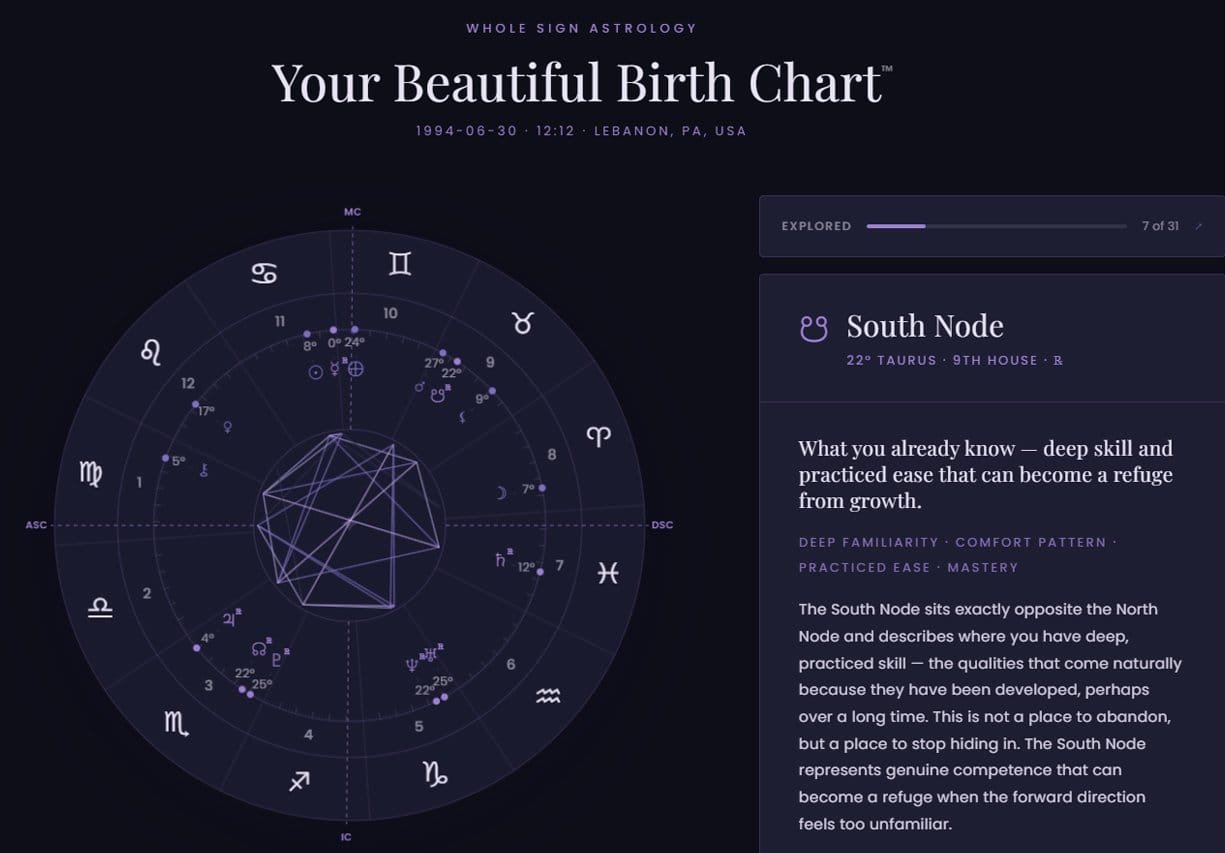
The lunar nodes show up in both karmic and evolutionary astrology, and for good reason: they’re the clearest storyline the chart offers for where someone has been and where they’re headed. If you want the fuller picture of how the nodes function as a record of the past, Karmic Astrology Explained covers that side of the axis in depth.
In evolutionary terms, the emphasis shifts forward. The South Node still represents the mastered terrain, the identity already built and comfortable. Evolutionary astrology gives more weight to the North Node, the specific developmental task this lifetime is organized around. It functions as a direction to keep moving toward, since the growth it describes doesn’t finish, it deepens. The North Node by Sign guide walks through what that growth edge looks like for each placement.
One thing worth understanding about the nodes: they describe a polarity, and growth on the North Node axis almost always involves tolerating the discomfort of leaving behind something that used to work. The South Node skills are real. They’re just no longer the growing edge.
Saturn in Evolutionary Astrology: Building the Capacity for Lasting Growth
Saturn plays a different evolutionary role than Pluto. Pluto describes transformation. Saturn describes the discipline required to hold what’s being transformed into. It’s the planet of structure, and in evolutionary terms, structure is what growth needs in order to last.
A hard Saturn placement often describes an area of life where a person has to build real competence slowly, without shortcuts, because the evolutionary task tied to that house or sign requires a level of maturity that can’t be rushed. This is why Saturn transits so often coincide with periods that feel restrictive or heavy. The restriction is the mechanism. It’s how the capacity gets built.
Over time, the areas governed by a difficult natal Saturn frequently become the areas of greatest mastery, precisely because they demanded the most deliberate development. If you want to see when Saturn is activating key points in your chart, the transit calendar tracks its movements. You can also pull up your natal Saturn’s house and sign using the free birth chart if you don’t have that in front of you.
Chiron in Evolutionary Astrology: The Wound That Becomes the Work
Chiron’s placement in evolutionary astrology describes the specific wound a person’s growth is organized around, and more importantly, what that wound eventually makes them capable of offering others. The wound comes first developmentally, but it isn’t the endpoint. The movement through the wound and out the other side into something useful is the whole point of a Chiron placement.
This treats Chiron as a training ground, the place where a person develops exactly the kind of understanding that can’t be taught, only lived through. A Chiron in the 7th house develops insight into relationships through relational difficulty. A Chiron in the 10th develops authority through the experience of being undermined or unseen. The specificity of the wound is precisely what makes the eventual capacity so particular.
Evolutionary Astrology vs. Karmic Astrology: Key Differences and How They Work Together
These two approaches overlap enough that people often use the terms interchangeably, but the emphasis is genuinely different. Karmic astrology is oriented toward identifying the pattern itself: what’s been carried forward and where it shows up in a chart. Evolutionary astrology takes that same pattern and asks what direction it’s pointing a person toward next.
In practice, most real chart work draws on both. Understanding where someone is growing starts with understanding where they’ve been, and a karmic pattern eventually asks what it’s for. If you haven’t read the companion piece yet, Karmic Astrology Explained walks through the pattern side of this in full. The two posts are designed to be read together, and most readers find the evolutionary picture makes more sense after they’ve sat with the karmic one.
How to Use Evolutionary Astrology in Real Time
Here’s the part worth sitting with. Evolutionary astrology can become another place to intellectualize, another framework to explain yourself with instead of living the growth it describes. The chart can show you that Pluto is transforming your relationship to power, or that Saturn is building your capacity for real commitment, but none of that changes anything by itself.
The growth happens in actual choices made on an actual Tuesday. This is the shift Observational Astrology and the Art of Pattern Recognition gets at as well: moving from asking what a placement means to noticing why it keeps creating the same experience in real time. Evolutionary astrology gives you the map. What you do with a Tuesday is still up to you.
You can start building that observational practice with the daily astrology feed, which tracks current sky conditions so you can start noticing the connections between what’s moving overhead and what’s showing up in your actual life.
The dynamics that are transforming, the capacities being built, the wound doing its slow work: that’s the living system Your Personal Pattern is designed to reflect back to you. The actual wiring underneath. [Your Personal Pattern →]
Frequently Asked Questions About Evolutionary Astrology
Is evolutionary astrology the same as karmic astrology?
They’re closely related but the emphasis differs. Karmic astrology focuses on identifying the pattern carried forward from the past. Evolutionary astrology takes that pattern and asks what direction it’s pointing toward next. Most chart readings draw on both, and Karmic Astrology Explained is a useful companion read to this post.
Do I need Pluto’s exact degree for an evolutionary reading?
Pluto moves slowly, so its sign is easy to determine even without an exact birth time. Its house placement is more precise and benefits from an accurate birth time, since that’s where the transformation plays out most specifically. You can pull up Pluto’s position in your chart using the free birth chart.
Why does evolutionary astrology focus so much on difficult placements?
Because difficulty marks where the most development is needed. Easy placements describe existing strengths. Challenging ones describe capacities still being built, which is why they carry so much of the evolutionary weight in a chart. The hardest placements are doing the most active work.
Can evolutionary astrology predict what will happen in my life?
Only loosely. It describes a direction of growth and the terrain that direction runs through, without guaranteeing a fixed outcome. What a person does with that direction shapes how it unfolds. For timing, the transit calendar can help you track when key planets are activating your natal chart.
How is evolutionary astrology different from traditional astrology?
Traditional astrology focuses on structure, timing, and observable outcomes. Evolutionary astrology layers a developmental lens on top of that structure, asking what a placement is helping a person grow into. For an overview of how I blend multiple approaches in my work, About My Approach lays that out directly.
What’s the best way to start with evolutionary astrology if I’m new to it?
Start with your chart in hand. Pull up your free birth chart, locate Pluto by house and sign, find your North Node, and read about those two placements first. Then read the North Node by Sign guide to understand the developmental direction your chart is pointing toward. The learn astrology hub is also a good foundation if you’re building vocabulary from scratch.
If this brought up a familiar loop, the same fear surfacing in different relationships, the same self-protective move that no longer quite fits, the same pattern that a transit seems to keep activating, the transit may be temporary, but the wiring underneath it has been there for a long time. Your Personal Pattern maps that connected system: the chart dynamics behind the way your energy has always moved, so you can see the pattern instead of only reacting to it.