
Saturn in Astrology: Archetype, Signs, Houses & Returns
Saturn in astrology is the planet of structure, time, discipline, and earned authority. It rules the capacity to build something real, the kind of thing that lasts because it was constructed slowly and on solid ground. Where Jupiter expands and invites, Saturn contracts and requires. Where Venus softens, Saturn clarifies. It is the planet that asks whether you are willing to do what a thing takes, and it is the planet that rewards the ones who are.
Saturn moves slowly through the zodiac, spending roughly two and a half years in each sign and taking approximately twenty-nine years to complete a full cycle. That pace is deliberate. Saturn’s lessons are not ones you absorb in a transit weekend and move on from. They accumulate. They build. And the areas of life where Saturn sits in your natal chart become, over time, the areas of greatest competence, precisely because they demanded the most from you.
If you’re newer to reading your chart, the learn astrology hub is a useful place to build vocabulary before going deeper into a placement like this.
Saturn in Astrology: The Archetype and Core Symbolism
The archetypal image of Saturn is time itself. The Romans named the planet after their god of agriculture and harvest, the deity who presided over sowing and reaping, over what grows when tended and withers when neglected. Before Saturn became associated with limitation in the popular imagination, it was associated with productivity, with the patience required to cultivate anything worth having.
The Greek equivalent, Kronos, added the dimension most people carry into their understanding of Saturn now: Kronos, who swallowed his children to prevent them from overtaking him, represents the fear that is embedded in the need for control. He is what happens when the principle of structure calcifies into something that destroys what it was meant to protect. The shadow of Saturn is always rigidity, the inability to allow what has been built to evolve.
Saturn also carries the archetype of the father, and in a birth chart it frequently describes the experience of paternal authority more directly than any other placement. This is the internalized father figure: what was modeled, what was withheld, what was demanded, and what was never offered. A Saturn that was shaped by a father who was absent, cold, critical, or simply overwhelmed by his own unlived Saturn material often leaves a person with a complicated relationship to authority, discipline, and their own sense of worthiness to take up space.
The work Saturn in the chart is pointing toward often tracks back to exactly that early imprint. Where the father was rigid, Saturn in the chart asks for flexibility. Where the father was absent, Saturn asks the person to become their own authority. Where the father was demanding without warmth, Saturn is asking for the development of an internal standard that is rigorous and kind at the same time. The father is the first model of what structure looks and feels like, and Saturn in your chart is where you are in the process of building your own.
At its most functional, Saturn is the energy that gives form to everything else. Dreams without Saturn stay dreams. The Moon gives you the feeling, Mercury gives you the language, Jupiter gives you the vision, and Saturn is what makes any of it real. In a chart that reads as deeply creative or emotionally complex, a well-developed Saturn placement is often what allows those gifts to produce something in the world.
Saturn rules Capricorn, and in traditional astrology, also Aquarius. Its exaltation is in Libra, where the need for structure finds its best expression through fairness, agreement, and balanced commitment. Saturn governs bones, skin, and teeth: the frameworks that hold the body together. Saturday is named after Saturn. In alchemy, its metal is lead, the densest of materials, the one that requires the most heat and time to transform.
The evolutionary astrology framework positions Saturn as the planet that holds what Pluto transforms. Pluto breaks down old identity. Saturn builds the container for what emerges. That combination is worth understanding in your own chart, because the house and sign of your natal Saturn tell you a great deal about what specifically you are here to build the capacity for.
Saturn in the Zodiac Signs: What Your Saturn Sign Reveals
Saturn’s sign describes the tone and quality of the discipline being developed: the flavor of the lesson, the style of the demand. It is a generational placement, shared with everyone born within the same two-and-a-half-year window, so the sign colors the collective experience of that cohort’s relationship to structure and authority. The house is where you’ll find the personal specificity.
Saturn in Aries
Saturn in Aries is developing the capacity to act with sustained discipline, the ability to initiate without burning out before completion. The gift being built here is decisive, self-directed action that doesn’t collapse under its own speed. This placement often experiences early difficulty with impulse and impatience, and gradually learns that real autonomy is earned through follow-through.
Saturn in Taurus
Saturn in Taurus is learning to build material security through consistent effort over time. The resistance here frequently shows up as either excessive caution around resources or difficulty trusting that slow accumulation is working. The mastery that develops is a deep, practical relationship to stability and value.
Saturn in Gemini
Saturn in Gemini is developing rigor in communication and thought. The early experience is often one of feeling misunderstood, of words not landing, of being dismissed as scattered or unserious. Over time, what develops is precision: the ability to communicate complex ideas with clarity and real depth.
Saturn in Cancer
Saturn in Cancer is building emotional structure and the capacity to hold a stable foundation for others. The difficulty here is frequently around early family dynamics, around what home and safety meant and whether they were reliably available. The mastery that emerges is an extraordinary ability to create security for the people in a person’s care.
Saturn in Leo
Saturn in Leo is learning to earn recognition through sustained creative effort. The early feeling is often that self-expression is somehow wrong or unwelcome, that visibility carries risk. The discipline required here is showing up creatively with consistency, and the authority that builds as a result is genuine.
Saturn in Virgo
Saturn in Virgo is developing excellence through meticulous attention and dedicated service. The shadow here is perfectionism that becomes paralysis, the inability to release work that doesn’t meet an impossibly high internal standard. The gift, once discipline is applied well, is an extraordinary capacity for craft and precise, useful contribution.
Saturn in Libra
Saturn in Libra is the exaltation of Saturn, the sign where its structuring principle finds its clearest expression. Here, Saturn is building the capacity for genuine, committed partnership and the ability to create fair agreements that hold over time. The lesson is about interdependence: learning that real structures require two people who are both willing to uphold them.
Saturn in Scorpio
Saturn in Scorpio is developing mastery over power, depth, and transformation. The early experience is often one of encountering intense dynamics around control, shared resources, or emotional intensity without adequate tools to navigate them. What builds over time is an unshakable capacity to go into deep territory and come back with something real.
Saturn in Sagittarius
Saturn in Sagittarius is learning to build genuine wisdom through experience and intellectual rigor. The early difficulty is often around belief, around received worldviews that don’t hold up under scrutiny, or around the gap between an expansive vision and the actual steps required to realize it. The mastery here is a hard-won philosophical authority.
Saturn in Capricorn
Saturn in Capricorn is in domicile, one of its home signs. The discipline and ambition here are in full expression. The capacity being built is public authority and long-term professional achievement, and the standard this placement holds itself to is high. The lesson Saturn in Capricorn is working with is the difference between structure that serves and structure that suppresses.
Saturn in Aquarius
Saturn in Aquarius, also a domicile placement in traditional astrology, is building the capacity for collective responsibility and systemic thinking. The developmental question here is how an individual functions within a larger structure: contributing to it, reforming it, knowing when to work within it and when to step outside. This placement is particularly relevant as we move through the Sleeping Phoenix era and the questions it raises about individual authority within collective systems.
Saturn in Pisces
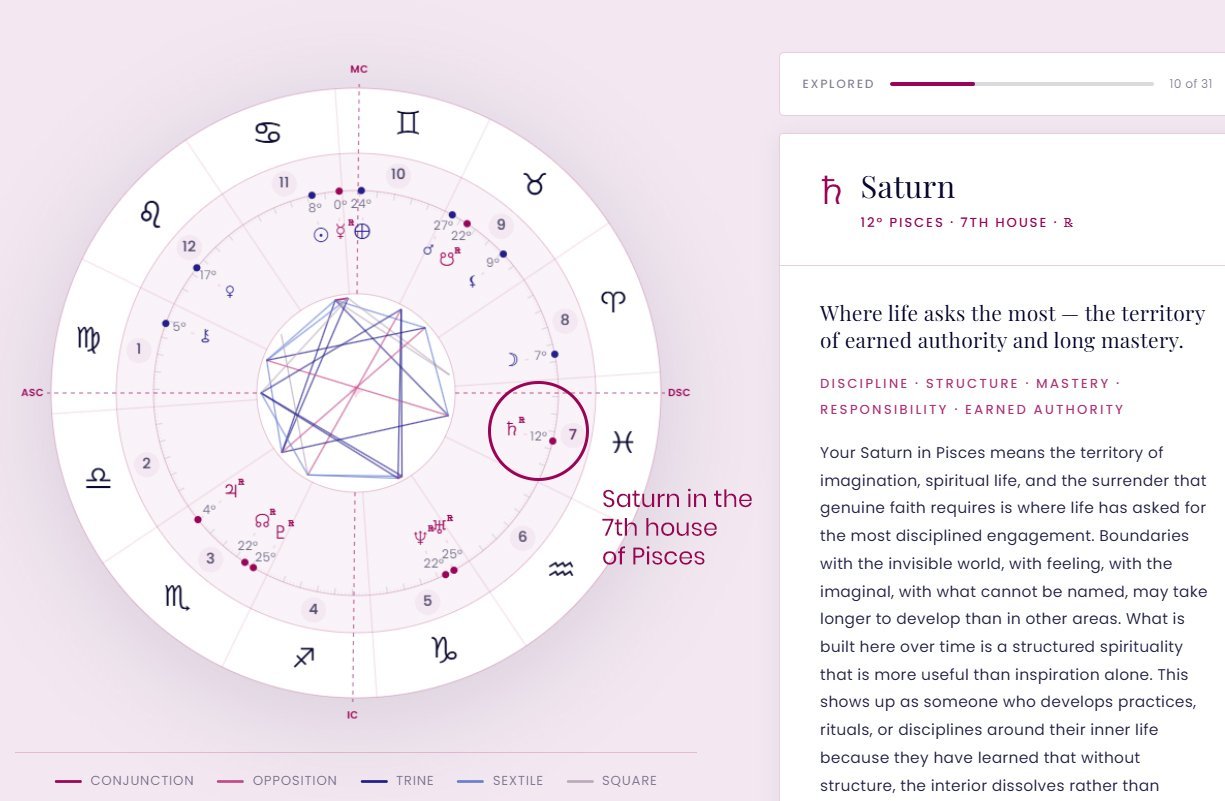
Saturn in Pisces is developing spiritual discipline and the ability to create structure around what is boundless, intuitive, or formless. The early experience is often one of feeling overwhelmed by sensitivity, unclear on where the self ends and the world begins. What builds is the capacity to channel that sensitivity into sustained creative or spiritual practice.
To find your Saturn sign and see how it aspects other placements in your personal chart, Your Beautiful Birth Chart shows your natal placements by sign and house, with aspects and forward and backward date navigation for transits.
Saturn in the Houses: Where Saturn’s Lessons Play Out in Your Life
If the sign tells you the quality of Saturn’s work, the house tells you the arena. This is where the general becomes personal, where a shared generational placement becomes the specific territory of your own life.
Saturn in the 1st House
Saturn in the 1st house is building identity and self-presentation through deliberate effort. This placement is frequently experienced early on as a kind of heaviness in the self, a seriousness or restraint that others notice before the person fully understands it. What develops over time is a commanding, earned presence and the ability to hold authority simply by being in the room.
Saturn in the 2nd House
Saturn in the 2nd house is developing a sustainable, disciplined relationship to resources, income, and self-worth. The early experience is often one of scarcity or instability around money, of having to build material security from very little. The mastery that emerges is a real and lasting relationship to value, both financial and internal.
Saturn in the 3rd House
Saturn in the 3rd house is building rigor in communication, learning, and the relationship to early education and siblings. This placement often experiences difficulty being heard or understood in early environments. The eventual gift is a particular kind of communicative authority, the ability to say precise things that carry real weight.
Saturn in the 4th House
Saturn in the 4th house is developing a stable internal foundation, often in the context of a home environment that demanded early responsibility or carried structural difficulty. This placement frequently builds the most solid internal architecture of any, because it had to construct it deliberately.
Saturn in the 5th House
Saturn in the 5th house is learning to create with sustained discipline and commitment, in play, creativity, children, and the areas of life where joy lives. The early feeling is often that creativity is serious business, that spontaneity is risky. What builds is a creative body of work with genuine endurance.
Saturn in the 6th House
Saturn in the 6th house is developing mastery through daily practice, work, and health. The discipline here is embedded in routine, in the slow accumulation of competence through showing up consistently to unglamorous work. This placement often builds expertise that looks effortless from the outside precisely because it was built through sustained, unglamorous effort.
Saturn in the 7th House
Saturn in the 7th house is developing the capacity for serious, lasting commitment in partnership. The early experience is often one of heavy or demanding relationship dynamics, of partnerships that required more than expected. What builds is a deep understanding of what real commitment requires and the ability to sustain it.
Saturn in the 8th House
Saturn in the 8th house is developing mastery in the territory of shared resources, transformation, power dynamics, and depth. This placement carries significant karmic weight and often involves working through complex inherited material, whether financial, psychological, or familial. The authority that builds here is hard-won and profound.
Saturn in the 9th House
Saturn in the 9th house is building genuine wisdom through experience, study, and the slow development of a personal philosophy that can hold weight. The early relationship to belief, religion, or higher education is often rigid or restricting. What develops is a philosophical framework built from real inquiry.
Saturn in the 10th House
Saturn in the 10th house is one of the most publicly significant placements in a chart. This is Saturn near the top of the wheel, in the house of career, reputation, and public authority. The building happening here is a life’s work, and it is designed to take exactly as long as it takes. The authority this placement earns is lasting.
Saturn in the 11th House
Saturn in the 11th house is developing the capacity for meaningful community connection and collective contribution. The early experience of belonging is often difficult or conditional, the sense that fitting in requires something. What builds is a real understanding of what community is and the ability to contribute to it in a way that lasts.
Saturn in the 12th House
Saturn in the 12th house is working through hidden limitation, spiritual discipline, and the slow release of structures that were built in isolation or fear. This is one of Saturn’s most complex placements, because the work here happens in the background, in solitude, in the parts of life that are least visible. The mastery that develops is a profound inner authority.
The repeating patterns in your Saturn house, the same themes surfacing in different forms across years and relationships and circumstances, are the living evidence of what your chart is building. Your Personal Pattern maps those dynamics as a connected system so you can understand the wiring underneath the repetition.
Saturn Return in Astrology: The Initiation at 29 and 58
A Saturn return occurs when transiting Saturn completes its full cycle and returns to the exact degree it occupied at the moment of your birth. The first happens around age twenty-nine, and the second around fifty-eight. These are the two great initiations of adult life, the points where Saturn demands a reckoning with everything built, avoided, or left unfinished in the preceding cycle.
The first Saturn return is frequently experienced as the collapse of structures that were inherited, assumed, or constructed without genuine self-knowledge: the career that was chosen for the wrong reasons, the relationship that fit a younger version of the self, the identity that was assembled to satisfy external expectations. What falls away at the first Saturn return is what was never truly yours.
The second Saturn return is more interior. By fifty-eight, the outer scaffolding of a life is largely in place. The work here is about integrity in the deepest sense: bringing what is built into alignment with what is most true, releasing what was held for appearance’s sake, and stepping into the final third of life with something real.
If you want to know when your Saturn return begins and ends, the Saturn Return Calculator gives you the exact dates. And if Saturn is currently conjunct your natal Sun, that combination carries its own particular weight: Saturn conjunct Sun walks through what that transit is asking of you.
For a broader view of what’s moving in the current sky, the transit calendar tracks upcoming planetary movements so you can see when Saturn will activate other key points in your chart. The daily astrology feed is also useful for building the observational practice of noticing how Saturn transits feel in real time.
Frequently Asked Questions About Saturn in Astrology
What does Saturn represent in a birth chart?
Saturn represents the principle of structure, discipline, time, and earned authority. Its placement in a birth chart describes the area of life where a person is developing real mastery over the course of a lifetime, the house showing where that development plays out and the sign showing the quality and flavor of the work being asked for.
Is Saturn a malefic planet in astrology?
In traditional astrology, Saturn is classified as the greater malefic, meaning its influence is associated with difficulty, delay, and restriction. In practice, what this describes is the genuine challenge of Saturn’s work. The difficulty is functional: it’s the mechanism through which the capacity gets built. A strong Saturn placement is typically a mark of real depth and lasting authority in a chart.
What is a Saturn return and when does it happen?
A Saturn return is the transit that occurs when Saturn completes its full orbit and returns to its natal position. The first happens between approximately twenty-eight and thirty years old, the second between fifty-seven and sixty. Both are threshold transits, periods of significant restructuring and maturation. The Saturn Return Calculator gives you the exact dates for yours.
How long does Saturn stay in each sign?
Saturn spends approximately two and a half years in each zodiac sign, taking about twenty-nine years to move through all twelve. This is why a Saturn return occurs around age twenty-nine and again around fifty-eight.
What does it mean to have Saturn retrograde in my natal chart?
A natal Saturn retrograde suggests that the work of the placement is internalized more deeply, often through the experience of external authority figures being unreliable or unavailable, which redirects the development of structure inward. Retrograde planets in the natal chart covers this dynamic in more depth.
How does Saturn differ from Pluto in astrology?
Both planets are associated with difficulty and transformation, but they work differently. Pluto tears down what is no longer authentic so something truer can emerge. Saturn builds the structure that holds what’s being developed into. In the evolutionary astrology framework, Pluto transforms and Saturn consolidates.
The patterns that show up in your Saturn house, the specific dynamics that repeat in the area of life Saturn governs, are part of a larger connected system in your chart. Your Personal Pattern maps that whole system: the underlying wiring behind why certain themes keep surfacing, and what your chart has been building toward all along.