
Human Design Gate 20 Meaning: The Gate of the Now, the Shadow of Superficiality, and Why Depth Is Never the Problem
There’s a version of presence that looks like spontaneity. You’re not planning what comes next, not charting a course three weeks out, not living so far into a future scenario that the current moment goes blurry. The now is simply where you are, because it’s the only place that exists. For people with Gate 20 strongly placed in their chart, this quality of natural immediacy is often there from the beginning, before they have a name for it, before they understand it as a design feature rather than a personality quirk.
And then there’s the other version. The one where your mind is running in six directions at once, none of them quite here, because something in your mental circuitry is pulled by whatever is most stimulating in the room, or in the idea bank, or in the next creative thread that just surfaced while you were supposed to be doing something else. Both of these live inside Gate 20. The gift and the distraction arrive through the same channel.
Gate 20 is my conscious earth, the Evolution sphere in my Gene Keys profile, which means it grounds my Life’s Work in a fundamental way. Where my Gate 34 is about the power I carry, Gate 20 is the practice that stabilizes it. And I want to be honest about what that’s looked like, because I think the way this gate plays out is more nuanced than most descriptions give it credit for.
What Gate 20 Means in Human Design
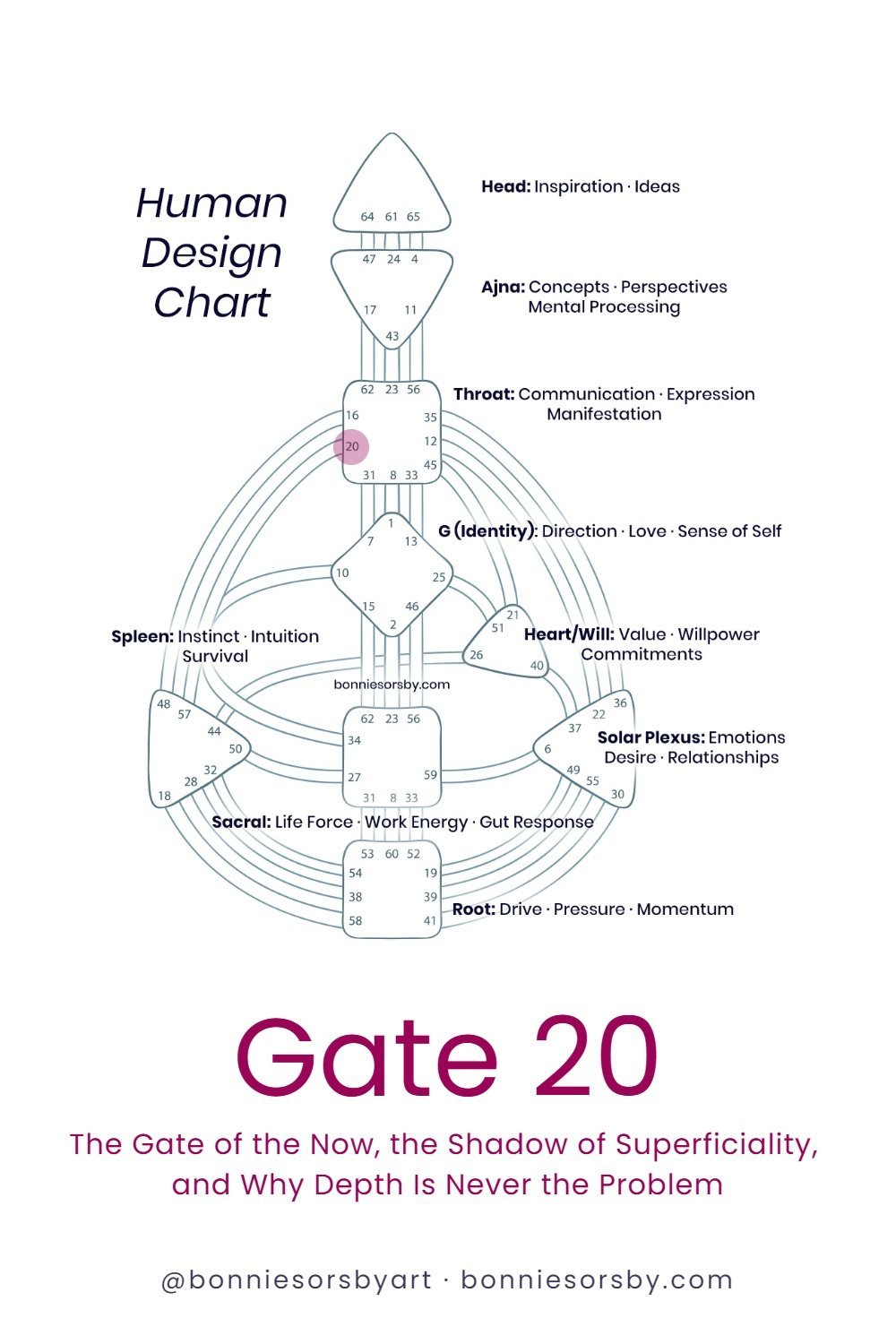
Gate 20 lives in the Throat Center, which is the center of expression and manifestation in Human Design. The Throat is where energy becomes words, actions, and presence in the world, and Gate 20’s particular role there is about the quality of what comes through rather than the quantity.
It’s called the Gate of the Now, and sometimes the Gate of Metamorphosis or Contemplation, and I think all three names point at something real. The now because this gate operates in the present moment, in the immediacy of what is happening rather than what was planned. The metamorphosis because authentic presence, real presence, often changes things. Not through strategy or force, but through the quality of attention itself. And contemplation because Gate 20 at its deepest isn’t about filling the now with noise. It’s about being fully in it, which requires a quality of inner quiet that doesn’t come automatically to everyone who carries this gate.
In the Gene Keys framework, Gate 20 moves through the shadow of Superficiality, the gift of Self-Assurance, and the Siddhi of Presence. As with the other gates in this series, I’ll speak to these from lived experience rather than as formal teaching, because that’s honestly the most useful thing I can offer here.
Gate 20 as Conscious Earth
The way gates operate shifts depending on whether they’re in a conscious or unconscious position, and whether they’re functioning as a sun or an earth placement. Gate 20 as my conscious earth means it’s something I can see in myself, something I’m actively learning through, and something that literally grounds the expression of my conscious sun gate, Gate 34.
Where Gate 34 is the seat of my self-sourced power, Gate 20 is the surface that power has to land on. You can have all the sacral force in the world, but if the expression of it is scattered, fragmented, or disconnected from the present moment, it doesn’t transmit cleanly. Gate 20 is the part of my design that asks my power to show up in the now rather than in anticipation of something, in the presence of the actual moment rather than the managed version of it.
That’s a practice. And some days I’m better at it than others.
The Shadow of Gate 20: Superficiality
When I first encountered the shadow name for Gate 20, my reaction was immediate and a little defensive. Superficiality? That one stings, particularly for someone who finds small talk genuinely difficult and who has never in her life thought of an idea as too complicated to explore fully.
And that’s exactly what made me sit with it longer.
Because the shadow of Superficiality doesn’t only show up in the obvious direction. It doesn’t only look like being busy, filling the now with noise, skimming from thing to thing without depth. It can also show up in the opposite direction, as a fear of surface level so strong that you struggle to say anything at all unless you can go all the way down the rabbit hole. The conflict of wanting to speak but not being willing to speak simply. The sense that if you can’t take someone through every layer and every nuance and every shade of meaning, why say it at all?
I live very much in full color. I see fifty shades of gray where some people see black and white, and I mean that in the most literal sense. The nuance is always present. The complexity is always visible. And what that creates, sometimes, is a kind of paralysis around expression, particularly in formats that demand brevity. A sixty-second reel on Instagram has never felt like a natural fit for how I think or communicate, because compressing what I see into sixty seconds feels like it falsifies it. Like I’m being asked to pretend something is simple when it isn’t.
That’s the shadow. Not that I’m not going deep. But that the fear of not going deep enough becomes its own obstacle to expression.
I carry Gate 56 in my chart, the Gate of Stimulation, which is the gate of the storyteller, the one that wants to take you on a journey rather than hand you a conclusion. And that gate pulls consistently toward the full narrative, the complete arc, the rabbit hole followed all the way to the bottom. When Gate 56 is running and Gate 20’s shadow is also active, what can happen is a kind of gridlock between wanting to say something and not being willing to say it any way other than completely. The result is either a very long piece of writing or silence.
The work of Gate 20 is finding the version of presence that doesn’t require complete depth to be real. Because genuine presence, the Siddhi-level expression of this gate, doesn’t need fifty shades of gray to land. It just needs to be fully here.
The Gift of Gate 20: Self-Assurance
Self-assurance in the context of Gate 20 is not confidence in the performative sense. It’s not certainty or bravado or having the right answer. It’s something quieter and more fundamental than that. It’s the quality of being at ease in the present moment without needing the present moment to be different than it is.
I do have access to this, even if it’s not always consistent. There’s a quality I notice in myself when I’m genuinely in flow, when the work is alive and the now is where I am, where I’m not reaching forward or second-guessing or running parallel mental commentary. Something settles. The expression comes cleanly. And I’ve observed that this is the version of me that people respond to most directly, the version that’s most here.
That’s Gate 20’s gift operating. And it connects directly back to Gate 34, because the 34-20 channel, the Channel of Charisma, is the conduit through which my sacral power speaks. When I’m present, the power has a voice. When I’m in my head, running in other directions, that connection goes quiet. The channel requires the now to function.
For Manifesting Generators especially, this is worth paying attention to. MG energy moves fast. It multi-tasks, it pivots, it picks up and puts down and picks back up again. And all of that can be a strength. But it can also mean that the quality of true presence is something you have to return to deliberately, because the speed of your design makes it easy to bypass.
The Siddhi of Gate 20: Presence
Presence as a Siddhi is not something you achieve. It’s not a state you arrive at through practice and stay in permanently. It’s the highest frequency expression of this gate, the thing that becomes available in moments of complete alignment, when there is no gap between who you are and what you’re expressing, when the now is genuinely all there is.
I think most people have had at least a taste of this. A moment in a conversation when time disappeared and you were completely with the other person. A creative session when the work was flowing and nothing else existed. A walk in nature when the thinking stopped and something larger came in. Those are Gate 20 Siddhi moments, whether you knew it or not.
The invitation for those who carry this gate isn’t to manufacture those moments or to chase them as a goal. It’s to create the conditions where they can happen more frequently. Which, ironically, usually means doing less rather than more. Planning less. Filling the now with less noise. Trusting that what’s here is enough to work with.
The Channel of Charisma: 34-20
Gate 20’s only channel in Human Design is the 34-20, the Channel of Charisma, which connects the Sacral Center to the Throat through the specific combination of Gate 34‘s power and Gate 20’s presence. We explored this channel from Gate 34’s perspective in a previous post, but it deserves a look from the Gate 20 side too.
From Gate 20’s vantage point, the channel is about what happens to power when it moves through presence. Sacral energy on its own is potent but nonverbal. It’s the gut response, the body knowing, the force that builds momentum. Gate 20 is what gives that energy a quality of transmission, a way of landing in the room without having to be explained.
When this channel is functioning well, there’s no lag between the inner experience and the outer expression. The presence is the communication. People feel something before they can name what they’re responding to. That’s the charisma this channel is named for, and it’s worth understanding that it has nothing to do with charm or performance. It’s the result of power and presence being genuinely integrated.
When the channel is in shadow, the opposite often happens. The power is present but the expression is scattered, or the expression is present but it’s coming from the head rather than the body, or the now is bypassed entirely in favor of something more controlled and polished that loses the very quality that would have made it land.
Open Centers and Gate 20
Something I think is worth naming, particularly for those who carry Gate 20 alongside undefined or open head and ajna centers. An open head center takes in mental inspiration from everywhere. An open ajna processes all perspectives without filtering to a fixed point of view. Both of these, when undefined, mean that the mental landscape is not your own in the way it might be for someone with defined centers in those areas.
What this creates is an internal environment that can feel like a lot. Ideas flowing in from outside, perspectives multiplying, the mental commentary running alongside everything. And staying present in the now is harder when the mental space is busy in this particular way, because you’re designed to take in and process rather than to hold a fixed mental position.
Understanding this helps reframe the inconsistency. The times when Gate 20’s gift is hard to access aren’t necessarily failures of practice. They might simply be moments when the open centers are running loud. The practice then becomes about noticing when you’re in someone else’s mental field and finding your way back to the body, where the Sacral and Gate 20 can do their work.
Gate 20 and the Cross of the Sleeping Phoenix
Gate 20 is one of the four gates that make up the Cross of the Sleeping Phoenix, the 400-year Human Design cycle beginning its activation in 2027, and I think its role in that cross is significant.
The era we’re leaving, the Cross of Planning, was organized around projection into the future. Long-term institutional structures, stability through predictability, security through systems that extended beyond any single lifetime. There’s nothing wrong with any of that, but it did often pull collective attention away from the now and toward a future that the structures were building toward.
Gate 20 in the Sleeping Phoenix era represents something different. It’s the energy of the present moment as the primary locus of intelligence and action. Not planning five years out. Trusting what is here now as sufficient information for what comes next. This is a fundamental reorientation, and for those who carry Gate 20, I think there’s something meaningful about being part of a generation that’s actively practicing what the collective is being asked to learn.
The now is not a consolation prize for people who can’t plan. It’s where the real intelligence lives.
How the Lines Shape Gate 20’s Expression
Your gate’s line, determined by the exact degree of your planetary activation, shapes how Gate 20 operates in your specific design. Here’s a brief orientation for each.
Gate 20 Line 1: Presence built on preparation. This line needs to understand something before it can be fully in it. The practice of the now includes creating a solid enough foundation of knowledge that the mind settles and presence becomes possible. Rushing into the moment without that grounding often produces anxiety rather than clarity.
Gate 20 Line 2: A natural quality of presence that others often recognize before the person themselves does. This line may not feel particularly present from the inside, even when everyone around them is responding to the quality of their attention. Needs significant space and solitude to recharge, as being pulled too consistently into others’ now can deplete the very presence they carry.
Gate 20 Line 3: Learns about presence through its absence. Experiences that pull this line out of the now, distraction, mental noise, forcing what isn’t flowing, are often the teachers. The shadow and the gift get worked out experientially, through contrast, which ultimately builds a nuanced and embodied understanding of what genuine presence requires.
Gate 20 Line 4: Presence that activates through connection. For this line, the now comes alive most fully in relationship, in the right conversation, in the company of people who call something forward. The quality of their community is the quality of their access to Gate 20’s gift. Being selective about who they spend time with is not incidental to this line’s practice.
Gate 20 Line 5: Universalizes presence. Others project onto this line an ability to be fully present and authoritative in the moment, sometimes before they feel it themselves. There’s a practical, real-world quality to how this line expresses Gate 20, a way of making the now tangible and applicable rather than ethereal. The challenge is managing the weight of what gets projected.
Gate 20 Line 6: Moves through three phases. The early years may be marked by the shadow, by the busyness and noise and difficulty accessing the now consistently. A middle period of stepping back and observing. And then a later expression that carries a quality of settled, earned presence that others genuinely feel, because they’ve lived it long enough to stop fighting it.
What Gate 20 Is Here to Teach
The thing I keep coming back to with Gate 20, particularly as someone who struggles with the brevity the modern content landscape demands, is that presence doesn’t require depth to be powerful. This is genuinely counterintuitive for me. My instinct is that depth is the point, that going all the way down is what makes something worth saying.
But the Siddhi of this gate is not comprehensive understanding. It’s pure, undivided attention to what is right here. And sometimes that looks like saying less. Sometimes the fully present version of an idea is the simple one, because the now doesn’t need all of it to be real.
The work of Gate 20, at least for me, is trusting that. Trusting that what’s available in this moment is enough to work with, that the rabbit hole doesn’t have to be explored in its entirety before something is worth expressing, and that presence itself carries more information than any amount of preparation or elaboration can manufacture.
The only thing that exists is now. Not as a consolation for not planning better. As the actual truth of how this gate works, and maybe how all of us work, when we let it.