
Human Design Gate 59 Meaning: The Gate of Intimacy, the Ethics of Transparency, and Belonging From a Distance
There is something worth examining in the experience of being the person people tell things to. Not the obvious things, the real things. The things they haven’t said out loud yet, or haven’t said to anyone they know. If you carry Gate 59, you probably recognize what I’m describing, as something that simply happens in your presence. People open. The barrier dissolves. And often neither of you quite planned for it.
Gate 59 is my unconscious sun, the Radiance sphere in my Gene Keys profile. Which means this is energy I transmit without full awareness of it, something others experience in me before I experience it in myself. I’ve had people tell me they feel safe with me before I’ve said much of anything. I’ve had readers say they feel like they know me after reading my writing, that there’s a quality of accessibility in it they don’t find elsewhere. And for a long time I received those reflections with some confusion, because from the inside, I’m quite private. The line between what I share and what I protect is one I think about carefully.
That tension, between the gate that dissolves barriers and the person who keeps certain things close, is what this post is really about.
What Gate 59 Means in Human Design
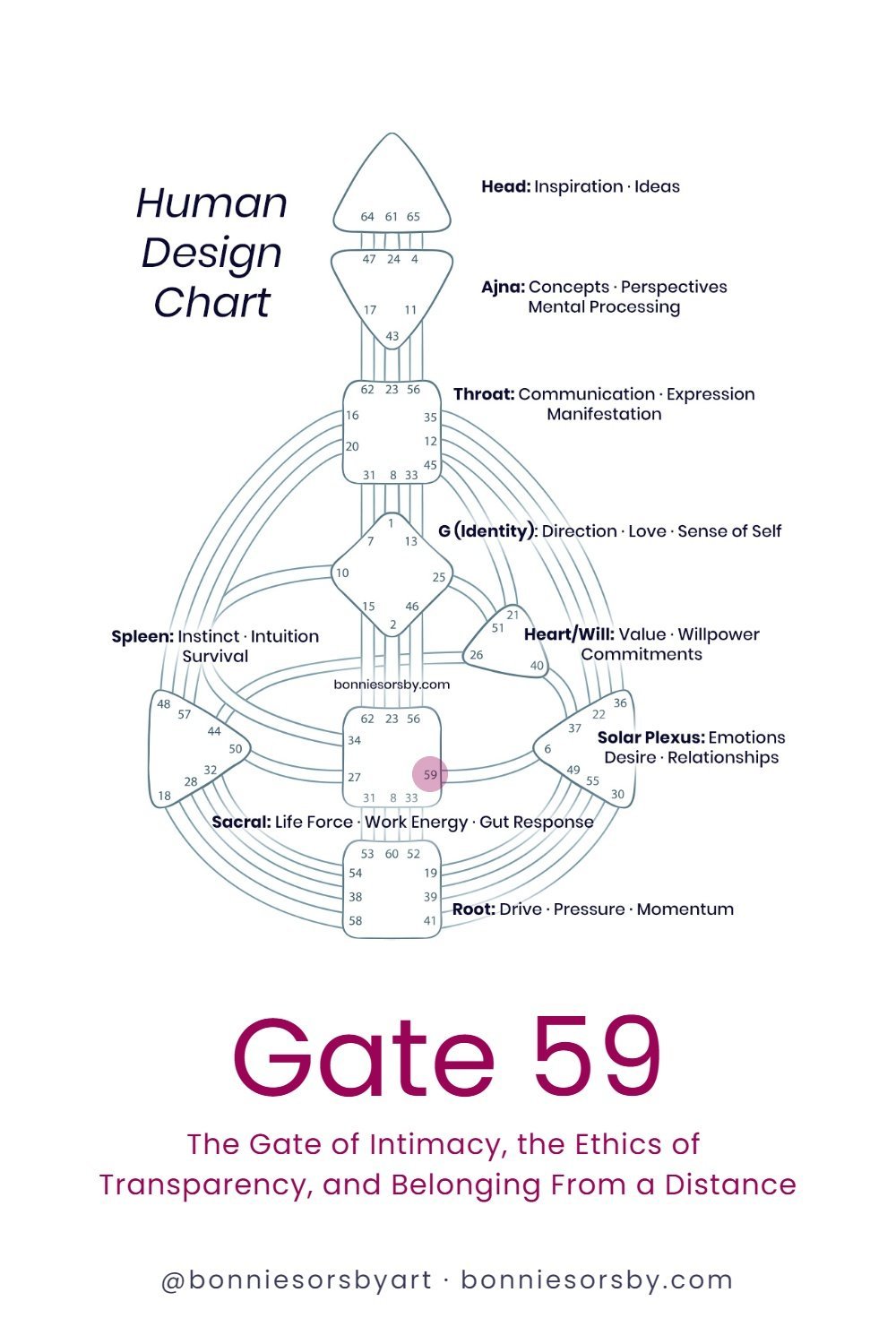
Gate 59 lives in the Sacral Center, which is the center of life force, reproductive energy, and response. It is called the Gate of Sexuality, the Gate of Dispersion, or most simply the Gate of Intimacy, and all of those names point at the same underlying quality: the capacity to penetrate the field that keeps people separate from one another.
This is not intimacy in a solely romantic or physical sense. It is the broader quality of genuine closeness, of two people reaching each other rather than exchanging pleasantries from behind their respective defenses. Gate 59 is the energy that makes that possible. It creates the conditions for real contact. And when it’s operating from its gift frequency, it does so without manipulation or performance, simply by being what it is.
Gate 59 belongs to tribal circuitry, which is significant. Tribal energy in Human Design is about bonds, about the structures that keep people connected and resourced over time. It’s the circuitry of family, of community, of the agreements we make to show up for one another. Gate 59 specifically is the gate that initiates those bonds, that creates the opening through which genuine connection becomes possible.
Gate 59 as Unconscious Sun
Being in the unconscious sun position means Gate 59 is not something I’m particularly aware of from the inside. It’s closer to the air I breathe than to something I can point to and observe. And in the Gene Keys system, the Radiance sphere describes the quality of light you emit without trying, the frequency that others pick up on before you’ve said a word.
For me this has shown up consistently in a particular way. People tell me things they don’t tell others. Something in my presence seems to signal that it’s safe to. I’ve come to understand this as Gate 59 operating exactly the way it’s designed to, radiating a field of openness that others feel and respond to.
What I find interesting about carrying this quality unconsciously is that I’m often the last to recognize it in any given interaction. The person across from me has already decided I’m trustworthy before I’ve formed an impression of the conversation. The gate is doing its work ahead of my awareness of it.
Gate 59 as a Hanging Gate
Gate 59’s only channel connection in Human Design is the 59-6, the Channel of Intimacy, which links the Sacral Center to the Solar Plexus through Gate 6. Gate 6 is the Gate of Conflict, or the Gate of Friction, and what it brings to the channel is the emotional mechanism through which closeness gets negotiated. Intimacy through Gate 6 involves the willingness to move through friction and emotional tension toward deeper resolution and connection.
Gate 59 is a hanging gate for me, which means I carry the opening quality without Gate 6’s anchoring mechanism. The field of safety is present. The emotional resolution process that Gate 6 would bring is not something I generate on my own. What this often means in practice is that people feel safe enough to open up quickly, sometimes before the relationship has the grounding to fully hold what gets shared. The intimacy Gate 59 creates can outpace the container available to support it.
For those who carry the full 59-6 channel, there’s a more complete arc available: the opening, the friction that tests it, and the deeper bond that comes from having moved through something together. As a hanging gate, the energy is real and the opening is real, but the process is more dependent on what the other person brings to the field.
The Shadow of Gate 59: Dishonesty
The Gene Keys shadow name for Gate 59 is Dishonesty, and I want to be careful about what that means in this context, because it doesn’t mean deception in the ordinary sense.
The dishonesty of Gate 59’s shadow is the subtle kind. It’s the gap between the openness being radiated and what’s being withheld behind it. The gate creates a field of safety and connection, and the shadow frequency uses that field while keeping the self behind glass. Receiving intimacy without risking it. Creating the conditions for others to open while remaining, at some level, closed.
I think about this honestly in relation to my own experience. I am careful about what I share publicly. Not everything that happens in my life is mine to explain or narrate, because other people are present in my experience and their stories are not mine to tell. This limits what I can share in good conscience, because genuine care for others requires a certain discretion about where my story ends and theirs begins.
What I’ve had to sit with is whether that discretion is the shadow or the gift. And I think the answer is that it depends entirely on what’s underneath it. Protecting other people’s privacy is not the same as protecting yourself from being seen. The shadow is the version where the withholding is self-defensive. The gift is the version where it comes from genuine ethical care for the complexity of shared experience.
Most people with Gate 59 are navigating somewhere in that territory. The question worth asking is why.
The Gift of Gate 59: Intimacy
What the gift of Gate 59 creates is something genuinely difficult to manufacture. It’s not warmth exactly, though warmth is often part of it. It’s not skill at conversation or emotional intelligence in the practiced sense. It’s more like a quality of presence that makes the space feel safe enough for real things to happen in it.
People feel this before they can name it. They find themselves saying more than they planned to. They reach for honesty in a context where they’re accustomed to performing. And afterward they often don’t quite know how to account for it, because nothing dramatic happened. You were just there, and somehow that was enough.
For those who carry this gate, the gift is about allowing what the gate naturally generates. The intimacy doesn’t come from technique. It comes from being genuinely present with someone in a way that communicates, without words, that what’s real is welcome here. That the barrier between them and the actual truth of what they’re experiencing doesn’t need to stay up.
That quality often creates connections that feel disproportionately meaningful for how brief they’ve been. Gate 59 can establish in an hour what takes most relationships months. Which is part of why carrying it carefully matters.
The Siddhi of Gate 59: Transparency
The highest expression of Gate 59 is Transparency, and it’s worth sitting with what that means. Because transparency in this context is not the same as disclosure. It’s not about sharing more. It’s about the quality of presence that has nothing hidden behind it, because the self that’s here is genuinely the self that’s here. No performance, no management, no curated version positioned between you and the person you’re with.
I think this is the quality people are responding to when they tell me they feel safe. Not that I’ve shared everything, but that what I’ve shared is real. There’s nothing in the room that’s being manufactured. And for Gate 59, that quality of genuine transparency, even when accompanied by careful discretion, is what creates the intimacy this gate is named for.
Tribal Energy in an Individual Chart
One of the more interesting things about carrying Gate 59 is that it sits, in my chart, inside a design that runs predominantly on individual circuitry. Individual energy in Human Design is the circuitry of uniqueness, of mutation, of the person who operates somewhat outside the tribal field rather than within it. It’s not antisocial energy, but it is self-referential in a way that tribal circuitry is not.
And then there’s Saturn in my eleventh house, conjunct my sun. The eleventh house is the house of community, of belonging, of the groups and friendships and collective structures that hold us over time. Saturn there makes belonging feel significant and effortful, not something that arrives lightly or without a particular weight to it.
What this combination produces, in my experience, is something I’ll try to describe as honestly as I know how. I often feel like I don’t quite have a place. And I often also don’t quite want one. Both of those things are true simultaneously, and for a long time I tried to resolve the contradiction rather than simply sit with it.
What I think is closer to the truth is that Gate 59 creates real, genuine connection one person at a time, in moments of actual presence, and the individual circuitry that dominates the rest of the chart means that belonging to a group, being held inside a tribal field, is not really where the energy flows most naturally. The intimacy is real. The belonging in the collective sense is not quite the design.
If you carry Gate 59 in a chart that doesn’t have much tribal energy elsewhere, this might resonate. The gate creates closeness. It doesn’t necessarily create the sense of fitting somewhere. Those are different things, and understanding that difference is often clarifying rather than discouraging.
How the Lines Shape Gate 59’s Expression
Gate 59 Line 1: Intimacy built through understanding. This line wants to establish a foundation before it opens. The barrier-dissolving quality of Gate 59 is present, but it operates after some level of trust and knowledge has been established. There’s a quality of careful approach here, a sense that genuine closeness is built through comprehension as much as through feeling.
Gate 59 Line 2: Natural intimacy that operates almost passively. Others are drawn in before this line has made any conscious move toward closeness. The challenge is that they may not fully recognize the impact they have on people’s willingness to open, which can occasionally create situations where more was shared than the container could comfortably hold.
Gate 59 Line 3: Learns the terrain of intimacy through what breaks it. Bonds that form and don’t hold, moments of closeness that reveal the conditions they couldn’t survive. This line often develops the most hard-won understanding of what real connection requires, precisely because they’ve experienced what it looks like when it fails.
Gate 59 Line 4: Connection that flows through the network. For this line, the intimacy Gate 59 generates is most available within relationships that have some existing social context. The right community amplifies the gate’s gift. The quality of their relational field is directly tied to how freely the energy can move.
Gate 59 Line 5: The universalizer of intimacy. Others project onto this line a quality of safety and connection that can feel like a responsibility before it feels like a gift. There’s a practical quality to how this line expresses the gate, a way of making the intimacy available more broadly rather than only in singular close relationships.
Gate 59 Line 6: The observer. Line 6 moves through three distinct phases, and in Gate 59 this creates a particular arc worth understanding. The early years may involve bonds that form quickly and dissolve just as quickly, the trial-and-error learning that underlies the first phase of all Line 6s. Then a period of stepping back, of watching from above, of developing what I’d call the bird’s eye view, the capacity to see the whole field of connection and belonging from a position that is not fully inside it. And eventually a return, as a living example of what genuine intimacy and transparency look like, because the distance has taught something that being in the middle of it couldn’t.
The bird’s eye view is not a failure to connect. For Gate 59 Line 6, it’s part of how the gate does its deepest work.
What Gate 59 Is Here to Teach
The thing Gate 59 seems to return to, in every configuration and every line, is that real intimacy requires something to be real on both sides. Not necessarily disclosed. Not necessarily vulnerable in the performed sense that the word has accumulated. But genuine. Present. Not managed into a shape that feels safer than the truth.
For those who carry this gate unconsciously, the teaching is subtle. You cannot see your own field very clearly from the inside. You find out what it does by watching what it produces, by noticing who opens and what they say and what that tells you about what your presence is communicating. And you learn, gradually, that the quality you’re transmitting doesn’t require your full awareness to function. It operates whether you’re tracking it or not.
What you do get to choose is what you do with what comes toward you. How you hold what people bring into the field your gate creates. Whether the ethics of receiving genuine openness are something you take seriously.
For most people with Gate 59, they are. The intimacy this gate creates is real. And real things deserve to be handled with care, including the parts you can’t quite see from the inside.