
Human Design Gate 19 Meaning: The Gate of Sensitivity, the Mystical Dimension, and What It Means to Feel Everything
In general, Gate 19 is not only about being sensitive in the emotional sense. It is about sensitivity to need, belonging, resources, connection, and the subtle signals that tell us whether we are included, supported, or separated. Some people experience this as emotional tenderness. Others experience it as spiritual attunement, pressure to connect, heightened awareness of other people’s needs, or a deep relationship with animals, land, community, or unseen support.
Not every gate in your Human Design chart announces itself clearly. Some of them you’ve been living so consciously that you can trace their influence through decades of your own story. Others sit in a quieter register, operating below the threshold of your full awareness, doing something you might only recognize by its effects rather than its presence.
Gate 19 is the latter kind for me. It lives in my chart through my Jupiter activations, both conscious and unconscious, which means it carries a quality of grace and expansion rather than the more driving, biographical force of sun or earth placements. It appears in two Gene Keys spheres simultaneously, my Culture sphere as Line 2 and my Pearl sphere as Line 5, making it the gate through which both my cultural contribution and my abundance path flow. And it is, by a significant margin, the gate I have had the most difficulty understanding in my own design.
What I know is that it’s a gift. What I’m still learning is the full shape of what that means.
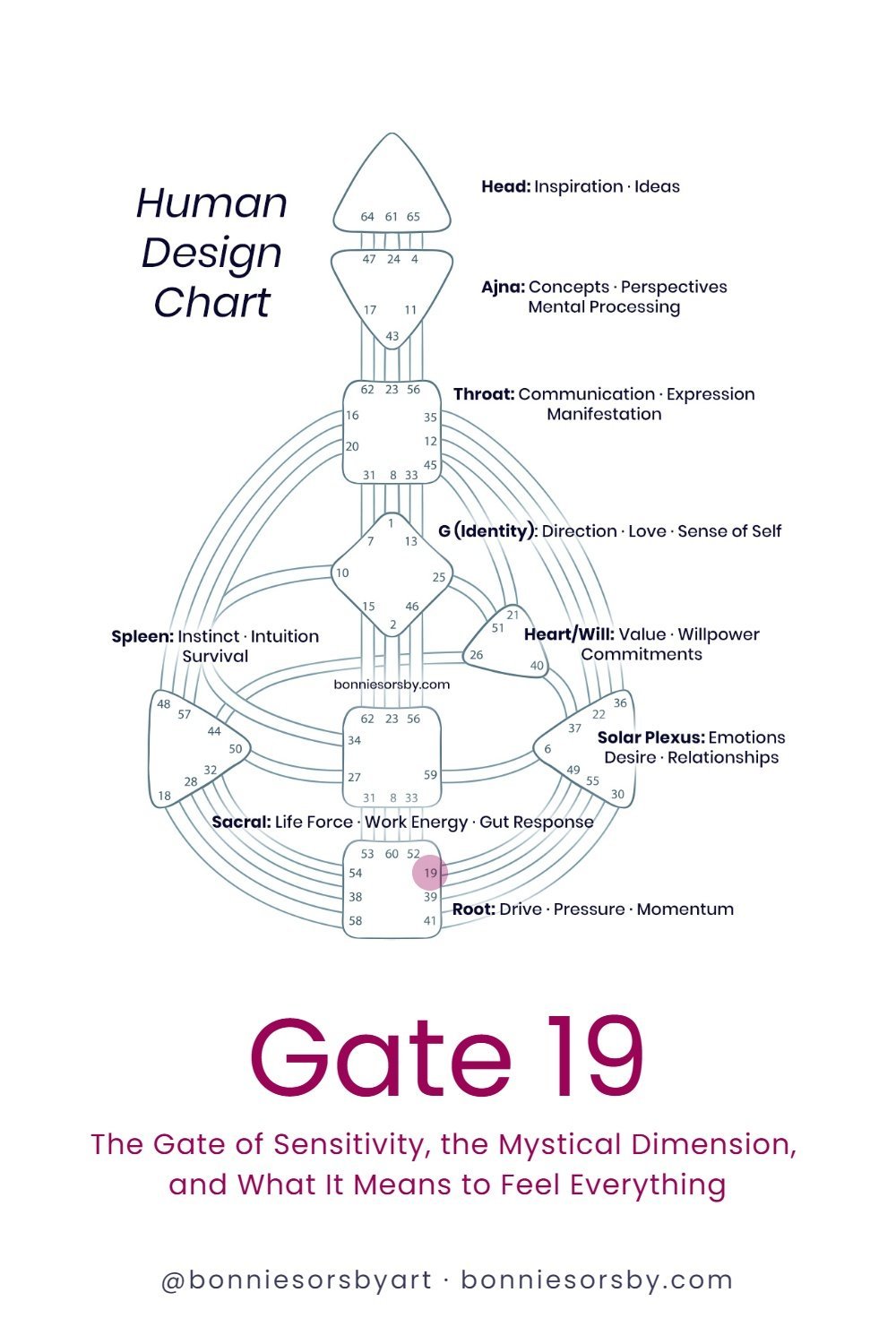
What Gate 19 Means in Human Design
Gate 19 lives in the Root Center, which is the pressure center in Human Design, the biological drive at the base of the body graph that creates urgency and fuels action. The Root doesn’t think. It pushes. And what Gate 19 specifically pushes through is sensitivity to needs, to what is wanted, to what the environment or the people in it are reaching toward before they’ve found words for it.
It’s called the Gate of Approach or the Gate of Wanting, and those names together describe something important. The approach is the sensing, the turning of attention toward what needs to be met. The wanting is what Gate 19 perceives before the wanting has been spoken. This is a gate that feels the room, with a specificity that can register what someone needs before they’ve consciously formed the request themselves.
Gate 19 belongs to tribal circuitry, which means it’s oriented toward the needs of the collective, toward resources and sustenance and what keeps the group supported over time. At its most literal, this is about practical needs. Food, shelter, warmth, belonging. But the sensitivity of Gate 19 doesn’t stay at the practical level. At higher frequencies it extends outward into the natural world, into the subtle layers of environment and energy that most people don’t slow down enough to perceive.
The Only Gate in the Root
This is worth sitting with for a moment. Gate 19 is the only gate I carry active in my Root Center, which means the entire organizing pressure of my design, every biological urgency, every impulse to move or respond, flows through the frequency of this gate.
In most charts, the Root Center has several gates active, each contributing a different quality of pressure and drive. Pressure toward achievement, toward progress, toward stimulation or stability or transformation. For me, there is only Gate 19. Which means the only pressure that runs in my system is the pressure of sensitivity. The urgency to feel what’s needed. The drive toward what I can only describe as attunement.
That is not a small thing to carry as your sole Root energy. It means the motivation system is not oriented toward external achievement in the conventional sense. It’s oriented toward a quality of presence and responsiveness that registers what’s real in the environment and moves from there. And as a hanging gate, without Gate 49’s emotional resolution mechanism anchoring it, there is no built-in filter on what gets felt. The sensitivity operates without a gate to close.
Jupiter and What Grace Looks Like in the Chart
Gate 19 shows up for me through my conscious and unconscious Jupiter activations, and I think it’s worth understanding what that means before going further. Jupiter in Human Design is not a driving force in the way the sun or earth placements are. It doesn’t define identity or life path in the same biographical way. Jupiter is more like a quality of grace, an energy that expands what it touches, that brings a certain abundance and ease to the gates it activates.
Having the same gate in both conscious and unconscious Jupiter means Gate 19 is doubly amplified in this way, that this quality of sensitivity has a grace and an expansiveness to it rather than being a burden I carry through effort. What I’m still learning about that is how to recognize the grace when it’s operating, because Jupiter placements often feel natural enough that you don’t always recognize them as gifts. They’re just there. The way good light is just there.
The Culture and Pearl Spheres
In the Gene Keys system, the Culture sphere describes the quality of your contribution to the world beyond yourself, how your energy lands in the collective field and what it offers to the larger whole. My Gate 19 sits there as a Line 2, which carries the quality of natural talent that others recognize before the person themselves does. Something expressed almost effortlessly that other people value and seek out.
The Pearl sphere is specifically about abundance, about how prosperity flows to and through you, and what the conduit for that flow is. Gate 19 as a Line 5 in my Pearl sphere means the path to abundance runs through the universalizing expression of this gate’s sensitivity, through making something that feels deeply personal and even mystical practically available and useful to a wider field of people.
Together these two placements suggest something that I find genuinely worth considering. The sensitivity Gate 19 carries isn’t separate from my work or incidental to it. The sensitivity is the work, and the abundance that comes from the work flows through how that sensitivity is expressed and made useful. Which reframes what might feel like a burden, feeling everything, registering what others need before they’ve named it, into something much closer to a vocation.
The Shadow of Gate 19: Co-dependence
The Gene Keys shadow for Gate 19 is Co-dependence, and it describes something that anyone with strong Gate 19 energy will likely recognize in themselves to some degree.
When the sensitivity of this gate runs in its shadow frequency, it creates a loop between what you feel in the environment and what you feel obligated to respond to. The needs of others become indistinguishable from your own. The pressure in the Root to approach and meet what’s wanted becomes a kind of chronic scanning, an inability to find the edges between your responsiveness and someone else’s needs. And because Gate 19 as a hanging gate has no Gate 49 to help with emotional discernment, the filter for which needs are yours to meet is harder to access.
The co-dependence shadow isn’t about weakness or dysfunction in any simple sense. It’s the shadow of a gate designed to feel everything, running the feeling without the wisdom about what to do with it. The path through the shadow isn’t becoming less sensitive. It’s developing discernment about where the sensitivity is being called and where it’s simply being pulled.
The Gift of Gate 19: Sensitivity
The gift of Gate 19 is Sensitivity with a capital S, and I want to be honest about what I think this means at the level I understand it, which is still incomplete.
The obvious dimension of this gift is the interpersonal one. The capacity to sense what someone needs before they’ve said it. To read the room at a level that goes past observation into something more felt. To be the person people feel understood by before they’ve explained themselves. I’ve experienced enough reflections of this from the people I work with to know it’s operating, even when I can’t always point to exactly what I’m doing or how.
But the dimension of Gate 19’s sensitivity that I find most interesting, and most difficult to speak to without oversimplifying it, is the one that extends beyond the human. What I can say from my own experience is that Gate 19 at higher frequencies doesn’t limit its sensitivity to people. It extends into the natural world, into what some traditions would call the elemental world, into the animal and spirit layers of reality that most people’s nervous systems are too busy to register. This isn’t something I’ve cultivated through practice so much as something that’s simply present, a quality of awareness that notices what lives in a room or a landscape beyond the human beings in it.
I hold this lightly and I’m not going to over-explain it. But I do think it’s part of what this gate genuinely carries, and I think for those of you who also experience this dimension of Gate 19, having it named in a straightforward way, without mysticism for mysticism’s sake, is more useful than leaving it as something that goes unacknowledged.
The Siddhi of Gate 19: Sacrifice
The Siddhi, the highest expression of Gate 19 in the Gene Keys system, is Sacrifice. And I want to hold this word carefully, because sacrifice in the conventional sense, martyrdom, giving until there’s nothing left, is not what this Siddhi is pointing at.
The Sacrifice of Gate 19 is the devotional kind. It’s the willingness to orient fully toward something larger than the personal self, from a depth of sensitivity so complete that the distinction between giving and receiving dissolves. The mystic traditions call this by different names. Service. Devotion. The state in which your sensitivity becomes so attuned to what life is asking through you that the question of personal cost stops being the primary frame.
I don’t think most people with Gate 19 are living at the Siddhi level most of the time, including me. But I do think the Siddhi points at something that the gate has been oriented toward all along, a quality of presence so genuinely responsive to what’s needed that it becomes its own form of grace. And the mystical dimension of this gate, the sensitivity to the non-human world, to the elementals and the animal and spirit layers of reality, feels directly connected to this. The Sacrifice Siddhi isn’t only about giving to people. It’s about the quality of attention itself, the willingness to be fully present to what is alive and what needs to be met in the entire field of experience.
The 19-49 Channel: Synthesis
Even as a hanging gate, it’s worth understanding the full channel Gate 19 is part of, because the channel describes the complete circuit that Gate 19’s energy is reaching toward.
The 19-49 Channel of Synthesis connects the Root Center to the Solar Plexus through Gate 49, the Gate of Principles or the Gate of Revolution. Gate 49 carries the energy of sensitivity to what the tribe needs alongside a readiness to act on that, even radically, when foundational needs aren’t being met.
Together the 19-49 channel creates a complete arc from sensing the need to responding to it with real consequence. The full channel doesn’t just feel what’s required. It moves.
As a hanging gate, I carry the feeling end of this channel without Gate 49’s response mechanism. Which means the sensing is present and the urgency is present, but the clear path from feeling to principled action isn’t always immediately available to me. This is worth knowing, both as a clarification of how the gate operates and as a reminder that the completion of this circuit may come through other people in my environment who carry Gate 49.
How the Lines Shape Gate 19’s Expression
Gate 19 Line 1: A foundational sensitivity that needs to understand what it’s feeling before it can fully express it. This line builds its relationship with need carefully, seeking knowledge and grounding before responding. There’s a quality of researching the feeling, wanting to know its origin and its meaning before it’s acted on.
Gate 19 Line 2: The natural sensitivity that others feel before this line is fully aware of transmitting it. Gate 19 Line 2 carries a quality of attunement that shows up effortlessly, that people describe as being known or understood without having explained themselves. The challenge is recognizing this as a gift rather than simply a way of being, because to the Line 2 it doesn’t feel like a talent. It feels like the air.
Gate 19 Line 3: Learns the landscape of sensitivity through what breaks it. The co-dependence shadow gets tested through experience, through encounters that reveal what the gate can sustain and what it can’t. This line develops the most embodied understanding of Gate 19’s edges, precisely because they’ve found those edges through living.
Gate 19 Line 4: Sensitivity that operates through relationship and community. The feeling of what’s needed flows most clearly when this line is in the right relational field. Their network is the context through which the gate’s gift becomes most accessible and most useful.
Gate 19 Line 5: The universalizer of sensitivity. Others project onto this line a quality of attunement and understanding that can arrive before the person themselves fully recognizes it in their own work. The Pearl sphere resonance here is significant, because Line 5 often finds practical, scalable expression for what Gate 19 feels, making the sensitivity available as something others can encounter and use rather than keeping it as a private inner experience.
Gate 19 Line 6: The observer of need. This line sees what the environment requires from a bird’s eye view, with a quality of perspective that comes from not being fully immersed in the needs being sensed. The Role Model dimension of Line 6 means this person eventually becomes a living example of how sensitivity can operate as a gift rather than a burden, though that destination often takes the full arc of their life to arrive at.
What Gate 19 Is Here to Teach
I want to be honest about the fact that I’m still learning what Gate 19 is here to teach me specifically. Some gates make themselves known through the stories you can tell about them. This one makes itself known, at least for me, through the things that happen in its presence, the quality of what people bring, the way the space around certain work or certain interactions carries something that wasn’t manufactured.
What I think I understand is this: Gate 19’s sensitivity is not a problem to be solved or a wound to be healed. It is the function. The sensitivity to what’s needed, in people, in spaces, in the natural and subtle dimensions of the world, is not a byproduct of carrying this gate. It is the gate.
The work is learning to hold that without losing yourself in it. To discern between the needs that are yours to meet and the ones that are simply present in the field. To develop enough relationship with the Root pressure of this gate that the urgency it creates can be felt without being immediately acted on. And to trust, which I think is the Jupiter dimension of this placement, that the grace underneath this sensitivity is real, that the abundance path running through it is genuine, and that what the gate opens in the people and places around you is not incidental to the work you’re here to do.
It is the work.