
Types of Astrology: A Complete Guide
Astrology is a living collection of traditions, philosophies, and techniques that developed across cultures and centuries, each asking slightly different questions about what the sky reveals and how to read it. Some branches trace back to ancient Greece and Babylon. Others emerged in direct conversation with modern psychology. Some treat the natal chart as a fixed blueprint. Others track the sky as it moves in real time and watch what gets activated when it does.
If you’ve spent any time in the astrology world, you’ve already encountered the terms. Whole sign. Vedic. Evolutionary. Karmic. Horary. Synastry. Mundane. They proliferate quickly, and without a map, they blur into a fog that makes the whole subject feel more intimidating than it needs to be.
This post is the map.
What I’ve found after years of practice is that the most honest answer to “which type of astrology is right?” is that every tradition here is looking at the same sky through a different window. Understanding what each window shows you makes you a better reader, a more grounded student, and someone who can use this system instead of only collecting information about it.
Here’s every major branch, what it is, and what it’s for.
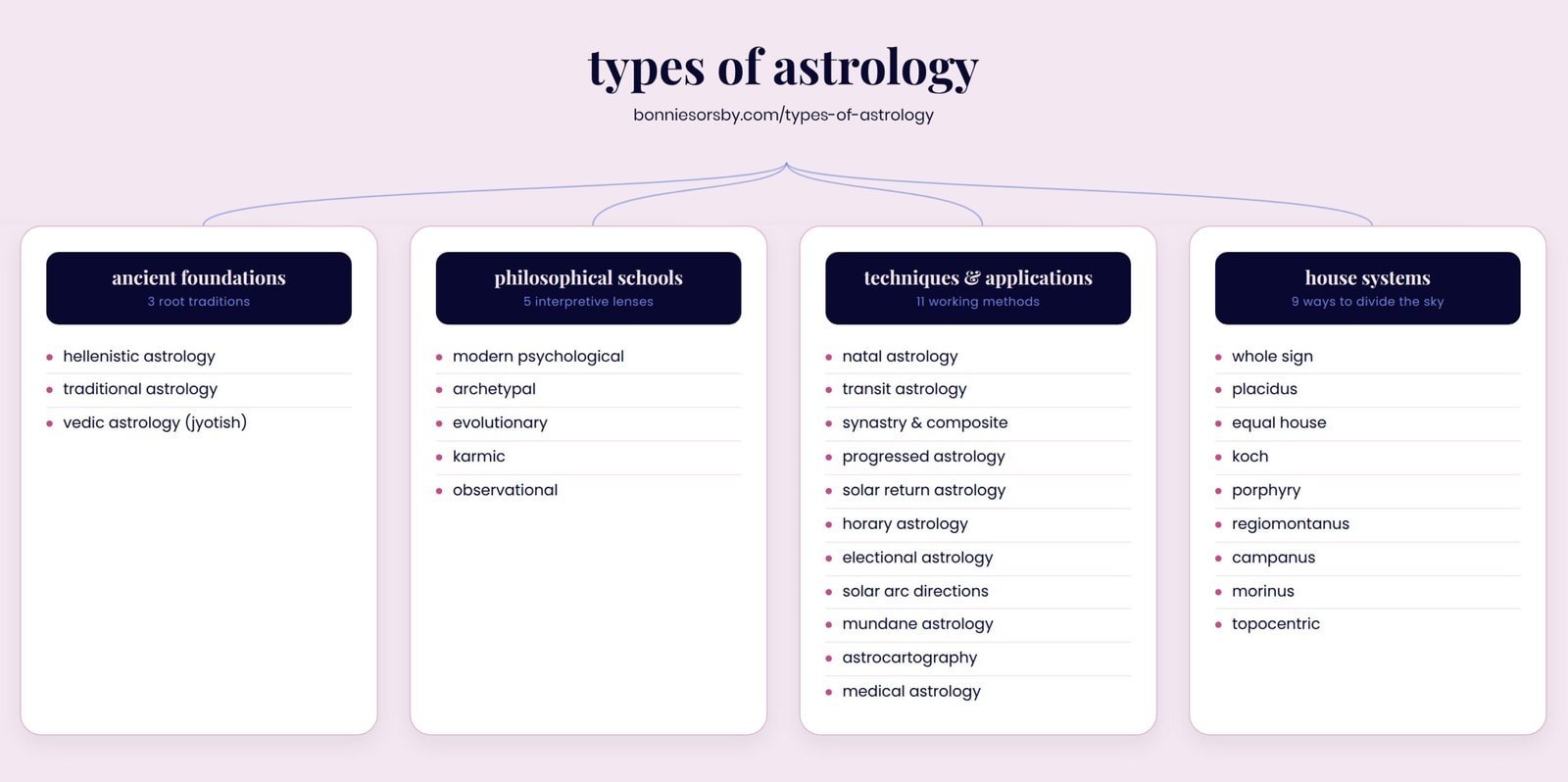
The Ancient Foundations
These are the root systems. Everything that came after grew from or in direct response to these traditions.
Hellenistic Astrology
Hellenistic astrology is the foundation of Western astrology as we know it. It developed in the Greek-speaking world between roughly 200 BCE and 700 CE, drawing on earlier Babylonian sky-watching and synthesizing it into a sophisticated symbolic language. The planets, signs, houses, aspects, and essential dignities that most Western astrologers still use today originate here. There has been a significant revival of Hellenistic techniques in contemporary practice, recovering methods that were largely lost during the medieval period and bringing renewed precision and structure back to chart interpretation.
Traditional Astrology
Traditional astrology refers to the Western astrological practice that developed through the medieval and Renaissance periods, roughly 700 to 1700 CE. It works with the seven classical planets: Sun, Moon, Mercury, Venus, Mars, Jupiter, Saturn. It places heavy emphasis on essential dignities, reception, and predictive timing techniques like annual profections and primary directions. Practitioners often favor a more structured, fate-oriented interpretive framework over the psychologically inflected approach that became dominant in the twentieth century. Many modern astrologers draw on traditional techniques selectively, blending them into contemporary practice without committing fully to the traditional worldview.
Vedic Astrology (Jyotish)
Vedic astrology, known in Sanskrit as Jyotish, is the astrological system that developed within the Hindu tradition in India. It uses the sidereal zodiac, which calculates planetary positions based on the actual observable positions of fixed stars, anchored to the constellations themselves and independent of the Earth’s seasonal cycle. This produces a zodiac that has drifted roughly 23 degrees from the Western tropical zodiac over centuries, so most placements shift backward by one sign when moving between systems. Jyotish places particular emphasis on the Moon, the lunar nodes (called Rahu and Ketu), a system of planetary periods called dashas, and divisional charts that examine specific life domains in fine detail. It is a complete and highly sophisticated system with its own philosophical framework, predictive tools, and cosmological assumptions.
Philosophical Schools
These are the interpretive lenses: the underlying philosophies that shape how an astrologer reads a chart and what they believe the chart is for.
Modern Psychological Astrology
Modern psychological astrology emerged in the early twentieth century, shaped significantly by Dane Rudhyar and his synthesis of astrology with Jungian depth psychology. It treats the planets and signs as archetypes of inner experience: parts of the psyche, patterns of perception, and ways the individual self organizes around its own becoming. This shift moved astrology toward self-understanding, and it remains the dominant framework in mainstream Western practice today. If you’ve read a sun sign column or a birth chart interpretation focused on personality and inner dynamics, you’ve encountered psychological astrology.
Archetypal Astrology
Archetypal astrology, developed most thoroughly by philosopher and cultural historian Richard Tarnas, situates astrology within a broader intellectual tradition connecting Jungian depth psychology, philosophy of mind, and the study of cultural and historical cycles. It understands the planets as archetypal principles: dimensions of reality that express through the psyche, through history, and through the patterns of an individual life simultaneously. It works at a broad interpretive level, tracing themes and asking how cosmic patterns and human experience might be meaningfully correlated, and it takes seriously the question of what that correlation means about the nature of reality itself.
Evolutionary Astrology
Evolutionary astrology reads the birth chart through the lens of the soul’s journey across many lifetimes. It treats this incarnation as one chapter in a much larger story, with the natal chart showing both the unfinished business carried in from the past and the evolutionary intention driving this lifetime forward. The South Node and its ruler reveal where the soul has been and what it’s releasing. The North Node and its ruler point toward the direction of growth this lifetime is calling for. I go into depth on this framework in my post on evolutionary astrology.
Karmic Astrology
Karmic astrology overlaps significantly with evolutionary astrology but emphasizes the themes of debt, completion, and resolution across lifetimes. Evolutionary astrology focuses on the soul’s directional growth, while karmic astrology pays particular attention to what has been left unresolved, what patterns are being repeated until they’re understood, and what the chart reveals about soul-level agreements and lessons carried into this life. The lunar nodes, Saturn, and the twelfth house figure prominently in karmic interpretation. For a full breakdown of what karmic astrology is and how it works, visit my post on karmic astrology.
Observational Astrology
Observational astrology is a practice as much as it is a philosophy. It asks you to watch: to track the sky in real time, notice what gets activated in your life when specific transits hit your chart, and build your astrological knowledge from direct lived experience. It treats your own life as the primary research and the chart as the tool that helps you organize what you’re noticing. Over time, this kind of attention creates a fluency with the symbols that no amount of reading alone can produce. I wrote about this approach in depth in my post on observational astrology.
Techniques and Applications
Beyond the philosophical schools, astrology has produced a wide range of specific techniques, each designed to answer a different kind of question or examine a different dimension of a person’s life or timing.
Natal Astrology
Natal astrology is the foundation most people encounter first. It reads the birth chart, the snapshot of the sky at the exact moment and location of birth, as a map of the individual’s nature, tendencies, gifts, and recurring patterns. Every other technique in astrology is built on or measured against the natal chart. If you have your free birth chart and you’ve ever looked at your placements by sign and house, you’ve been working with natal astrology.
Transit Astrology
Transit astrology tracks the current positions of the planets and measures them against your natal chart. When a transiting planet makes a significant angle to one of your natal placements, it activates that part of your chart, bringing themes to the surface, creating pressure or opportunity, and timing events in ways that often align with what’s moving in the sky. Transits are the most commonly used predictive technique in modern Western astrology. You can follow current planetary movements in real time with the transit calendar.
Synastry and Composite Charts
Synastry is the comparison of two birth charts to understand the dynamics between two people, whether in romantic relationships, friendships, family bonds, or business partnerships. It examines the aspects formed between one person’s planets and another’s to identify areas of resonance, friction, attraction, and challenge. The composite chart takes a different approach: it creates a third chart representing the relationship itself as its own entity, with planetary positions derived by finding the midpoints between each person’s placements.
Progressed Astrology
Secondary progressions move the natal chart forward symbolically: each day after birth corresponds to one year of life, producing a progressed chart that evolves slowly over time. A progressed Sun moves approximately one degree per year, changing signs roughly every thirty years. Progressions reveal how the psyche ripens over time, what themes become more prominent in different life periods, and how a person is changing beneath the surface of whatever transits are occurring simultaneously.
Solar Return Astrology
A solar return chart is cast for the exact moment the Sun returns to its natal position each year, at or near your birthday but not always on the exact date. This chart is read as a forecast for the year ahead, showing the themes, challenges, and opportunities likely to be most prominent until the next solar return. The house the solar return Sun falls in, the rising sign of the return chart, and any close aspects all factor into the interpretation. Solar return astrology is often used alongside transits and progressions to build a layered picture of what a given year is calling for.
Horary Astrology
Horary astrology answers a specific question by casting a chart for the moment the question is asked and understood by the astrologer. It reads the chart of the question itself, examining the planets, their positions, dignities, and relationships at that precise moment, to determine the likely answer or outcome. Horary is one of the oldest and most technically precise branches of astrology, with a strict set of rules governing how charts are judged. It requires deep familiarity with traditional technique and is considered by many traditional astrologers to be among the most powerful predictive tools available.
Electional Astrology
Electional astrology is the art of choosing the most auspicious moment to begin something: a business, a marriage, a surgery, a launch, a move. It works backward from a desired outcome to find the chart that best supports it. Electional astrology draws heavily on traditional technique, dignities, and an understanding of which planetary conditions support which kinds of endeavors. It is the branch of astrology devoted entirely to conscious timing.
Solar Arc Directions
Solar arc directions move every planet in the natal chart forward at the same rate as the progressed Sun, approximately one degree per year. This shifts the entire chart together, maintaining the original relationships between planets while advancing all of them simultaneously. The resulting directed chart can be measured against the natal chart for timing. Solar arcs are particularly useful for identifying when natal configurations become activated by major life events, and they are often used alongside transits and progressions for more precise timing work.
Mundane Astrology
Mundane astrology applies astrological technique to collective events: nations, governments, economies, weather, cultural shifts, and world history. It works with charts cast for the founding of countries, the inauguration of leaders, eclipses, ingresses (the moment the Sun or a planet moves into a new sign), and major planetary conjunctions. Mundane astrology is among the oldest branches of the practice. Long before astrology was used for individual natal interpretation, it was the primary tool of rulers seeking to understand what cycles were governing their kingdoms. It remains the branch most concerned with the question of where the world is headed.
Astrocartography
Astrocartography, developed by Jim Lewis in the 1970s, maps the birth chart onto the geography of the Earth. It shows which planetary lines run through which locations on the planet and how those lines correlate with different kinds of experiences when you live, work, or travel along them. A Venus line through a particular city might correlate with ease, beauty, and relational connection in that location. A Saturn line might bring discipline, restriction, or karmic weight. Astrocartography is one of the most practically verifiable branches of the practice, especially for people who have lived in multiple locations and can map their experiences against their lines.
Medical Astrology
Medical astrology is one of the oldest applications of astrological symbolism, tracing back to ancient and medieval practice. It draws correspondences between planets, signs, and houses and specific body systems, organs, and health tendencies. Historically, medical practitioners used the chart to understand constitutional predispositions and timing around illness and healing. Contemporary medical astrology is typically used for understanding energetic and constitutional patterns, and practitioners in this area emphasize working alongside conventional medical care.
House Systems
The house system you use determines how the sky is divided into the twelve houses of the chart, and different systems can produce meaningfully different placements, particularly for planets near house boundaries. This is one of the genuine points of divergence in astrological practice, and it’s worth understanding what each system is doing before you decide which one you work with.
Whole Sign Houses
Whole sign is the oldest house system in the Western tradition, originating in Hellenistic astrology and experiencing a significant revival in contemporary practice. In whole sign houses, each house corresponds to one entire sign. Whatever sign was rising at the moment of your birth becomes your entire first house, all 30 degrees of it, and each subsequent sign becomes each subsequent house in order. The Ascendant degree still matters as a sensitive point, but it does not function as the house cusp. The result is a clean, sign-based architecture where every house is exactly 30 degrees. It’s the system I work in, and I’ve written a full breakdown of the differences and why they matter in my post comparing whole sign vs. Placidus houses.
Placidus Houses
Placidus is the most widely used house system in modern Western astrology and the default in most mainstream chart software. It divides the diurnal arc, the time it takes a degree of the zodiac to travel from the horizon to the meridian, into equal thirds. This produces houses of unequal size that expand and contract depending on how far you are from the equator. For people born at extreme latitudes, Placidus can produce severely distorted houses or fail to calculate entirely, which is one of the practical criticisms leveled at the system. For most birth locations it works cleanly, and it’s the framework most astrology books published in the twentieth century assume you’re using. My post on whole sign vs. Placidus goes into depth on what changes between the two systems and what stays the same.
Equal House
Equal house divides the chart into twelve equal 30-degree segments beginning at the exact degree of the Ascendant. If your Ascendant is 15° Aries, every house cusp falls at 15° of its sign: 15° Taurus for the second house, 15° Gemini for the third, and so on around the wheel. This makes it easy to confuse with whole sign, but the starting point is the key difference. Whole sign houses always begin at 0° of a sign. Equal houses begin at the Ascendant degree and carry that degree through every cusp. Planets near sign boundaries can land in different houses between the two systems, which is why the distinction matters practically.
Koch Houses
Koch is another time-based system, developed by Walter Koch in the twentieth century. It calculates house cusps based on the birth latitude and the diurnal arc of the Ascendant degree specifically. It produces results similar to Placidus in many charts but diverges more noticeably at higher latitudes. Koch has a strong following particularly among German-speaking astrologers and in certain traditional and predictive communities.
Porphyry Houses
Porphyry is one of the oldest quadrant house systems, attributed to the third-century Neoplatonist philosopher Porphyry. It divides each quadrant of the chart into three equal sections between the four angles: Ascendant, Midheaven, Descendant, and IC. This makes it simpler to calculate than Placidus or Koch and avoids the distortion problems those systems encounter at extreme latitudes. Porphyry is increasingly used by astrologers working in the Hellenistic revival as a quadrant alternative that fits within the ancient framework.
Regiomontanus Houses
Regiomontanus was developed by the fifteenth-century German mathematician Johannes Müller and was widely used during the Renaissance. It divides the celestial equator into equal sections, then projects those divisions onto the ecliptic to produce house cusps. It fell out of mainstream use as Placidus became dominant but remains particularly favored in horary astrology, where many traditional practitioners consider it the most reliable system for judging charts.
Campanus Houses
Campanus, attributed to thirteenth-century mathematician Giovanni Campano, divides the prime vertical, the great circle passing through the east and west points of the horizon, into equal 30-degree sections and projects those divisions onto the ecliptic to derive house cusps. It fell largely out of mainstream use as Placidus became standard but has retained a devoted following, particularly among astrologers drawn to space-based division over time-based division.
Morinus Houses
The Morinus system, developed by seventeenth-century French astrologer Jean-Baptiste Morin, divides the celestial equator into twelve equal sections of 30 degrees beginning at 0° Aries and projects them onto the ecliptic. It is entirely independent of the horizon and meridian, which means it produces the same house cusps regardless of birth latitude and avoids the distortion problems that affect other systems at extreme locations. It has a small but committed following, particularly among astrologers drawn to its mathematical consistency.
Topocentric Houses (Polich-Page)
The Topocentric system was developed in the 1960s by Wendel Polich and A. Page Nelson as a mathematically refined alternative to Placidus. It produces results very similar to Placidus for most birth locations but diverges slightly, particularly in the intermediate houses. Proponents argue it is more astronomically precise than Placidus. In practice, the difference between the two is subtle enough that many astrologers who have experimented with Topocentric have returned to Placidus without noticing significant interpretive difference.
The house system question matters most when planets fall near house boundaries. Those are the charts where the system you use will change a placement. For everything else, the philosophical question of which system best reflects how the sky is organized is worth sitting with, and most astrologers settle it over time through practice. If you want to understand the core of that debate, start with whole sign vs. Placidus.
This post gives you the general landscape, but your own chart will show where all of this lives for you. Your Beautiful Birth Chart lets you explore your natal placements by sign and house, see your aspects, and move through transits with forward and backward date navigation.
What most people discover, once they start looking at their chart with any consistency, is that the same themes surface across different techniques and different transits in slightly different forms. That repetition is the chart talking. If you’ve noticed a recurring thread in your life and want to understand the connected system underneath it, Your Personal Pattern reads your chart as a living ecosystem, showing how your placements interact and why certain themes have always moved through your life the way they do.
Frequently Asked Questions
What is the most popular type of astrology?
Western natal astrology, rooted in the Hellenistic tradition and filtered through a modern psychological lens, is the most widely practiced form in the English-speaking world. Sun sign astrology, the kind you find in horoscope columns, is the most recognizable entry point to the system, though it uses only one of dozens of chart factors. Transit astrology is the other technique most people encounter early, since it addresses what is happening now in current timing.
What is the difference between Western and Vedic astrology?
The primary difference is the zodiac each system uses. Western astrology uses the tropical zodiac, tied to the seasons and the relationship between the Earth and Sun. Vedic astrology uses the sidereal zodiac, based on the fixed positions of stars. Because the Earth’s axis wobbles slowly over time in a phenomenon called the precession of the equinoxes, the two zodiacs have drifted apart by roughly 23 degrees, which is why most people’s placements shift backward by one or two signs when their chart is calculated using the Vedic system. Beyond the zodiac difference, the two traditions use different house systems, different predictive techniques, and different philosophical frameworks, making them genuinely distinct systems with their own internal logic.
What type of astrology is best for beginners?
Western natal astrology is the most accessible starting point for most people, since it has the largest body of available resources in English and forms the foundation that most other Western techniques build on. Starting with your birth chart, understanding your Sun, Moon, and rising sign, and then gradually learning how the houses and planets interact gives you a working framework you can build on for years. If you’re just getting started, learn astrology is a good place to begin on this site.
What is the difference between karmic and evolutionary astrology?
They share a great deal of common ground. Both read the natal chart through the lens of past lives and use the lunar nodes as primary indicators of the soul’s trajectory. The distinction is largely one of emphasis. Karmic astrology focuses on completion, resolution, and what has been left unfinished from previous incarnations. Evolutionary astrology emphasizes the directional growth of the soul and what this lifetime is specifically calling the individual toward. In practice, many astrologers working in this space draw on both frameworks without treating them as entirely separate. My posts on karmic astrology and evolutionary astrology go into the specifics of each.
Can you use multiple types of astrology together?
Yes, and most serious practitioners do. Transits, progressions, and solar arcs are routinely layered together for timing. Natal interpretation often draws on both modern psychological insight and traditional technique. The house system question is largely about which foundational approach resonates most with your practice, but the techniques that build on top of it are broadly compatible across systems. What matters more than choosing a single tradition and staying within its walls is developing genuine fluency with whatever tools you use, which is what observational astrology is really about at its core.
Is astrology a religion?
Astrology is a symbolic system, a language for reading patterns in time, and it requires no specific religious belief to practice. People engage with it across a wide range of spiritual backgrounds and none at all. That said, many branches of astrology carry philosophical or metaphysical assumptions about the nature of time, the soul, and the relationship between the cosmos and the individual. Karmic and evolutionary astrology, for example, rest on a framework that includes reincarnation. Whether those assumptions resonate with you will shape which branches feel most useful and true.