
The Planets & Points in Astrology
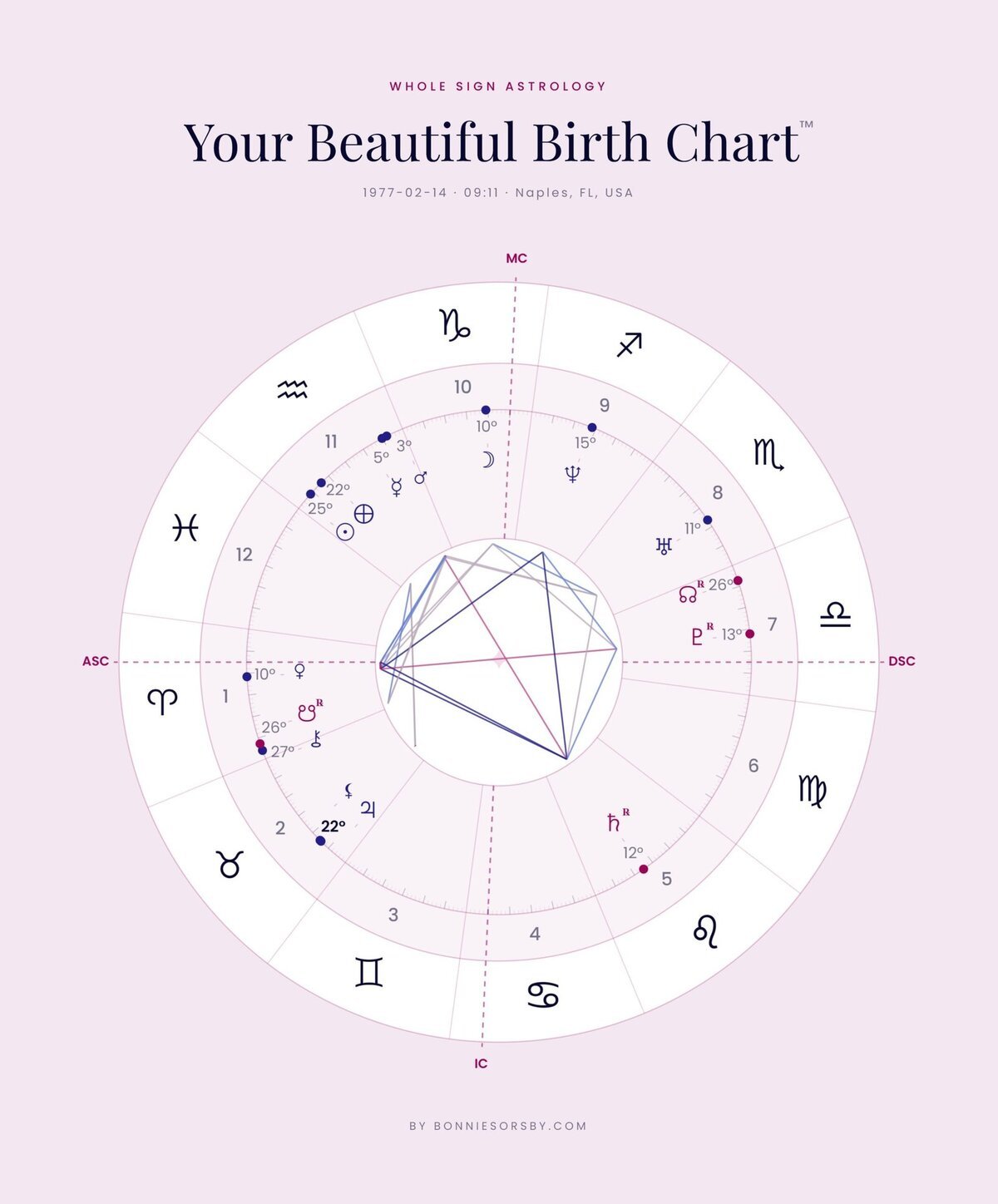
Every placement in a chart is really two questions layered together. The sign describes how something shows up. The planet describes what is showing up in the first place.
The Planets: What Each One Represents
Sun
The Sun describes identity, vitality, and the core sense of self that everything else in the chart organizes around. It is about what a person is fundamentally building a life around expressing.
Moon
The Moon describes the emotional and instinctive layer underneath conscious choice, the needs that show up before a person has decided anything. It moves faster than any other point in the chart, changing signs every two to three days, which is part of why it gets tracked daily rather than by long transit.
Mercury
Mercury describes how a person thinks, processes, and communicates, including the pace and style of that thinking. It is also the planet most associated with retrogrades, since its closeness to the Sun means it appears to move backward from Earth’s vantage point several times a year.
Venus
Venus describes what a person values, what they are drawn to aesthetically and relationally, and how they receive affection or resources. It governs both love and money, since both are really about what feels worth pursuing and holding onto.
Mars
Mars describes how a person takes action, asserts themselves, and pursues what they want. It is the planet of drive and confrontation, showing up in how someone fights for something rather than just wants it.
Jupiter
Jupiter describes expansion, the areas of life where growth, opportunity, and confidence build over time. It is generous by nature, magnifying whatever it touches, which can mean genuine abundance or simply more of whatever was already there.
Saturn
Saturn describes structure, responsibility, and the places where life asks for discipline rather than ease. Its transits often feel restrictive in the moment but usually leave behind something durable once the pressure passes.
Uranus
Uranus describes disruption, innovation, and the sudden break from whatever has gone stale. It moves slowly enough that its sign placement marks generational shifts more than individual moments.
Neptune
Neptune describes dissolution, imagination, and the places where the line between what is real and what is hoped for gets blurry. It can inspire genuine vision, but it can also make it harder to tell inspiration apart from avoidance.
Pluto
Pluto describes transformation through pressure, the parts of life that change by being broken down before they can be rebuilt. It moves so slowly that its sign placement describes generational and cultural shifts more than personal ones.
Points & Other Bodies
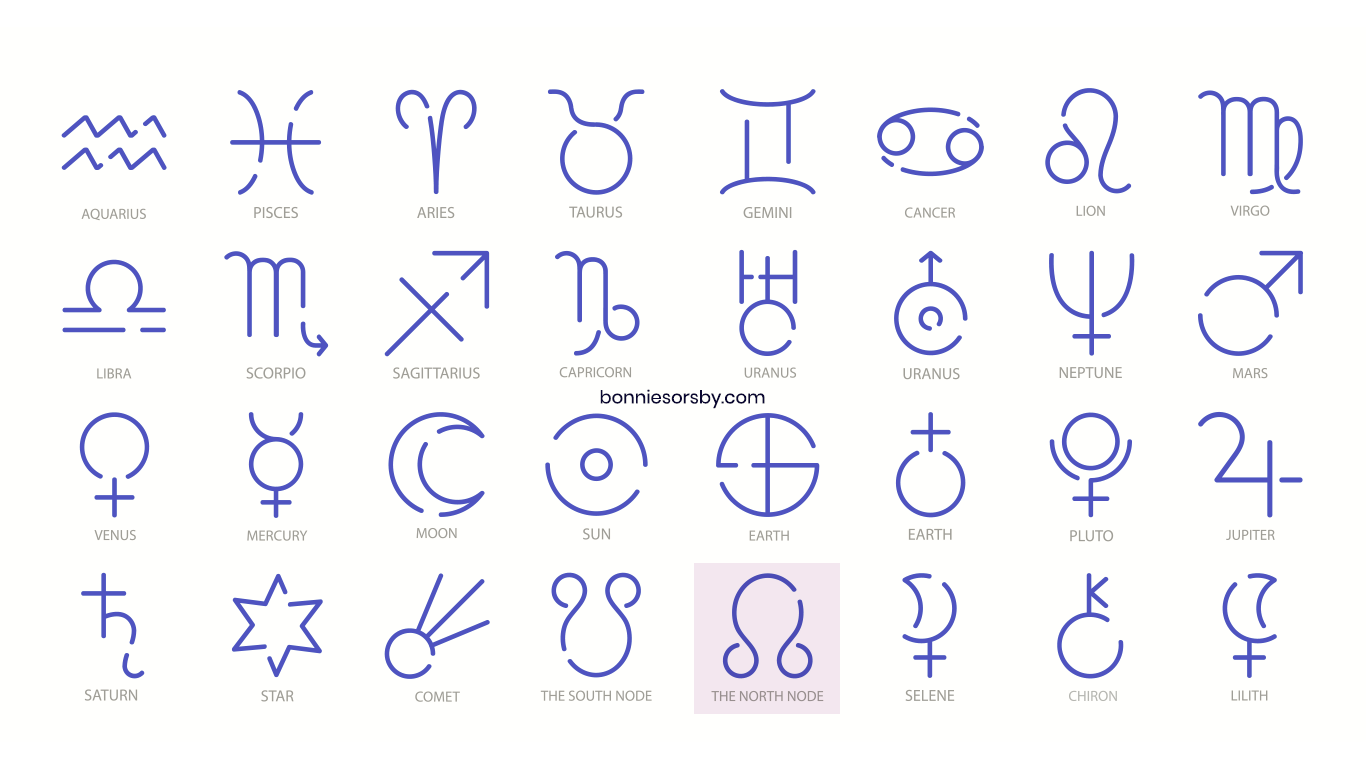
Not everything tracked here is technically a planet. A few are mathematical points or minor bodies, but they can carry real weight in a chart and are worth understanding the same way.
Chiron
Chiron is a minor planet rather than a true planet, but it carries real weight in a chart. It describes a wound that becomes a source of capability once it has been worked with directly instead of avoided.
North Node
The North Node is a mathematical point rather than a physical body, marking the direction a person is growing toward across a lifetime. It often points toward what feels unfamiliar or slightly uncomfortable, since growth rarely happens inside what already feels easy.
South Node
The South Node sits directly opposite the North Node and describes what feels instinctive and familiar, sometimes to the point of being a crutch. It is not something to fix, more something to understand the pull of, so it stops running the show by default.
Juno
Juno is an asteroid associated with commitment, partnership, and the kind of agreements people make and keep, sometimes long after they have outgrown them. It gets less attention than the planets above, but it shows up clearly once you know where to look for it.
Lilith
Lilith, specifically Black Moon Lilith, is a mathematical point rather than a physical body, marking the apogee of the Moon’s orbit. It describes raw instinct, repressed power, and whatever has been shamed into hiding, the parts of a person that get reclaimed rather than refined.
Ceres
Ceres describes nurturance, the body, and the cycles of loss and renewal that come with caring for something over time. It often shows up around how a person was nurtured early on and how they learned to nurture themselves or others since.
Pallas
Pallas describes strategic intelligence, the ability to see a pattern across a wide field and know how to work with it. It often shows up in creative problem-solving and the kind of skill that looks effortless only because it has been practiced for a long time.
Vesta
Vesta describes devotion and the ability to focus completely on one thing at the expense of almost everything else. It is the placement most associated with vocation in the literal sense, a calling that asks for real dedication rather than casual interest.
Eris
Eris describes what has been excluded, overlooked, or left out of the official story, and the disruption that follows once it demands to be seen. It is about refusing to stay quiet for the sake of false harmony.
Chart Angles
These four work differently than everything above. Planets and points transit, meaning the whole world experiences a given planet’s sign change together, which is why “Mercury in Taurus” means the same thing for everyone right now. The angles are personal instead. Your Ascendant is fixed at the exact moment and place you were born and stays that way for life.
Ascendant (ASC)
The Ascendant, also called the rising sign, describes how identity and the rest of the chart get expressed outward, including first impressions and instinctive approach to new situations. It changes roughly every two hours, which is why an exact birth time matters so much for finding it.
Descendant (DSC)
The Descendant sits directly opposite the Ascendant and describes what a person seeks in close partnership, often the qualities that feel most different from their own instinctive approach. It usually shows up most clearly in long-term relationships once the initial attraction settles into something more familiar.
Midheaven (MC)
The Midheaven describes public direction, reputation, and the qualities a person grows into professionally over time. It sits at the top of the chart and often gets the most attention when someone is trying to understand their career path through astrology.
Imum Coeli (IC)
The Imum Coeli sits directly opposite the Midheaven and describes the private, internal foundation a person builds everything else on top of, including family patterns and what genuinely feels like home. It is felt more than displayed, which is part of why it gets discussed less often than the Midheaven.