
Placidus vs Whole Sign:
Which House System Is Right for You
Whole sign and Placidus are two ways of dividing your birth chart into 12 houses. Whole sign gives each sign one house, starting with the sign of your Ascendant. Placidus divides the time it takes each degree to travel between the chart’s four angles, so the houses come out different sizes. Your planets and signs are the same in both, and only the house each planet lands in can change.
In the example chart further down, 3 of the 10 planets change houses, and the Midheaven falls in the whole sign 9th house while it marks the start of the Placidus 10th.
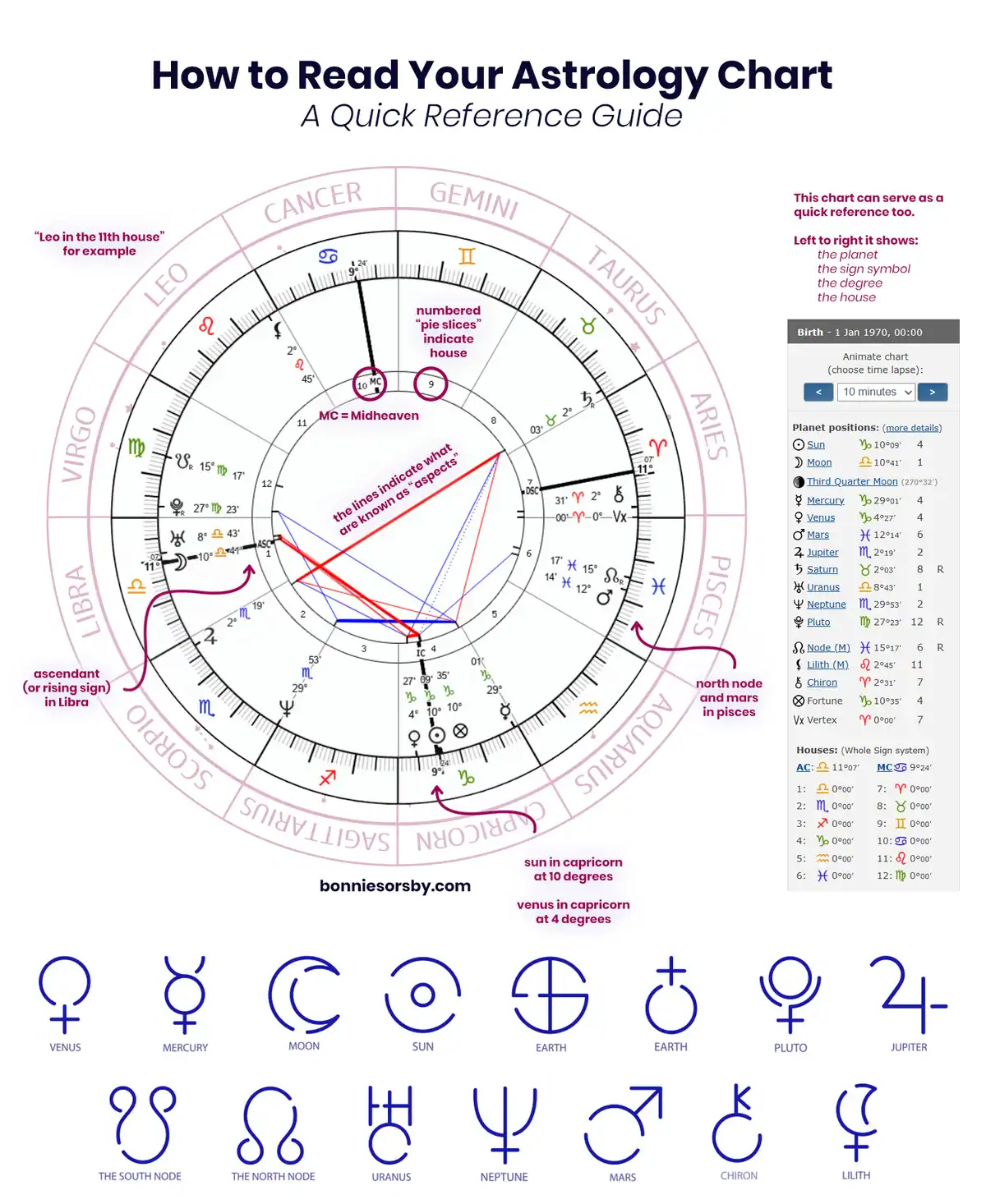
The fastest way to settle this for yourself is to look at your own chart and notice which houses move. Your Beautiful Birth Chart shows your placements by sign and house, so you can see which ones shift between systems and which stay exactly where they are.
One of the most common points of confusion in astrology is why a birth chart can look different depending on where it is generated. The planets and signs may stay the same, but the houses shift. Sometimes dramatically. What produced the write-up changes the answer too, and I go through that in my breakdown of AI astrology readings and the four alternatives.
This almost always comes down to the house system being used.
Two of the most widely used systems in Western astrology today are Whole Sign houses and Placidus houses. While both aim to describe how planetary energy shows up in lived experience, they are built on very different foundations. Understanding that difference can bring an unexpected amount of clarity.
What astrology house systems are describing
Astrological houses describe where life unfolds. They represent areas of experience such as identity, relationships, work, home, creativity, health, and purpose.
Planets describe what is happening. Signs describe how it happens. Houses describe where it plays out.
House systems are simply different ways of dividing the sky into twelve sections. Because each system divides space differently, planets can land in different houses depending on the method used.
This does not mean one chart is wrong. It means the chart is being interpreted through a different lens.
What is Whole Sign astrology
Whole Sign houses are one of the oldest known house systems in Western astrology. In this system, the sign of the rising sign becomes the entire first house. Each sign that follows becomes the next house in order. That clean one-to-one structure is why I teach chart reading in whole sign first.
If you have Aquarius rising, Aquarius is your first house, Pisces is your second house, Aries is your third house, and so on.
Each house contains one sign in full. No sign is split between houses.
This creates a coherent, symbolic structure that emphasizes patterns, themes, and lived experience over mathematical division.
Why many people resonate with Whole Sign houses
Whole Sign houses often feel grounded and integrated for many people. The chart reads as a unified system rather than a collection of fragmented zones.
Because each house is clearly defined, it becomes easier to track planetary rulers, long term transits, and repeating life themes. It is also the system annual profections run on, since that technique moves one whole sign per year and has nothing to stand on in Placidus. Many people find that when they switch to Whole Sign houses, placements suddenly make more sense in practical, embodied ways.
Struggling to connect with a Placidus chart does not indicate a lack of depth. Often, it simply means the symbolic language of that system does not align with how a person experiences their life.
For many, Whole Sign houses offer clarity and resonance both.
You can learn more about the Whole Sign House system in this blog post.
Just starting to learn about astrology?
Your Beautiful Birth Chart™ is literally a beautiful place to begin.
Explore your personal chart through an interactive, guided experience.
What Is Placidus in Astrology? Placidus Meaning Explained
Placidus is a time based house system. It divides the sky based on how long it takes for planets to move between angles, using birth time and latitude as key variables.
As a result, houses in Placidus vary in size. Some signs may span more than one house, while others may not appear on any house cusp at all.
Placidus is the default house system on many astrology websites, which is why it is often the first chart people encounter.
Placidus takes the path a degree of the zodiac travels from the horizon up to the Midheaven, and from the horizon down to the Imum Coeli, and cuts each stretch into thirds by time. The points where those thirds land become the house boundaries, which is why house sizes depend on your exact birth time and place, and why a sign can cover two houses or none.
It is named for Placidus de Titis, a 17th century monk and mathematician whose house tables popularized it. It also has a hard limit: Placidus can’t be calculated beyond about 66° of latitude north or south, near the polar circles, because some degrees of the zodiac never rise or set there. Whole sign has no such limit.
Why Placidus works for some people
Placidus can resonate with people who experience life as highly transitional or process oriented. It can highlight subtle shifts over time and bring attention to internal dynamics that feel psychologically nuanced.
At the same time, many people experience Placidus as fragmented or abstract. Planets that move across house boundaries can feel difficult to integrate, especially when lived experience does not match the interpretation.
Not resonating with Placidus does not mean a person lacks emotional awareness or psychological insight. It usually means that the system itself is not the most useful framework for how they understand themselves.
The real difference between Whole Sign and Placidus
The difference between these systems is not about correctness. It is about coherence versus segmentation.
Whole Sign houses emphasize structural clarity, long term patterns, and embodied experience. They answer questions like:
- What themes consistently show up in my life
- How do long term transits affect me
- What areas of life are emphasized over time
Placidus houses emphasize nuance, timing, and internal movement. They are often used to explore how experiences unfold or shift across different stages.
Neither system owns depth. Depth comes from interpretation, self awareness, and lived experience.
Whole Sign vs Placidus at a Glance
| Whole sign | Placidus | |
|---|---|---|
| How the houses are divided | Each sign is one house, starting with the sign of your Ascendant | By time, cutting the arcs between the angles into thirds |
| House sizes | Always 30 degrees | Uneven, set by your birth time and latitude |
| What decides a planet’s house | The sign it is in | Its exact degree against the start of each house |
| Where the Ascendant falls | Anywhere inside the 1st house | On the start of the 1st house |
| Works near the poles | Yes, at any latitude | No, not beyond about 66° latitude |
| Roots | Hellenistic astrology, roughly 2,000 years old | 17th century, named for Placidus de Titis |
| Often the default in | Hellenistic and traditional astrology | Many modern chart sites and software |
Both systems use the same planets and the same signs. Only the house lines move. To see your own chart with whole sign houses, start with your whole sign birth chart.
The Same Chart in Both Systems
Here is one example chart calculated both ways: January 5, 2001, 2:00 PM, New York. It has a Gemini Ascendant at 8°11′ Gemini and a Midheaven at 13°58′ Aquarius.
| Planet | Position | Whole sign house | Placidus house |
|---|---|---|---|
| Sun | 15°31′ Capricorn | 8 | 8 |
| Moon | 20°15′ Taurus | 12 | 12 |
| Mercury | 22°06′ Capricorn | 8 | 9 |
| Venus | 2°13′ Pisces | 10 | 10 |
| Mars | 7°44′ Scorpio | 6 | 6 |
| Jupiter | 1°50′ Gemini | 1 | 12 |
| Saturn | 24°24′ Taurus | 12 | 12 |
| Uranus | 18°53′ Aquarius | 9 | 10 |
| Neptune | 5°30′ Aquarius | 9 | 9 |
| Pluto | 13°56′ Sagittarius | 7 | 7 |
Three planets change houses. Jupiter at 1°50′ Gemini is in the same sign as the Ascendant, so whole sign calls it a 1st house planet, but it sits about 6 degrees before the Ascendant, so Placidus places it in the 12th. Mercury at 22°06′ Capricorn passes the start of the Placidus 9th house at 21°23′ Capricorn, so Placidus calls it a 9th house planet while whole sign keeps it in the 8th with the rest of Capricorn. Uranus at 18°53′ Aquarius sits past the Midheaven at 13°58′ Aquarius, which makes it a 10th house planet in Placidus, while whole sign puts all of Aquarius in the 9th.
| House | Whole sign begins | Placidus begins |
|---|---|---|
| 1 | 0° Gemini | 8°11′ Gemini |
| 2 | 0° Cancer | 0°57′ Cancer |
| 3 | 0° Leo | 21°23′ Cancer |
| 4 | 0° Virgo | 13°58′ Leo |
| 5 | 0° Libra | 13°12′ Virgo |
| 6 | 0° Scorpio | 23°28′ Libra |
| 7 | 0° Sagittarius | 8°11′ Sagittarius |
| 8 | 0° Capricorn | 0°57′ Capricorn |
| 9 | 0° Aquarius | 21°23′ Capricorn |
| 10 | 0° Pisces | 13°58′ Aquarius |
| 11 | 0° Aries | 13°12′ Pisces |
| 12 | 0° Taurus | 23°28′ Aries |
Whole sign houses are always 30 degrees wide. In this chart the Placidus houses range from about 20 to 45 degrees, and the 1st house starts at 8°11′ Gemini instead of 0° Gemini.
Why charts can feel confusing when switching systems
One of the most unsettling experiences for someone learning astrology is seeing a planet move houses when switching systems. A placement that once felt central can suddenly appear elsewhere.
It helps to remember that the planet itself has not moved. Only the framework has changed.
A planet interpreted through different house systems may highlight different layers of meaning without canceling the original experience. In practice, many astrologers use Whole Sign houses for foundational structure and reference Placidus selectively when additional nuance feels relevant.
Which house system makes sense
The most useful house system is the one that helps you understand your life more clearly.
If a system consistently reflects your lived experience, helps you recognize patterns, and supports meaningful interpretation, then it is doing its job.
For many people, Whole Sign houses provide that clarity more reliably, especially when working with long term transits, life direction, and collective astrology. Placidus can still offer insight for those who resonate with it, but it is not a requirement for depth or sophistication.
Astrology is not about proving allegiance to a system. It is about understanding reality more clearly.
Other House Systems
Placidus and whole sign are not the only options. Koch and Topocentric are close relatives of Placidus, built on time and place in similar ways, and Equal houses starts at your Ascendant degree and gives every house 30 degrees. Porphyry, Regiomontanus, Campanus and Morinus each divide the chart in their own way and give their own version of your houses. Each one has an entry in the house systems section of types of astrology.
Once your house lines are set, each house has its own meaning, starting with the 1st house and the 10th house, or see the complete guide to astrology houses, signs, planets and aspects.
Why I primarily work with Whole Sign houses
For me, Whole Sign houses consistently reflect lived experience in a clear, grounded way. They allow patterns to emerge without unnecessary fragmentation and support long term interpretation without overcomplication.
This is especially important when working with major transits and collective cycles, where coherence matters more than minute shifts.
That is why I primarily use Whole Sign houses in my work, while remaining open to additional lenses when they feel genuinely supportive rather than confusing.
Let astrology be useful
Astrology is not meant to feel like a puzzle you have to earn your way into. It is meant to be a tool for understanding yourself and the world with greater clarity.
If a house system does not resonate, that information matters. It does not mean you are missing something. It often means you are paying attention.
The most meaningful astrology is not the most complicated. It is the astrology that helps you recognize patterns, make sense of experience, and move through life with greater awareness.
If you are curious how different house systems shape your own chart, this is something I explore often in personal readings, especially when working with long term transits and life themes.