
8th House Astrology Meaning: What It Truly Represents
The 8th house in astrology is the part of the birth chart associated with transformation, shared resources, intimacy, and the psychological depths most people spend a lifetime avoiding. It has a longstanding association with death in traditional astrology, and that association isn’t wrong exactly, but it’s incomplete in a way that has done real damage to how this house gets talked about online.
If you’ve ever looked up your 8th house placement and immediately felt a small jolt of dread, I want to slow that reaction down before we go any further. This is one of the richest, most misunderstood houses in the entire chart, and reducing it to a single word does it, and you, a real disservice. Let’s look at what it holds.
What the 8th House Represents
In whole sign houses, which is the system I work in, the 8th house sits opposite the 2nd house of personal resources and self-worth. Where the 2nd house asks what is mine, the 8th house asks what happens when mine becomes ours, and what happens when something I’ve held onto has to be released. That opposition is the key to understanding almost everything this house touches.
The 8th house governs shared finances, debt, taxes, inheritance, and any resource that is not fully within your own control because someone else has a hand in it. Its counterpart is the 2nd house, which covers what you earn and hold on your own. It governs sex and physical intimacy at the level where you become genuinely vulnerable with another person, physically and psychologically both. It governs the unconscious mind, the parts of yourself you don’t examine in daily life because they only surface under pressure. And it governs the entire category of experience we associate with death: endings, grief, loss, and the transformation that follows all three.
That’s a lot of territory for one house, and every single item on that list shares a common thread. Each one involves losing control over something you’d prefer to control completely, and each one asks you to trust a process you can’t fully manage on your own.
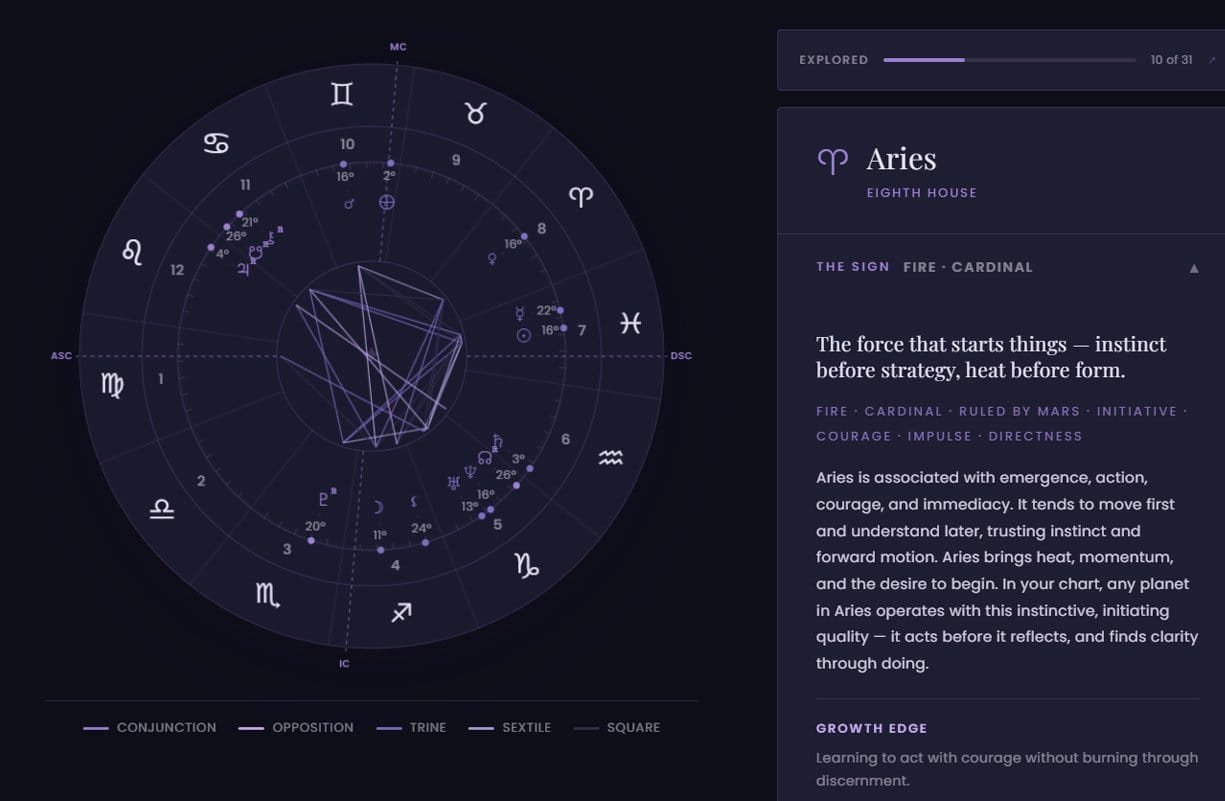
The Natural Ruler of the 8th House
In the natural zodiac wheel, the sign that rules the 8th house is Scorpio. This matters because Scorpio’s themes and the 8th house’s themes are essentially the same material described twice, once through a sign and once through a house. Scorpio governs intensity, depth, transformation, and a comfort with what most people avoid looking at directly, and all of that maps directly onto everything the 8th house already represents.
Scorpio has two ruling planets in modern astrology: Mars, its traditional ruler, and Pluto, its modern ruler, discovered in 1930. Mars brings drive, assertiveness, and a willingness to fight for what matters. Pluto brings the deeper undercurrent of destruction and rebirth, the planet most associated with power, obsession, and the kind of transformation that changes someone permanently. Together, they explain why the 8th house carries both a fierce, protective quality and a slow, regenerative one.
This matters for interpretation because Scorpio being the 8th house’s natural ruler doesn’t mean your own 8th house is in Scorpio. Your 8th house can fall in any sign, and your rising sign is what decides which one. What Scorpio’s rulership tells you is the underlying energetic flavor the house carries by default, the baseline this part of the chart is built on before your specific sign, planets, and aspects modify it further.
Transformation
Transformation is probably the most accurate single word for what the 8th house is about, more accurate than death, more accurate than crisis, more accurate than any of the dramatic language that typically surrounds it. The 8th house describes the process by which something has to end so that something truer can take its place. That’s a much bigger category than literal death. It includes the end of an identity you’ve outgrown, the end of a relationship dynamic that was never honest, the end of a belief about yourself that a hard year finally exposed as false.
People with strong 8th house placements often report a pattern of periodic, intense reinvention throughout their lives. Not chaos for its own sake, but a recurring cycle of building something, having it tested or stripped away, and rebuilding from a more honest foundation. It’s uncomfortable while it’s happening and remarkably clarifying once it’s done.
Shared Resources
This is the most literal, least mystical layer of the 8th house, and it’s worth naming clearly because it gets buried under all the death talk. The 8th house governs money and resources that involve another party: joint accounts, inheritance, loans, investments, business partnerships, taxes, and anything financial that requires trust in someone else’s hands.
A well-placed 8th house here often describes someone who’s genuinely good at navigating shared finances, comfortable with the vulnerability of merging resources with another person, and capable of managing debt or investment with real skill. A more challenged 8th house might describe someone who struggles to trust others with money, or who has had difficult experiences with inheritance, taxes, or financial partnerships. Neither version is a curse. Both are workable.
Intimacy and Vulnerability
The 8th house is where astrology locates real intimacy, the kind that goes past physical closeness into full psychological exposure. This is the house of being fully known by another person, including the parts of yourself you don’t show casually. It’s not a coincidence that this house governs both sex and psychology in the same breath. Both require letting someone see you without your usual defenses.
People often discover their 8th house placements matter most in their closest relationships, the ones where surface-level charm stops being enough and something more honest has to take over. A strong 8th house here can describe someone who bonds deeply and rarely does anything halfway once real trust is established. A more guarded 8th house might describe someone who takes much longer to let another person in, often for understandable reasons rooted in earlier experience.
Psychology and Emotional Depth
The 8th house rules the unconscious mind, which makes it the natural home of psychology, therapy, and any process of digging beneath the surface to understand why you do what you do. This is the part of the chart that explains compulsions, deep fears, and the emotional material that only surfaces when something forces it up.
This is also why so many gifted therapists, researchers, and healers carry strong 8th house placements. The house rewards a willingness to sit with discomfort long enough to understand it, and that willingness translates directly into an ability to help other people do the same.
Crisis as a Catalyst for Growth
Crisis has a bad reputation, and the 8th house has absorbed most of that reputation by association. But crisis, in the 8th house sense, isn’t random misfortune. It’s the specific kind of pressure that forces an honest reckoning with something you’ve been avoiding. A financial crisis forces honesty about spending and security. A relationship crisis forces honesty about what you’ve been tolerating. A health crisis forces honesty about how you’ve been living.
None of that makes crisis pleasant. What it does mean is that the 8th house describes what hard periods make possible afterward, more than the hard periods themselves. The growth that follows real crisis is often more durable than growth that comes easily, because it’s been tested.
Inheritance and Legacy
Beyond literal financial inheritance, the 8th house governs everything you receive simply by being born into your particular family and lineage: emotional patterns, generational beliefs, inherited fears, and inherited strengths, all passed down without your consent before you were old enough to evaluate any of it.
Part of the mature work of an 8th house placement is sorting through that inheritance deliberately. Some of it is worth keeping. Some of it was never yours to carry. Learning the difference is one of the more valuable things this house asks of a person over the course of a lifetime.
Grief and Healing
Grief belongs here too, and not only the grief connected to literal death. The 8th house holds grief for any real loss: an ending relationship, a version of yourself you’ve outgrown, a dream that didn’t materialize the way you’d hoped. Healing, in the 8th house sense, means letting the loss do its full work, so that whatever comes next is built on solid ground instead of something unprocessed.
This is part of why 8th house placements often correlate with real emotional resilience later in life. They’ve had practice moving through it fully instead of around it.
Shadow Work
Shadow work, in the psychological sense Carl Jung introduced, means facing the parts of yourself you’d rather not look at directly: jealousy, rage, shame, desire, control. The 8th house is the natural home for this work in the chart, because it’s the house most willing to go beneath a polished surface.
People with prominent 8th house placements are often unusually capable of this kind of honest self-examination, sometimes because life has given them little choice in the matter. It’s not always comfortable to carry that capacity. It is often enormously valuable to the people around them, who benefit from someone willing to name what everyone else is avoiding.
Why the 8th House Has Become Associated With Death
The death association isn’t invented out of nowhere. In traditional astrology, the 8th house has long been connected to death, loss, and the affairs that follow it, including inheritance and estates. That association made practical sense in historical contexts where mortality, inheritance, and family transformation were closely intertwined parts of everyday life.
Modern astrology, particularly the online, algorithm-driven version most people encounter first, took that traditional association and simplified it into the single loudest word available: death. It’s a dramatic, attention-grabbing claim, and drama performs well in a feed built for quick engagement. The nuance around transformation, inheritance, intimacy, and psychological depth is harder to compress into a headline, so it usually gets left out entirely.
Why That Isn’t the Whole Story
Reducing the 8th house to death flattens a house whose real subject is the entire process of transformation, of which literal death is only one, fairly rare expression. Most people with prominent 8th house placements will never experience anything close to what internet astrology implies about that placement. What they will experience is a life shaped by intensity, depth, periodic reinvention, and a capacity to handle what other people find unbearable.
That’s a very different story than the one that circulates in scary infographics, and it happens to be the more accurate one.
Does the 8th House Predict Death?
No, and this is worth saying plainly because so many people arrive at this question carrying real anxiety about it. Having planets in your 8th house, even multiple planets, does not mean you or someone close to you is destined for an early death. That’s a dramatic oversimplification of a house that covers an enormous range of human experience.
Astrology is far more nuanced than assigning one literal meaning to an entire house and calling it settled. The 8th house describes a category of experience, transformation, shared resources, intimacy, psychological depth, and yes, endings in the broadest sense, including but nowhere close to limited to physical death. Treating an entire house as a death indicator ignores everything else it’s describing, and it ignores the rest of the chart the house sits inside of. A single house placement never operates alone. It interacts with the sign it falls in, the planets that occupy it, and the aspects those planets make to the rest of the chart, and all of that context changes what the placement is pointing toward. I’ve written more on why single placements should never be read as isolated verdicts in “Astrology Predictions: Where I Draw the Line,” if you want the fuller philosophy behind this.
Moon in the 8th House Meaning: A Closer Look
Moon in the 8th house mother associations show up constantly online, usually as the claim that this placement predicts a mother’s early death. It’s worth using as a direct example of everything wrong with that kind of reading.
The Moon represents emotional nature, early conditioning, and the relationship with the mother or primary nurturing figure. In the 8th house, that emotional nature meets a house of intensity, depth, and transformation. What that combination describes, in most charts, is someone with profound emotional depth, a capacity to sense what other people are feeling beneath the surface, and an early exposure to intensity, loss, or emotional complexity within the family system. That early exposure might mean a difficult relationship with a parent, an early experience of loss of some kind, or simply growing up in a household where emotions ran deep and were not always easy to name.
It can also point to inherited emotional patterns passed down through the maternal line, patterns around control, secrecy, money, or intimacy that the person absorbed long before they had the language to identify them. Learning to recognize and work with those inherited patterns is often one of the central emotional projects of a lifetime for someone with this placement.
None of that is the same as a forecast that a parent will die early, and treating it that way does something genuinely harmful. It hands someone a fear to carry for years based on a single placement, when what the Moon in the 8th House is offering is a capacity for extraordinary emotional depth and psychological insight, once the person has done the work of understanding where that depth comes from.
If you want to see how your own Moon interacts with its house, sign, and aspects, Your Beautiful Birth Chart lets you explore your full chart, placements, aspects, and transits together, so any single piece is read inside its full context.
Working With an 8th House Placement
Good birth chart interpretation always reads a house alongside the rest of the chart, never in isolation, and the 8th house is no exception. If you have a strong 8th house, whether that comes from the sign ruling it, multiple planets there, or a stellium, the most useful question isn’t what am I destined for. It’s what am I being asked to face honestly, and what happens on the other side once I do. This house rewards people who stop avoiding intensity and start working with it directly. Therapy, honest financial planning, real intimacy, and a willingness to sit with grief instead of rushing past it all often serve this placement well.
If you’ve noticed a recurring pattern around trust, control, money, or intimacy that seems to trace back further than any single relationship or event, that’s often the 8th house speaking through a repeating theme. Your Personal Pattern reads your chart as one connected system, so you can see the dynamics underneath a pattern like that instead of only reacting to it every time it resurfaces.
Frequently Asked Questions
Does having planets in the 8th house mean something bad will happen to me?
No. The 8th house describes a category of experience involving transformation, intimacy, shared resources, and depth. It does not predict specific negative events, and most people with strong 8th house placements live full, ordinary lives shaped by intensity and depth.
What does Moon in the 8th House mean for my relationship with my mother?
It often points to emotional depth, early exposure to intensity within the family, or inherited emotional patterns passed down through the maternal line. It does not predict a parent’s death and should always be read alongside the rest of the chart.
Is the 8th house always about death?
No. Death and endings are part of what the 8th house governs, but the house also covers transformation, shared resources, intimacy, psychology, inheritance, grief, and shadow work. Death is one expression of a much larger theme.
Why do so many astrology posts online connect the 8th house to death?
Traditional astrology has long associated the 8th house with death and its related affairs, like inheritance and estates. Online astrology content often simplifies that traditional association into its most dramatic possible form because it performs better for attention than the fuller, more nuanced picture.
How do I know what my 8th house really means for me?
Look at the sign on your 8th house, any planets placed there, and the aspects those planets make to the rest of your chart. All three layers work together to shape what the house means in your specific life.
Can the 8th house describe positive things beyond crisis or loss?
Yes. Depth, intimacy, financial partnership, psychological insight, resilience, and the capacity to help others through hard periods are all common expressions of a strong 8th house. It’s one of the more misunderstood houses precisely because its positive expressions get less attention than its dramatic reputation.
The Twelve Houses
1st house · 2nd house · 3rd house · 4th house · 5th house · 6th house · 7th house · 8th house · 9th house · 10th house · 11th house · 12th house
Each house also gets a year to itself on a repeating cycle, which is what the annual profections series covers. Newer to the system? Whole sign houses explained covers why the sign on a house follows straight from your rising sign, and what houses are in astrology is the plain-language version.