
How to Decorate a Large Wall With Small Original Art
The easiest way to decorate a large wall is to group several smaller pieces of art so they read as 1 big piece, with 2 to 4 inches between frames and the center of the whole grouping 57 to 60 inches from the floor. A grid of 9 framed 16x20s with 3-inch gaps measures 54 inches wide by 66 inches tall, which is plenty to hold a big empty wall. I paint mostly small and medium originals, so this is how I fill big walls in my own house, and it is how I hope people will hang my work in theirs.
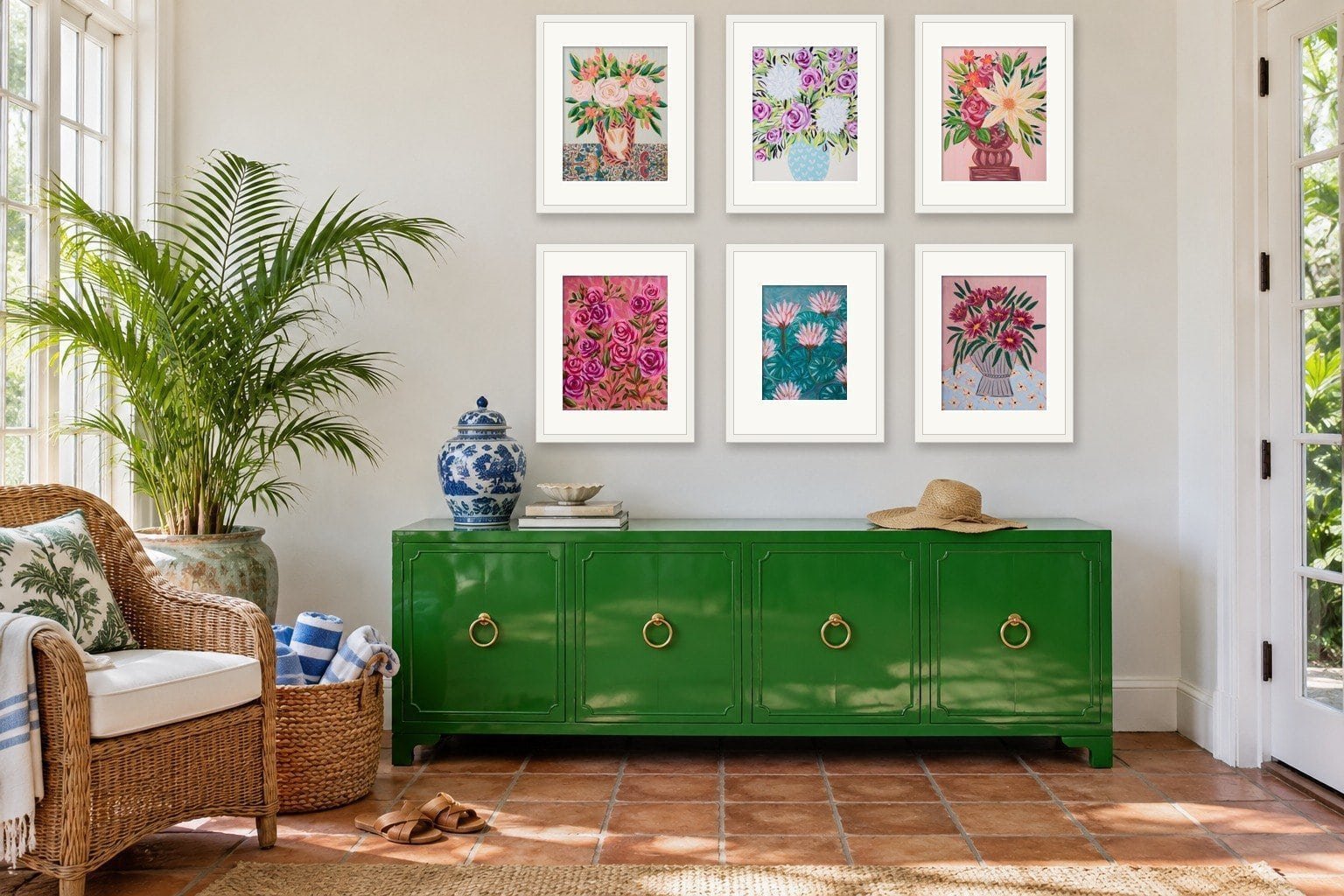
Start by Measuring the Wall and Treating the Grouping as 1 Piece
Before you pick a single painting, measure the wall and decide how much of it you want covered. Then think of your grouping as 1 large rectangle and measure its outer edges as if it were a single canvas. That outer rectangle is what the eye reads from across the room, so it is the number that matters.
If furniture sits against the wall, size the grouping to about 2/3 to 3/4 the width of the furniture. On a bare wall, leave generous open space on each side so the art has room to breathe. My 3 simple rules for hanging art cover height and scale in more detail, and my guide to gallery walls for every style walks through layouts and spacing for every kind of grouping. If you are planning a big wall, start there.
Small Originals Grow When You Frame Them
A small painting on paper gets much bigger once it is matted and framed. An 11×14 painting with a mat goes into a 16×20 frame, and a 9×12 grows to about 12×16 or 14×18. So a stack of modest paintings on paper turns into a set of frames with real presence on the wall.
Here is the math for a few common groupings of framed 16x20s, hung tall with 3 inches between frames:
- 3 in a row: 16 + 16 + 16 = 48 inches of frame, plus 2 gaps of 3 inches = 54 inches wide by 20 inches tall.
- 2 rows of 3 (6 pieces): 54 inches wide, and 20 + 20 + 3 = 43 inches tall.
- 3 rows of 3 (9 pieces): 54 inches wide, and 20 + 20 + 20 + 3 + 3 = 66 inches tall.
- 4 across, 3 rows (12 pieces): 16 x 4 = 64, plus 3 gaps of 3 = 73 inches wide by 66 inches tall.
To fit your own wall, swap in your frame size and gap. Width is the frames across added together, plus 1 gap fewer than the number of frames. Height works the same way going down. A 54-inch-wide grouping is close to 2/3 of an 84-inch sofa (56 inches), which is why 3 framed 16x20s look so right over a couch.
How to frame original artwork explains mats and frames for paper and canvas, and Try a Frame lets you preview frame colors on a painting first.
Gallery Wall Grids vs Salon Style
There are 2 main ways to arrange small art on a big wall, and both work with original paintings.
The Grid
A grid uses matching frames in matching sizes, lined up in even rows and columns with the same gap everywhere. It feels calm and tailored, and it lets a set of paintings in a similar palette or subject read as a series. The 3×3 grid of framed 16x20s above is a classic for a living room or dining room wall. A grid is also the simplest to hang, since every nail sits on the same measurements.
Salon Style
A salon wall mixes sizes, orientations and frames in a looser cluster. It feels collected over time, and it is a lovely home for paintings bought one at a time from different places. Here is a looser mix that fills about the same area as the 3×3 grid:
- 1 framed 16×20 or a 24×30 canvas as the anchor, a little left or right of center
- 2 framed 16x20s, 1 tall and 1 wide
- 3 framed 12x16s or 14x18s from 9×12 paintings
- 2 or 3 small canvases, 6×8 or 8×10, to tuck into the gaps
Keep 2 to 4 inches between every frame and fit everything inside an outer rectangle of about 54 by 66 inches. The pieces can vary inside it, but the outside edge stays steady.
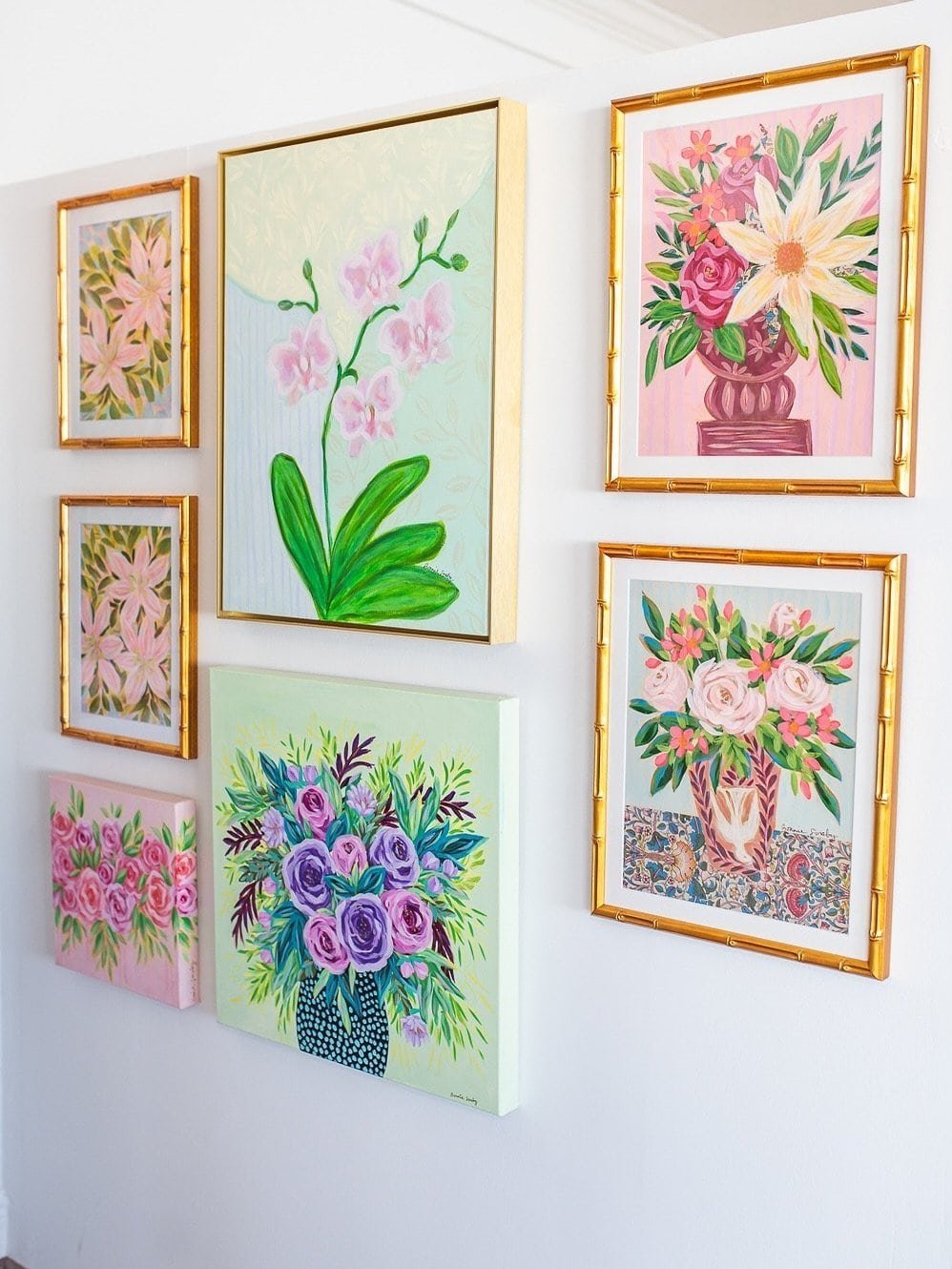
Mix Sizes With a Consistent Outer Edge
A clean outer edge makes a mixed grouping look intentional. Line up the top edges of the top row, the bottom edges of the bottom row, and the outside edges on the left and right. Inside that frame, sizes can play.
Mark the outer rectangle on the wall with painter’s tape first. Then trace each frame on kraft paper, cut the pieces out and tape them up inside your rectangle. Move them around for a day or 2 before you pick up a hammer. You can also mock up framed art on your own wall from a photo of the room to test a few layouts.
How to Decorate a Very Large Wall
On a wall 12 feet wide or more, a single 54-inch grouping can look lost. You have a few good options:
- Go wider: a grid of 4 or 5 across stretches the grouping to 73 or 92 inches using framed 16x20s.
- Anchor with furniture: center the grouping over a sofa, sideboard or bench so the wall feels furnished end to end.
- Use 2 groupings: split a long wall into 2 matching grids with a window, doorway or lamp between them.
A single big canvas can also hold a long wall, though grouping smaller originals lets you build the wall a few pieces at a time.
Filling a Tall Wall
Tall walls in great rooms, 2-story entries and stairwells call for a grouping that goes up as well as across. Keep the center of the lowest row near eye level so the art still connects with people in the room, then build upward. A 3×3 grid of framed 16x20s centered at 60 inches runs from 27 inches to 93 inches off the floor, which suits a standard wall. For a taller wall, add a 4th row or switch to a tall column of 2 across and 4 or 5 down. On stairs, keep each piece’s center 57 to 60 inches above the step directly below it so the grouping climbs on a diagonal with the handrail, and my stairway wall decor ideas go into more detail.
For smaller walls around the house, see entryway art and art above a bed, and floral wall art: which piece goes where brings every room together.
Frequently Asked Questions About Decorating a Large Wall
How many pictures do I need for a large wall?
Most large walls look full with 6 to 9 framed pieces. A grid of 6 framed 16x20s measures about 54 by 43 inches, and a grid of 9 measures about 54 by 66 inches with 3-inch gaps.
How far apart should frames be in a gallery wall?
Keep 2 to 4 inches between frames. Use the same gap throughout a grid, and keep salon-style gaps close to the same so the grouping reads as 1 piece.
How high should I hang a large grouping of art?
Put the center of the whole grouping 57 to 60 inches from the floor on an open wall. Over furniture, keep the bottom edge 8 to 10 inches above a sofa back or 6 to 10 inches above a console.
Can small art work on a big wall?
Yes. Frame small paintings with mats to bring them up in size, then group them closely so the outer edges add up to a big rectangle. An 11×14 painting framed at 16×20 gives you a lot of wall coverage.
Should I use a grid or salon style?
Choose a grid for matching frames and a calm, tailored look. Choose salon style for mixed sizes and pieces collected over time, and keep the outer edge consistent either way.
If you are dreaming up a big wall of your own, you are welcome to explore my original paintings, and Studio Steals is where I keep smaller pieces that group beautifully.