
Stairway Wall Decor Ideas With Small Original Art
The simplest stairway wall decor idea is a staggered line of small framed originals that climbs with the stairs, with the center of each piece 57 to 60 inches above the step directly below it so the whole grouping runs on a diagonal parallel to the handrail. A stair wall is one of the most walked-past walls in a house, and it suits small paintings beautifully, because people see each piece up close, one step at a time. As a South Florida painter who works mostly in sizes from 6×8 to 16×20, I love seeing my small originals on a staircase, where they get looked at every single day.
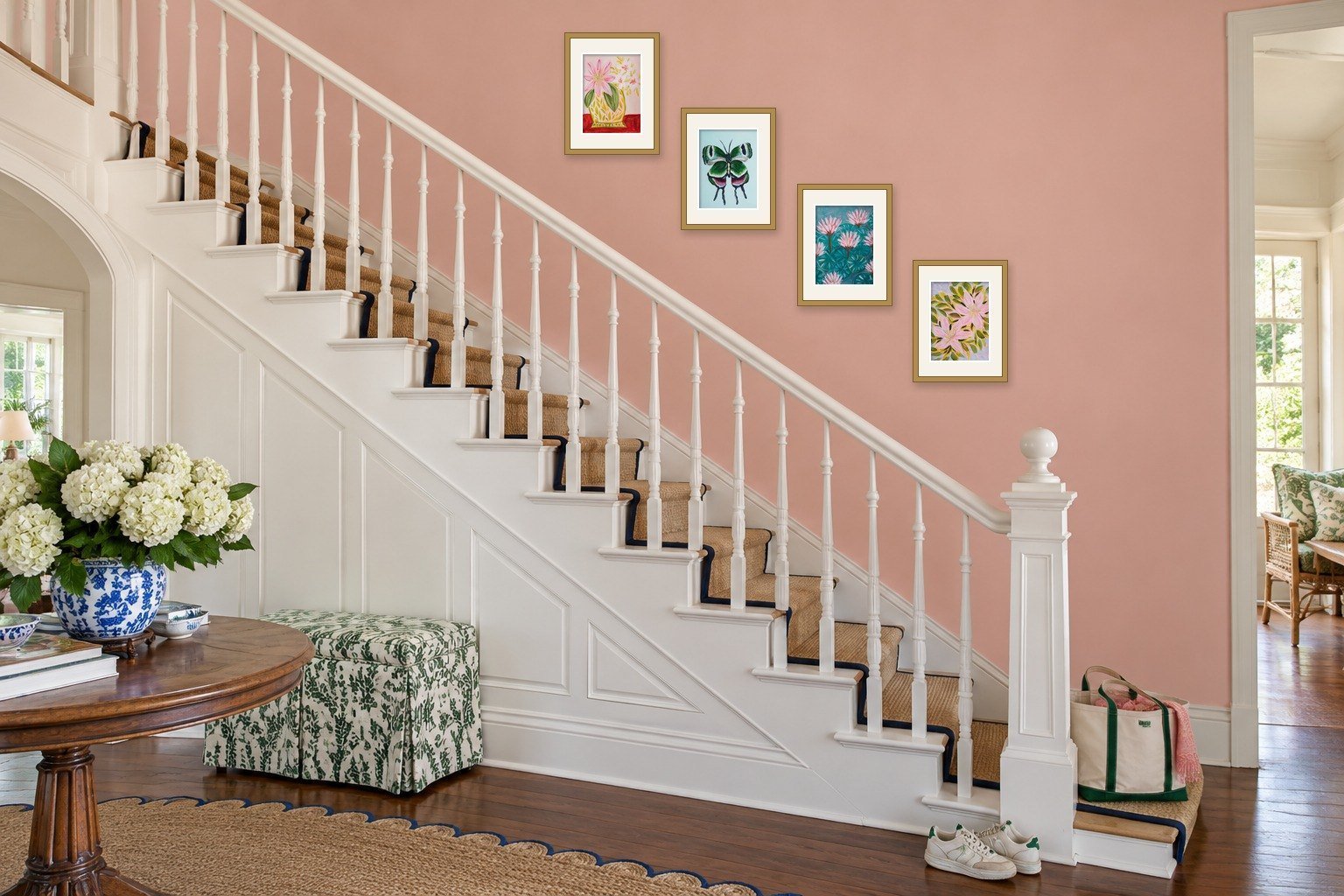
Follow the Handrail Diagonal
On a flat wall, the center of a painting usually sits 57 to 60 inches from the floor, which is about eye level for most adults. On stairs, the floor keeps rising, so the measurement moves with it. For each piece, find the step directly below it and mark the center of the frame 57 to 60 inches above that tread. Repeat for every frame, and the grouping climbs at the same angle as the stairs and the handrail.
That diagonal is what makes staircase wall decor look settled. If the frames all hang at 1 height, the ones at the bottom float far above your head and the ones at the top sit near your knees. Following the rail keeps every piece at a comfortable viewing height for someone walking up or down. My 3 simple rules for hanging art cover the same eye-level idea for every other wall in the house.
The Math for Framed Small Originals Climbing the Stairs
Small originals grow when you frame them, and on a stair wall that extra size helps. A 9×12 painting on paper with a mat goes into a frame of about 12×16 or 14×18, depending on how wide the mat is. A 14×18 frame has real presence on a stair wall, even though the painting inside is small.
Here is a worked example you can use for your own stairs, with 4 framed 9×12 originals in 14×18 frames:
- Width: 4 frames at 14 inches each is 56 inches, plus 3 gaps of 3 inches is 9 inches, so the grouping runs about 65 inches along the wall.
- Climb per frame: each frame center sits 17 inches to the right of the last one (14 inches of frame plus a 3-inch gap). A typical stair rises about 7.5 inches for every 10 inches of tread, so each center steps up about 13 inches (17 x 0.75 = 12.75).
- Total rise: the first center and the last are 3 steps apart, at about 13 inches each, for a climb of roughly 39 inches.
- Check: each center still lands 57 to 60 inches above the tread directly below it.
To fit your own stairs, measure 1 step’s rise and tread, divide rise by tread to get your slope, and multiply by the distance between frame centers. With 12×16 frames and 3-inch gaps, centers sit 15 inches apart, so on the same stairs each one climbs about 11 inches. Keep the gaps between frames at 2 to 4 inches, and measure the outer edges of the whole grouping as if it were 1 piece so it fits the wall between the bottom step and the ceiling line at the top.
Gallery Wall on Stairs Ideas
A gallery wall on stairs can be as tidy or as relaxed as you like. A few layouts that work well with small originals:
A Single Staggered Line
Matching frames in 1 size, climbing in a clean diagonal. This suits a narrow stairwell, and it lets each painting be seen on its own as you pass.
A Double Row
2 rows of small frames stepping up together, with the same 2 to 4 inches between rows as between frames. This fills a taller stair wall and gives you room for 8 to 10 small pieces.
A Mixed Cluster
Different frame sizes grouped loosely, with the cluster’s overall outline still following the rail. Keep the gaps even and pick 1 thread to tie it together, like a color that repeats, a single frame finish or a subject such as florals. These gallery wall layouts for every style show more ways to arrange a mixed group.
Decorating Stair Wall Ideas for Landing Walls
A landing is a little room of its own, and it gives you a flat floor again, so the regular rule returns: center the art 57 to 60 inches above the landing floor. Landing walls are often the first thing you see from the bottom of the stairs, which makes them a lovely spot for a grouping you want to stop and look at.
For a wider landing wall, 3 framed 16x20s in a row with 3-inch gaps measure 54 inches wide by 20 inches tall (16 + 3 + 16 + 3 + 16 = 54). That same grouping fills the wall over an 84-inch sofa, since 2/3 of 84 is 56, so it has plenty of presence on a landing too. If there is a bench or console on the landing, hang the bottom edge 6 to 10 inches above it and keep the grouping about 2/3 to 3/4 the width of the furniture. A single large painting works here too if you have one, though a grouping of small pieces lets you add to it over time.
For a narrow landing wall, a vertical stack of 2 or 3 small frames is often all it needs. The same idea works by a front door, and my guide to entryway art covers those narrow spaces in more detail.
Plan the Stair Wall Before You Hammer
Stairs make mistakes harder to fix, since you are working at an angle and often on a ladder. Trace each frame onto kraft paper, cut the pieces out, mark where the hanging hardware sits, and tape them to the wall. Walk up and down the stairs a few times and adjust until the diagonal feels even. Then nail through the paper at your marks and pull it away.
If you want to see the paintings themselves in place first, you can mock up framed art on your own wall from a photo of your stairwell, and Try a Frame lets you preview frame colors on a painting. For what canvas, board and paper each need, see how to frame original artwork. On a busy staircase, frames with secure hanging hardware and wall bumpers on the back corners stay straight as people brush past.
Choosing Art for a Staircase
Because people see stair art close up and in motion, small paintings with clear color and simple subjects read well from each step. Florals, birds, palms and coastal scenes all work, and a run of related pieces can feel like a story told 1 step at a time. If you are drawn to florals, my hub on floral wall art and which piece goes where walks through every room. For bigger flat walls elsewhere in the house, see how to decorate a large wall and art over a couch.
Frequently Asked Questions About Stairway Wall Decor
How high should art be hung on a stairway wall?
Keep the center of each piece 57 to 60 inches above the step directly below it. That way the grouping climbs on a diagonal parallel to the handrail.
How far apart should frames be on a stair wall?
2 to 4 inches between frames keeps a staircase gallery wall feeling like 1 grouping. Keep the gaps consistent along the whole climb.
What size frames work best going up stairs?
Frames from about 12×16 to 16×20 suit most stair walls. A 9×12 painting on paper with a mat goes into a 12×16 or 14×18 frame, which gives a small original real presence on the wall.
How do I hang art on a stair landing?
Treat a landing like any flat wall and center the art 57 to 60 inches above the landing floor. Over a bench or console, hang the bottom edge 6 to 10 inches above it.
How many pieces do I need for a gallery wall on stairs?
It depends on the length of the wall. 4 or 5 framed small originals fill a single staggered line on most straight staircases, and a double row holds 8 to 10.
If you would like to start a stair wall of your own, Studio Steals is where I keep smaller original pieces at a gentler price, and you are welcome to explore my original paintings any time.