
How to Find Your Life Purpose: A Practical Guide
If you’re wondering how to find your life purpose, start by paying attention to what comes naturally to you, what brings meaning to your life, and where your gifts can make a difference for other people. Give yourself permission to explore, follow what interests you, and recognize that your understanding of purpose will continue to evolve as you do.
There is a version of you who knows what she is building and what belongs inside it, and who no longer has to guess whether the next move belongs to the same thing as the last one. Your Contribution Pattern is designed to help you see the through-line already running through your work, voice and instincts, with the language and evidence for it, now while you are still deciding what comes next.
What Is a Life Purpose, Anyway?
I would relate it to peeling back layers of the onion. I love that analogy for a lot of different things, for my health journey, for this idea of life or soul purpose. I think it reveals itself in a lot of different ways through different people that we meet and situations and just how life unfolds for us.
Sometimes a new layer reveals something you hadn’t considered before. Other times, you realize something that’s been part of you all along has a significance you never fully appreciated.
I think we can get so caught up in trying to identify our one great purpose that we overlook the many ways we’re already expressing it. Maybe it’s through your work, your relationships, your creativity, your family, or the way you show up for your community. Maybe it’s something you haven’t explored yet.
For me, purpose has a lot to do with understanding what we’re naturally equipped to contribute, what brings us fulfillment, and how those things find expression in our lives.
Why Is Finding Your Life Purpose So Difficult?
Stop expecting it to be some final destination, because I think it’s this ever-evolving new understanding. We’re chasing some single answer, and maybe there is a single answer in this season of life, in this chapter.
As humans we’re innately curious, evolving people. As we meet new people and find new understanding or learn about some new practice or become interested in this or that, our path is being guided and it’s a winding, changing road. New doors open, some doors close, there has to be some flexibility.
Consider how much you’ve changed over the last 10 or 20 years. The things you wanted, the things that interested you, the responsibilities you carried, even what you considered a meaningful life may be very different today.
There’s also the question of what happens once you have some understanding of your purpose. Meaning needs somewhere to land. You can recognize that you’re creative, compassionate, analytical, or particularly good at helping people solve problems, but eventually those qualities need opportunities for expression. And sometimes the life you’ve built leaves very little room for that.
6 Practical Ways to Find Your Life Purpose
1. Pay Attention to What Comes Easily to You
I do think you have to follow what you’re good at too. As much as I want to say just do what you love, obviously that’s not always practical. So how do you at least make it bearable? You do things that you’re good at, what comes easy to you.
We often overlook our own gifts because we assume that if something is easy for us, it must be easy for everyone else. Meanwhile, someone else might find that same thing difficult.
Think about the things people regularly come to you for. Maybe you’re the person who can organize a complicated situation, explain something in a way that finally makes sense, notice details everyone else misses, or come up with ideas seemingly out of nowhere. What feels almost ridiculously easy to you?
2. Notice Where You’re Meeting Constant Resistance
One of the things I’ve come to recognize is that when just everything is hard, you’re off track. Life will have challenges, and then there’s the kind of hard that feels like a brick wall.
Another sign is the resistance to whatever you’re doing. I was burnt out and forcing myself to keep performing a job that was bringing no light to my life.
Difficulty alone doesn’t mean you’re doing something wrong, since every worthwhile pursuit comes with frustrations, learning curves, and responsibilities we’d probably prefer to avoid. But there’s a difference between the occasional hard day and a persistent feeling that you’re forcing yourself through a life that no longer fits.
If you’re feeling that resistance, get curious about where it’s coming from. It might be the work itself, the environment, the expectations, or the amount of time and energy you’re giving to something that no longer feels meaningful. You may discover that you need a significant change, or you might find that a relatively small adjustment creates some breathing room.
3. Look for Ways Your Gifts Can Help Other People
To really find purpose and meaning in life, I feel we need to feel helpful, to create impact in the world.
There’s something satisfying about knowing that who we are and what we’re naturally good at has value beyond our own enjoyment. And impact doesn’t have to be particularly grand. You might make someone’s day easier, create something beautiful that brings another person joy, offer a perspective that helps someone understand themselves, or simply be a steady presence in the lives of people you love.
Consider where your strengths intersect with something another person genuinely needs, and what people appreciate about your contribution even when you barely notice you’re doing it.
That’s where the idea behind Your Contribution Pattern comes in for me. It reaches past finding some career you can tolerate and into fulfillment, purpose and the contribution you make in the world. Your work may be one expression of that contribution, and it doesn’t have to be the only one.
4. Follow the Small Clues and See Where They Lead
A Reiki session told me I should be painting.
It’s brought so much joy into my life, and it’s not even a huge part of my income, and yet it has filled my cup in so many ways. It’s brought so many incredible people into my world, and some of them have turned into different opportunities that are not just art related. It’s a ripple effect.
To be fair, painting wasn’t out of left field for somebody who’s been creative her whole life. Sometimes the thing worth exploring is already familiar to us. We may have set it aside, underestimated its importance, or simply never considered what might happen if we gave it more attention.
You don’t have to know how an interest will serve you 5 years from now to give it a little space in your life today. Take the class, make the thing, read the book, have the conversation, and see what happens.
5. Make Time to Look Inward
I think a lot of people are just missing it when it’s right in front of them, because they haven’t slowed down long enough to look inward and see it for what it is.
We’re surrounded by expectations about careers, income, accomplishments and productivity, and it’s easy for them to become so familiar that we stop questioning whether they’re even ours.
This is where self-reflection becomes useful. Journaling, meditating, or simply spending some time thinking without reaching for another distraction can help you recognize what matters to you. You might ask yourself which parts of your life feel nourishing, and what you continue to feel drawn toward even when there’s no practical reason to pursue it. Also, pay attention to what you’re giving yourself permission to want.
Honestly, I feel like astrology gave me a lot of direction and clarity around soul purpose. For me it’s shaping up, at least in this season of life, to be very different than I would have given myself permission for it to be. Almost too easy. And yet when I’ve leaned into that, things have just fallen into place in a lot of ways.
That has made me question how often we dismiss something meaningful simply because it doesn’t look difficult or impressive enough.
6. Give Yourself Room to Change Your Mind
What feels meaningful today may develop into something entirely different in another season of life, and that’s allowed. You can be committed to something without insisting it define you forever, and you don’t have to turn every new interest into your next big thing.
Some things are worth exploring simply because they bring richness to your life. There’s no requirement that your answer at 25 be the same as your answer at 45 or 65.
What the Usual Life Purpose Advice Gets Right (and Where I Land)
If you’ve searched for how to find your life purpose, you’ve probably met some familiar recommendations. Here’s where I land on them.
Self-reflection, journaling, and meditation? I don’t disagree, especially when you’ve been so busy meeting everyone else’s needs that you’ve barely considered your own.
Ikigai? Pretty spot on. The popular framework asks you to consider what you love, what you’re good at, what the world needs, and what you can be paid for. I appreciate that it includes both meaning and practicality.
Hire a life coach? I’m a little bit anti, unless you have a very specific goal in mind.
Identify your values and strengths with an assessment? Maybe, if you’re having trouble seeing your gifts. Sometimes an outside framework helps us recognize qualities we’ve taken for granted, and Your Contribution Pattern does that too.
Help others or volunteer? Not a bad idea. Putting yourself in situations where you can contribute, meet new people, and experience different perspectives may reveal interests or abilities you haven’t had much opportunity to use.
Don’t wait for a big revelation because purpose changes over time? Spot on.
And then there’s the idea that you create your purpose through action. Yes and no. Action helps you discover it because it puts you in situations. You meet people, learn things, develop skills, and encounter opportunities that might never have appeared otherwise.
But many people miss it when it’s already in front of them, and slowing down to look inward is what lets them see it for what it is. I think both matter. You need experiences that give you something to learn from, and you need enough awareness to recognize what those experiences are showing you.
How I Approach Life Purpose Through Astrology
Astrology is one of the less conventional ways I explore life purpose, and it’s been meaningful in my own understanding of it. It’s a little bit of that onion analogy where you’re constantly finding some new piece that opens something up.
I love that astrology invites you to go inward instead of looking outward for answers. It gives you a means, questions to ask, categories of life to consider, something to think about.
I don’t see a birth chart as a definitive statement about what someone must do with their life. It can offer clues, bring certain patterns into focus, and encourage questions you might never have thought to ask.
What I Look at in a Birth Chart for Life Purpose
I look at all the basic parts: your North Node, your 6th house, wherever any concentrated energies are in the chart. The 7th house is very interesting, the 2nd house for earnings, the 11th house for how you reach out and make impact. It varies chart to chart, because it depends on where the energies are concentrated and what’s important in that chart.
The North Node is often associated with the qualities and experiences we’re learning to develop, while the South Node represents familiar patterns and tendencies. Together, they can provide an interesting lens for considering where we feel comfortable and where life may be inviting us to grow.
The 6th house can bring up questions about daily work, service, routines, and how you use your abilities in practical ways. The 2nd house can help us explore values, resources, and earning potential, while the 7th house brings relationships and partnerships into the conversation. The 11th house is particularly interesting when considering community, collective contribution, and the impact we hope to have beyond ourselves.
There’s no single placement that answers the entire question of life purpose, and I wouldn’t want there to be. We’re complicated people with many different ways of expressing who we are.
If you’d like to go deeper on this side of it, I cover the astrology in full in What Is My Soul Purpose? What Astrology Shows, and Is Your North Node Your Life Purpose? looks at the North Node on its own.
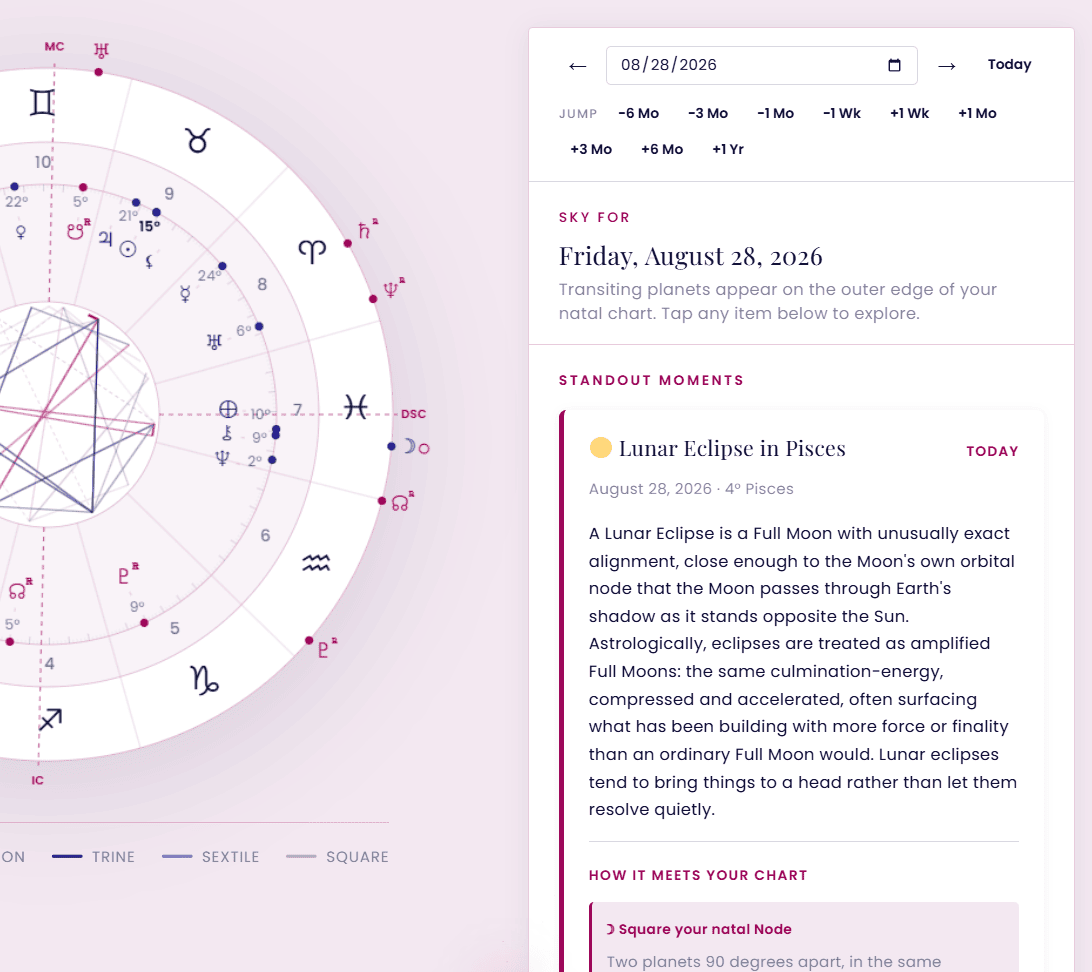
You can start with your placements in the free birth chart. Your Beautiful Birth Chart then lets you explore your placements by sign and house, see aspects, and move through transits by date.
Why Your North Node Might Not Resonate Yet
I had a revelation recently that some people may come to astrology at a stage that isn’t yet their deepest. They may not resonate yet with what their North Node is suggesting they’re here to reach for.
For a great deal of people’s life they’re in South Node energy, and I’m sure certain events could propel that shift.
For example, my North Node in Taurus in the 4th house is all about home life, slowing down, steadiness. If I had read that before I had health challenges or children, I might not see how that could possibly make sense.
We may understand something intellectually long before we understand it through living. You might read something in your chart that resonates immediately, or you may find yourself returning to an idea years later with an entirely different perspective, and neither experience needs to be forced.
You Don’t Have to Have It All Figured Out
I hope you leave with a little clarity, a little permission to let it be easy, and some relief that you don’t have to have it all figured out.
I think we’re so accustomed to believing that meaningful things require enormous effort that we can overlook what comes naturally. We keep searching for something bigger, more impressive, or more definitive, when sometimes the next clue is sitting in plain view.
For me, painting is a wonderful reminder of that. It doesn’t have to become the largest part of my income to hold an important place in my life, and I think the same is true of purpose. There can be meaning in the work you do, the people you care for, the things you create, and the ways you contribute that may never appear particularly remarkable from the outside.
You may find that your understanding changes dramatically in another 5 or 10 years. That’s okay. There are more layers of the onion to peel back, more people to meet, more things to learn, and probably a few surprises along the way. For now, you can simply start with what’s in front of you, and maybe give yourself a little more credit for what already comes easily.
Everything here helps you collect clues. The harder part is seeing what they add up to. Your Contribution Pattern reads your chart for the contribution themes already moving through your life, work, voice and instincts, and names the through-line connecting them.
Frequently Asked Questions About Finding Your Life Purpose
How do I find my life purpose if I have no idea what I want to do?
Start by identifying what comes naturally to you, what interests you, and where you feel useful to other people. If you feel completely disconnected from those things, think back to activities you enjoyed before you became concerned with whether they were practical or productive.
Can my life purpose change over time?
Yes, your understanding and expression of life purpose can change considerably over time. New relationships, responsibilities, interests, and experiences can change what feels meaningful to you, and something that once occupied a central place in your life may eventually make room for something else.
Does my life purpose have to be my career?
No, your life purpose doesn’t have to be connected to your career or the way you earn money. Work can be one avenue for using your gifts, and so can creativity, relationships, family life, community involvement, and personal interests. You can find considerable fulfillment in something that never becomes a significant source of income.
How can I tell if I’m on the wrong path in life?
Persistent resistance, burnout, and a feeling that everything has become unnecessarily difficult can be signs that something in your life needs attention. Everyone encounters challenges, so look at whether the friction is temporary, whether your circumstances need adjusting, or whether you’re continuing to force yourself into something that no longer feels meaningful.
Can astrology help me discover my life purpose?
Astrology can offer useful prompts for exploring your natural tendencies, values, relationships, work, and sense of contribution. I consider several areas of the birth chart, including the North Node and the houses associated with daily work, resources, relationships, and community. These interpretations aren’t scientific determinations of purpose, and they don’t tell you what you must do with your life. For the career side, see how astrology reveals your calling and career path.