
gallery wall ideas for every style, and how to hang one

A gallery wall is a group of framed art hung close enough together that it reads as 1 piece. The easiest version starts with 1 anchor piece, a few smaller pieces around it, and frames spaced no wider than the width of your hand. Below are gallery wall ideas for every style, from colorful and maximalist to minimalist and traditional, plus the layouts and sizes I use on my own walls and how to hang them without the guesswork.
colorful gallery walls
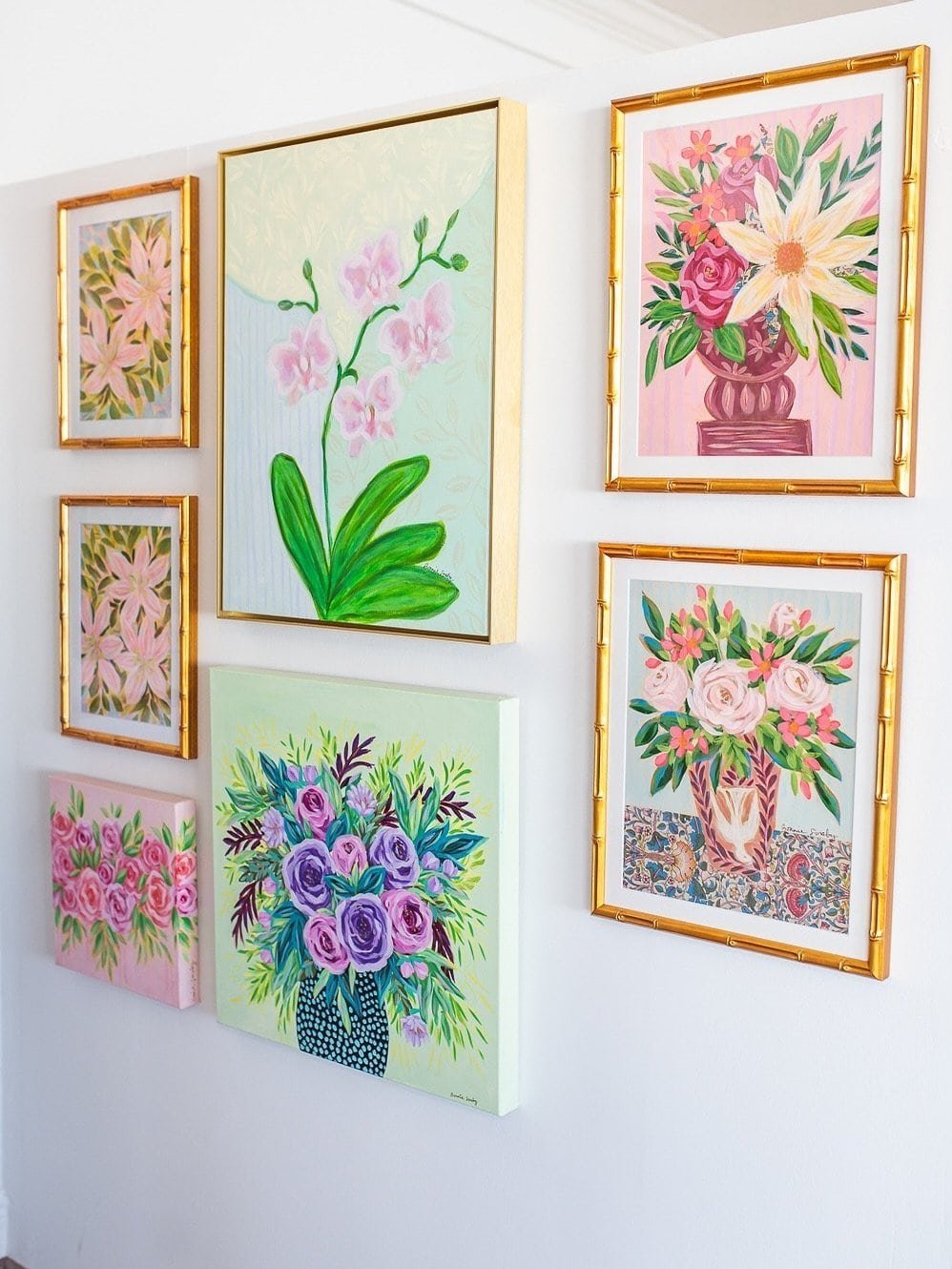
A colorful gallery wall works when the color repeats. That’s the whole secret. Pick 1 or 2 colors that show up in almost every piece, like the pinks and greens on my wall, and let them carry the eye from frame to frame. The pieces can be different sizes, subjects and frames, and the wall still reads as 1 story because the color ties it together.
When you mix framed works on paper with unframed canvases, the wall feels collected and relaxed, and a matching frame finish, like the gold bamboo here, does the same quiet work as the repeated color. If you want to start small, 3 bright originals hung close together will give you the feel of a colorful wall without filling the whole thing at once.
go bold with Maximalist Gallery Walls

Bold and Abundant: Maximalism is all about embracing excess and celebrating abundance. For a maximalist gallery wall, think big, bold, and colorful. It’s a style that thrives on variety and visual excitement.
Tips:
- Mix and Match Frames: Combine different frame styles, sizes, and colors. The more varied, the better. Think gold, black, wooden, and colorful frames all together.
- Vibrant Artwork: Choose artwork with bright, saturated hues that will make your wall pop. Don’t shy away from clashing colors or bold patterns.
- Full Coverage: Fill the wall with art from floor to ceiling. The goal is to create a dense, vibrant collage that feels immersive.
- Eclectic Art Choices: Include a mix of paintings, prints, photographs, and unique items like plates, masks, or even small sculptures mounted on the wall.
- Personal Touches: Incorporate personal items like travel souvenirs, your children’s artwork, or cherished letters. This adds a unique and intimate touch to your gallery wall.
keep it simpler with Minimalist Gallery Walls

Clean and Simple: Minimalism focuses on simplicity and functionality. A minimalist gallery wall is sleek, carefully curated, and purposeful.
Tips:
- Consistent Frames: Stick to one frame style, preferably in a neutral color like black, white, or natural wood. This creates a cohesive look that’s easy on the eyes.
- Neutral Palette with Pops of Color: While a subdued color palette is typical, don’t be afraid to include sparing touches of color. A few well-placed colorful pieces can bring life and energy to the space while maintaining a minimalist vibe.
- Negative Space: Leave ample space between each piece to avoid a cluttered look. This emphasizes the beauty of each individual piece.
- Quality over Quantity: Select a few high-quality, meaningful pieces rather than many. Minimalism is about appreciating the art itself.
- Natural Elements: Consider incorporating natural textures and colors, like wood frames or botanical prints, to add warmth and subtle color to the minimalist setting.
grid gallery walls
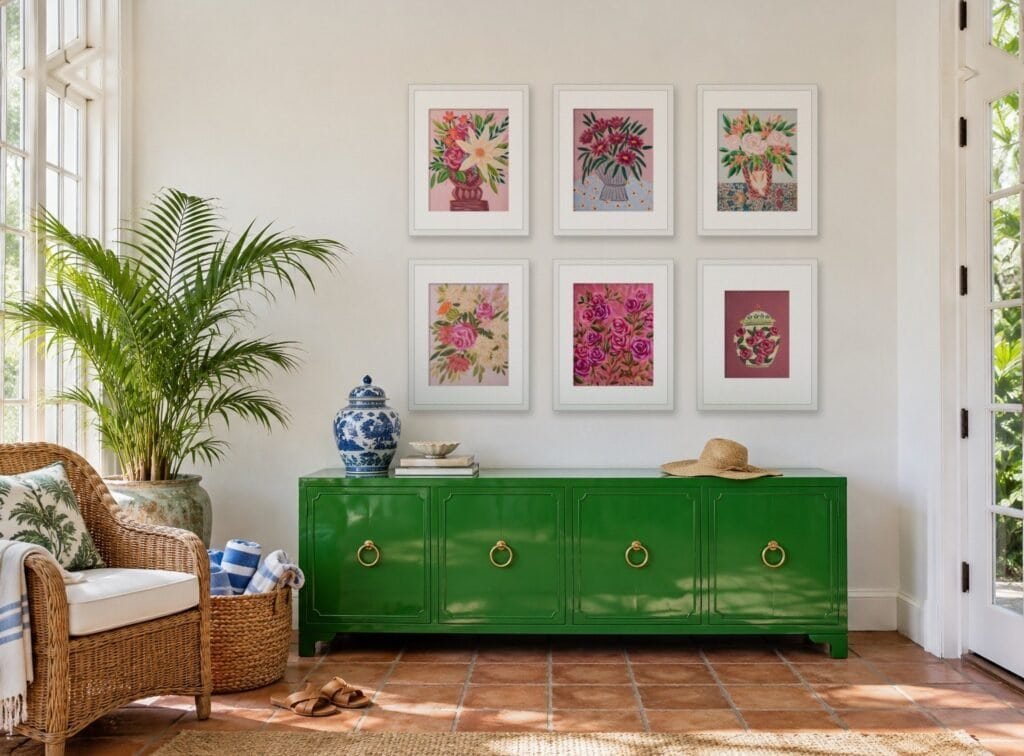
A grid gallery wall uses matching frames in matching sizes, lined up in even rows and columns with the same gap everywhere. It’s the most forgiving layout there is. The order does the styling for you. If you have a set of small paintings that would get lost on a big wall one at a time, a grid lets you hang them as 1 bold piece.
6 framed 16x20s in 2 rows of 3, with 3-inch gaps, measure 54 inches wide by 43 inches tall. 9 of them in a 3 by 3 grid measure 54 by 66 inches. For more sizes, see my grids and groupings for a large wall.
salon style gallery walls
Salon style hanging is the looser, collected look, with different sizes, orientations and frames grouped closely together, the way paintings were stacked in old Paris salons. The trick to keeping it from looking random is an anchor. Start with your largest piece a little left or right of center at eye level, then build outward, keeping the gaps close to the same and the outer edge of the whole grouping roughly rectangular.
Salon style is where mixing originals with personal pieces really shines, and it suits vintage and eclectic gallery walls beautifully. Lay everything out on the floor first, and step back often while you hang.
Grandmillennial Gallery Walls too
Nostalgic and Cozy: The grandmillennial style brings a touch of nostalgia with a modern twist. It’s characterized by a love for vintage and heirloom pieces, combined with contemporary sensibilities.
Tips:
- Vintage Frames: Use ornate, antique-style frames that bring a sense of history and charm to your gallery wall.
- Floral and Patterned Art: Incorporate botanical prints, needlepoint, and vintage posters. These elements add a touch of classic elegance.
- Mix Old and New: Blend contemporary pieces with vintage finds for a fresh take on nostalgia. This could include modern art prints in vintage frames or classic art pieces displayed in a new, unexpected way.
- Symmetry: Arrange art in a symmetrical layout to create a sense of order and harmony. Symmetry is pleasing to the eye and helps balance the eclectic nature of the grandmillennial style.
- Heirloom Pieces: Include family heirlooms or thrifted treasures to add personal significance and historical depth to your gallery wall.
can’t go wrong with Traditional Gallery Walls
Classic and Timeless: Traditional gallery walls exude elegance and sophistication, focusing on classic art and orderly arrangements.
Tips:
- Uniform Frames: Choose frames that are similar in style and color for a cohesive look. Think classic wood or gold frames that evoke a sense of timelessness.
- Classic Art: Opt for traditional artworks like landscapes, portraits, and classical prints. These pieces should evoke a sense of history and refinement.
- Symmetrical Layouts: Arrange pieces symmetrically, either in a grid or a balanced formation. This creates a structured, harmonious look that’s visually pleasing.
- Matting: Use matting in frames to add a polished, museum-like quality to your wall. Matting can make each piece stand out more distinctly.
- Consistent Theme: Stick to a consistent theme, such as all black-and-white photography or all botanical prints, to create a cohesive and harmonious gallery wall.
how far apart should pictures be on a gallery wall?
Keep 2 to 4 inches between frames, no wider than the width of your hand. That is my rule, and it means you never have to pull out a ruler. Hold your hand flat between 2 frames, and if the gap is wider than your hand, slide them closer.
Use the same gap everywhere on a grid. On a salon style wall, keep the gaps close to the same so the grouping still reads as 1 piece. Even a minimalist wall looks more intentional at the wide end of that range than with pieces drifting across the wall on their own.
gallery wall layouts with sizes
To work out the size of any layout, add up the frame widths, then add the gaps between them. There is always 1 fewer gap than frames. Aim for the whole grouping to be about 2/3 the width of the furniture below it, and hang the center of the grouping at 57 to 60 inches from the floor. A few common layouts with framed 16x20s and 3-inch gaps:
- A pair side by side measures 35 inches wide by 20 inches tall, which suits a full or queen bed or a 48-inch console.
- A row of 3 measures 54 inches wide by 20 inches tall, which suits an 84-inch sofa or a king bed.
- A grid of 6 in 2 rows of 3 measures 54 by 43 inches.
- A grid of 9 in 3 rows of 3 measures 54 by 66 inches, enough to hold a big empty wall.
gallery wall ideas by room
- For a living room, see art over a couch, with sizes, height and groupings.
- For a bedroom, see art above the bed, with pairs that work.
- For a staircase, see stairway wall decor ideas with small original art.
- For an entryway or hallway, see entryway and hallway art for passing walls.
- For a big empty wall, see how to decorate a large wall with small original art.
General Tips for Styling and Spacing your groupings

Planning and Layout: Before committing to hanging anything on the wall, it’s crucial to plan your layout. This can save you time and help you visualize the final look.
Tips:
- Use a Tabletop or Floor: Lay out your frames on a large table or the floor to experiment with different arrangements. This allows you to see how the pieces work together and make adjustments easily.
- Painter’s Tape: Use painter’s tape to outline the frames on the wall. This helps you visualize the spacing and arrangement without making any holes.
- Spacing Rule of Thumb: A good rule of thumb for spacing is to keep 2-4 inches between each frame. Use your hand as a guide. You should have no more than a hands width between pieces. This provides enough space for each piece to stand out while maintaining a cohesive look, without anything floating off in space.
- Eye Level Focus: Start by placing the central piece at eye level, which is typically about 57-60 inches from the floor. This creates a natural focal point.
- Balance and Harmony: Ensure that your gallery wall feels balanced. Mix larger pieces with smaller ones, and distribute colors and textures evenly across the arrangement.
General Tips for gallery wall Installation
Installation: Once you’re happy with your layout, it’s time to start hanging.
Tips:
- Mark and Measure: Use a measuring tape and a level to ensure your frames are evenly spaced and straight. Mark the spots lightly with a pencil.
- Picture Hanging Tools: Invest in good picture hanging tools like hooks, nails, and wall anchors appropriate for your wall type. This ensures your frames stay securely in place.
- Step Back: After hanging each piece, step back to see how it looks from a distance. This helps you maintain perspective and make adjustments as needed.
gallery wall questions
How far apart should pictures be hung?
2 to 4 inches between frames. A hand’s width is the easy measure, and a group spaced that way reads as 1 piece.
How high should a gallery wall be?
Hang the center of the whole grouping at 57 to 60 inches from the floor. Over furniture, leave about 8 to 10 inches between the top of the furniture and the bottom of the lowest frame.
How do I make a gallery wall look intentional?
Repeat something across every piece, like a color, a frame finish or a subject, keep the gaps consistent, and start from 1 anchor piece. Those 3 things make even a mix of sizes look planned.
What size should a gallery wall be?
About 2/3 the width of the furniture under it. On a bare wall, leave a margin around the grouping so it does not run edge to edge.
No matter your style preference, creating a gallery wall is a personal and creative endeavor. By following these tips tailored to maximalist, minimalist, grandmillennial, and traditional aesthetics, along with general styling and spacing advice, you can design a gallery wall that enhances your space and reflects your unique taste. Experiment, have fun, and let your walls tell your story.
Studio Steals is where the smaller pieces and past work live, and the rest of my original artwork is in the shop.
Thanks for being here <3
Bonnie