
Calculate Your Moon Sign + What It Means In Astrology
Looking for yours right now? Pull your free birth chart and your Moon sign is listed with the ☽ glyph. Your birth date usually settles it, since the Moon changes sign every two to three days, though your birth time matters if you were born on a day it shifted.
Most people know their Sun sign.
Far fewer know their Moon sign… and really, that is usually the one that makes people stop mid-reading and go “wait… why is this painfully accurate?”
Your Moon sign in astrology speaks to your emotional world. The part of you that reacts before you think. The version of you that shows up when you are overwhelmed, safe, hurt, attached, nostalgic, anxious, loved, emotionally exhausted, or trying to comfort yourself after a long day.
Your Sun sign may describe your identity and direction, but your Moon sign often describes your inner climate. Your emotional wiring. The things you need in order to feel grounded, connected, understood, and okay.
And sometimes people spend years reading their Sun sign descriptions without fully relating… until they discover their Moon sign and suddenly everything makes way more sense.
Find Your Moon Sign
You can find your Moon sign using your free birth chart.
Your Moon sign is calculated using your birth date, birth location, and ideally your exact birth time, since the Moon moves through the zodiac fairly quickly. Even a difference of a few hours can sometimes change your Moon sign entirely.
And honestly, this is usually one of the placements people end up obsessing over once they learn it.
It describe the emotional patterns underneath everything else. The reactions you do not always consciously choose. The things that make you feel safe, overwhelmed, connected, comforted, emotionally exposed, or understood. Though if we’re being completely honest, Your Personal Pattern™ goes to a whole different level on those kinds of emotional patterns.
But anyway, if your Sun sign never fully felt like the whole story… your Moon sign may very well explain why.
What Is A Moon Sign In Astrology?
In astrology, the Moon represents your emotional nature.
It governs instinctive reactions, emotional processing, comfort patterns, attachment, memory, vulnerability, and the ways you seek emotional safety. While your Sun sign often describes your conscious identity and outward vitality, your Moon sign often operates underneath the surface.
This is why people often resonate with it so deeply.
Your Moon sign can show:
- how you process emotions
- how you react under stress
- what makes you feel emotionally secure
- how you nurture others
- what kind of emotional environment affects your nervous system
- how you experience intimacy and connection
It is not just “how emotional you are.” Every sign feels deeply in its own way. The difference is how those emotions move, process, protect, express, suppress, intellectualize, or stabilize themselves.
And honestly, once you start paying attention to Moon sign patterns in real life, it becomes really difficult to unsee them.
How To Find Your Moon Sign
To calculate your Moon sign accurately, you need:
- your birth date
- your birth location
- your birth time
The Moon changes signs approximately every 2 to 2.5 days, which means timing matters far more than many people realize.
Someone born earlier in the day may have a completely different emotional makeup than someone born later that same evening.
That is also why birth charts become so much more interesting once you have accurate birth information. Astrology is not just about your zodiac sign. It is a full map of planetary placements, houses, aspects, and patterns interacting together.
If you are unsure of your birth time, you may want to read:
- “Why Birth Time Matters In Astrology”
- “What Are Houses In Astrology?”
- your Rising Sign calculator results alongside your Moon sign
Because once those pieces start connecting together, astrology becomes significantly more layered and personal.
Why Your Moon Sign Feels So Personal
The Moon is fast moving, reactive, cyclical, and deeply tied to human rhythm.
Astrologically, it represents the emotional body.
It can describe why one person withdraws emotionally while another talks everything through immediately. Why one person needs reassurance while another needs space. Why some people process emotions physically through their nervous system while others intellectualize them first.
This is also why Moon sign compatibility becomes such a huge topic in relationships. People are not just relating through personality. They are relating through emotional habits, attachment styles, coping patterns, sensitivity levels, and nervous system responses.
And your Moon sign often shows where those patterns live.
Moon Sign vs Sun Sign
One of the biggest misconceptions in astrology is thinking your Sun sign is your entire personality.
Your Sun sign matters deeply of course, but it is only one part of the chart.
Your Sun sign often describes:
- identity
- vitality
- self expression
- conscious direction
- what you are growing into
While your Moon sign often describes:
- emotional responses
- subconscious reactions
- comfort and safety
- attachment patterns
- emotional needs
You may act very differently emotionally than people expect based on your Sun sign alone.
For example, someone with a fiery, outgoing Sagittarius Sun may still have a deeply cautious or emotionally private Moon sign underneath that confidence. Someone who appears highly logical externally may have an incredibly sensitive emotional inner world.
What Your Moon Sign Means
Aries Moon
Aries Moons often react quickly and feel emotions intensely in the moment. They often process emotionally through action, movement, independence, and directness.
Taurus Moon
Taurus Moons usually crave emotional stability, consistency, comfort, and grounded routines. Their nervous systems often respond strongly to environment and security.
Gemini Moon
Gemini Moons often process emotions mentally first. Talking things through, analyzing situations, learning, movement, humor, and mental stimulation can all become emotional outlets.
Cancer Moon
Cancer Moons often feel everything deeply and personally. Emotional memory, attachment, protection, nurturing, and sensitivity are often heightened here.
Leo Moon
Leo Moons often need emotional warmth, recognition, affection, creativity, and genuine appreciation. Their emotional world can be incredibly generous and expressive.
Virgo Moon
Virgo Moons frequently process emotions through observation, analysis, improvement, routines, and nervous system regulation. Emotional vigilance is common here.
Libra Moon
Libra Moons often seek emotional harmony, balance, reassurance, beauty, and relational connection. Conflict and emotional tension can feel especially disruptive.
Scorpio Moon
Scorpio Moons often experience emotional intensity, deep loyalty, privacy, emotional protection, and profound transformation through relationships and trust.
Sagittarius Moon
Sagittarius Moons usually need emotional freedom, perspective, meaning, movement, and room to breathe emotionally without feeling emotionally trapped.
Capricorn Moon
Capricorn Moons often learn emotional self control early. Responsibility, stability, structure, and emotional resilience can become strong themes.
Aquarius Moon
Aquarius Moons frequently process emotions intellectually or through detachment first. Independence, individuality, observation, and unconventional emotional patterns are common.
Pisces Moon
Pisces Moons often absorb emotional environments deeply. Intuition, imagination, empathy, sensitivity, escapism, and emotional permeability can all be heightened.
Your Moon Sign Is Only One Layer
Your Moon sign matters, but it is still only one part of your birth chart.
The house your Moon is in, the aspects it makes to other planets, your Rising sign, and your overall chart pattern can completely change how your emotional world expresses itself.
Two people with the exact same Moon sign can still experience emotions very differently depending on the rest of their chart.
That is why astrology starts becoming much more useful once you stop looking at isolated placements and start looking at the patterns.
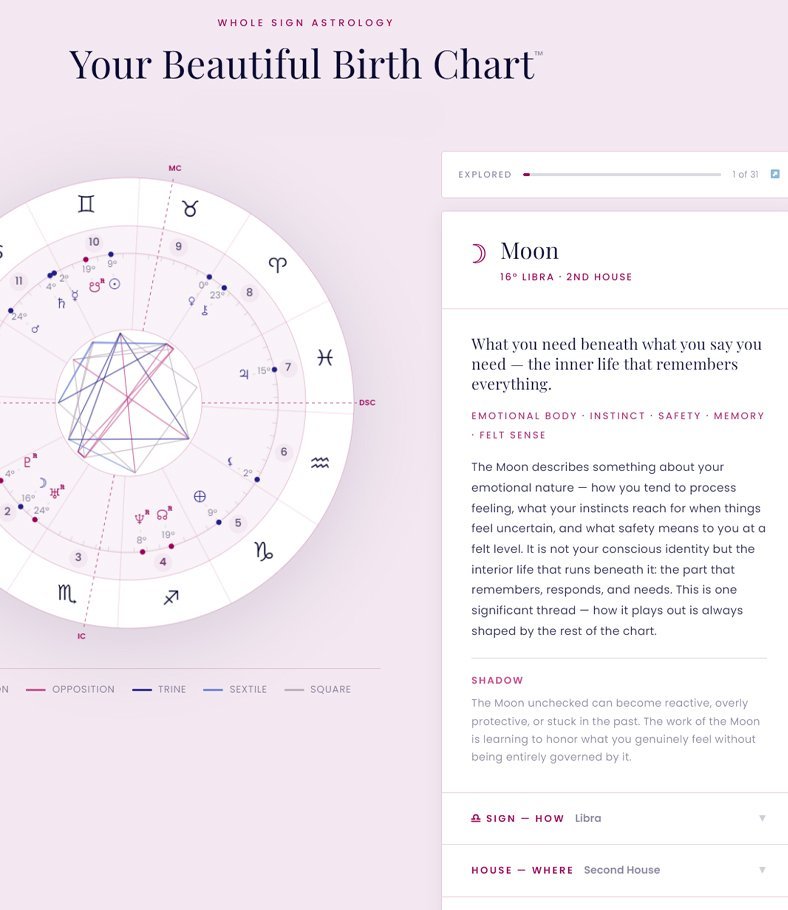
If you want to explore your full chart more deeply, including your houses, aspects, transits, and emotional patterns in context, you can explore my interactive birth chart experience, Your Beautiful Birth Chart, where you can learn your placements visually and track your transits in real time.
The Moon Through the Houses
The house the Moon occupies shows where the instinct for safety and emotional nourishment often gets focused. The sign describes how a person feels. The house describes where that feeling gets lived out most visibly and where security often gets sought most actively.
Moon in the 1st House
The emotional life is written on the body and the face. Mood and inner state often come through immediately and visibly, sometimes before the person has fully registered what they are feeling themselves. This placement is often perceived as more emotionally expressive or changeable than others, and there is a quality of leading with the feeling rather than filtering it first. The physical presentation shifts with the inner weather in ways that are hard to conceal.
Moon in the 2nd House
Emotional security is closely tied to material stability and personal resources. The 2nd house is the realm of what is owned, earned, and held, and with the Moon here, financial or material uncertainty can trigger something that runs much deeper than a practical concern. Comfort comes through the physical and sensory world: good food, reliable income, beautiful or meaningful possessions. Self-worth and emotional wellbeing are often linked in ways worth examining consciously.
Moon in the 3rd House
Emotional life runs through the mind and through communication. Talking, writing, and thinking about feeling are how this placement processes feeling, and the need to put words to inner experience is genuine rather than performative. The immediate environment matters, the neighborhood, the daily routines, the nearby people. Siblings and early close relationships often carry significant emotional weight, and the way someone learned to communicate growing up often shapes the emotional style long into adulthood.
Moon in the 4th House
The Moon rules the 4th house naturally, which means this placement carries particular weight. Home, family, ancestry, and private life are the emotional center of gravity. The roots, both literal and psychological, feel enormously significant, and there is often a strong pull toward creating a home environment that functions as genuine refuge. The inner emotional life is private and protected, kept close. A lot happens below the surface here that rarely makes it all the way into words.
Moon in the 5th House
Emotional needs find expression through creativity, play, romance, and joy. This placement needs to have fun, to create, to feel delight, and when those things are absent for too long the emotional wellbeing suffers in ways that can be difficult to name. Romance is never entirely casual with a Moon in the 5th house; each connection carries emotional weight regardless of how it is framed. Children, whether the person’s own or those around them, often become emotionally significant.
Moon in the 6th House
Emotional health and physical health are closely linked. The daily routine, the state of the body, the quality of the work, and the sense of being useful all feed directly into emotional wellbeing. When the routine breaks down or the work feels meaningless, the emotional dysregulation that follows can seem out of proportion to the practical circumstances. This is also a placement where anxiety often shows up in the body first, before it registers as a mental or emotional state.
Moon in the 7th House
One-on-one partnership is where the emotional life gets most activated. Safety, nourishment, and the sense of being truly known are often sought through close relationship, and there is often a genuine emotional dependency on having that kind of bond in place. This can produce deep and committed partnership, but it can also mean the inner life gets unconsciously projected onto partners in ways that become patterns worth recognizing. Marriage and partnership feel less optional and more like a genuine emotional necessity.
Moon in the 8th House
The emotional life runs deep, runs private, and is comfortable with territory that most people find difficult: loss, intensity, intimacy, and what is hidden beneath the surface. Bonds formed here are rarely light; they often feel transformative over time or not worth forming at all. Shared resources, inheritance, and the emotional weight of what is owed or transferred between people often come with particular charge. This placement has strong emotional instincts and usually knows, at a level it cannot always articulate, what is really going on beneath what is being said.
Moon in the 9th House
Emotional needs are tied to meaning, expansion, and the sense that life is part of something larger. Philosophy, religion, travel, and learning are not merely intellectual interests here; they function as genuine sources of nourishment and comfort. When life feels small, confined, or meaningless, this placement suffers emotionally in a way that practical solutions rarely address. Exposure to different cultures, belief systems, or ways of living carries real emotional significance, often from a young age.
Moon in the 10th House
The emotional life and the public life are connected in ways that can be difficult to separate. Career, reputation, and the relationship to authority and public standing all carry emotional weight, and the instinct for security can become focused on achievement, recognition, or position in the world. The mother or primary maternal figure was often prominent, publicly active, or strongly associated with ambition and structure. Being seen and known in the world feels important at a level that goes beyond professional ambition.
Moon in the 11th House
Belonging, community, and friendship function as primary sources of emotional nourishment. The group feels like home, sometimes more so than family of origin, and friendships can carry a depth and significance that looks more like family than what most people expect from friendship. Social causes and collective vision often generate genuine emotional investment. The future as an idea, the possibility of what could be built collectively, is emotionally sustaining.
Moon in the 12th House
The emotional life operates largely out of plain sight, sometimes even from the person themselves. A great deal happens in the interior that rarely makes it into direct expression, and there is often a private, contemplative quality to this placement that needs solitude and retreat in order to process. Spiritual practice, time alone, creative work, and sleep all provide a kind of emotional release that direct conversation rarely matches. Dreams are often vivid and emotionally significant. The sensitivity of this placement runs very deep; it simply often stays quiet about it.
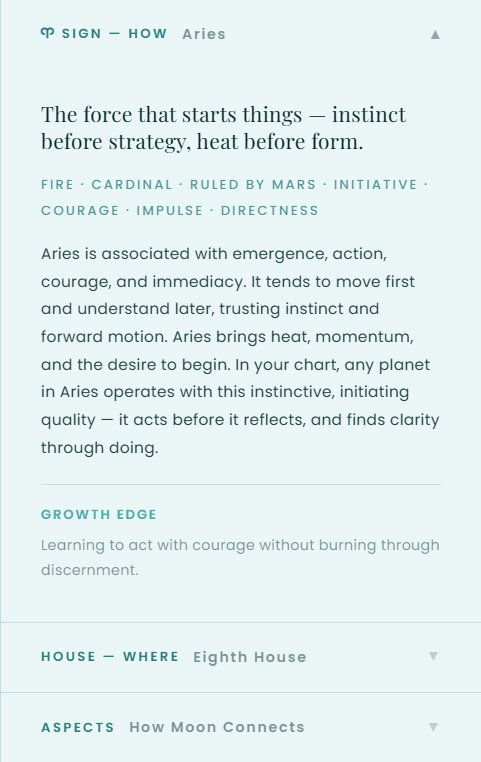
You now have two pieces: the sign your Moon is in and the house it occupies. Those two things together already narrow things considerably. What Your Beautiful Birth Chart goes further into is the full layer beneath that, the aspects your natal planets make to your Moon, and the transits currently moving through it. Your Beautiful Birth Chart is where those layers all get read for your specific chart.
How the Moon Connects to the Rest of Your Chart
The Moon is one of the most personally felt placements in a chart, which is part of why it can land with startling accuracy when someone finally looks at it carefully. But the Moon sign and house alone still describe one piece of a chart that contains many. The Sun, the rising sign, the aspects the Moon makes to other planets, and the overall structure of the chart all shape how those emotional patterns play out across a life.
This is often where the recurring themes become legible, as a pattern that shows up across different relationships, different situations, and different decades. The Moon is one thread in that pattern. The way it connects to everything else is where the fuller picture comes through.
If you have noticed the same emotional dynamics cycling through your life and you want to understand the underlying system, rather than just another list of placements, that is exactly what Your Personal Pattern™ was built for. It reads your chart as a connected whole, so the recurring dynamics stop feeling like coincidence and start making sense.
Moon Sign FAQ
What is my Moon sign in astrology?
Your Moon sign represents your emotional nature in astrology. It describes how you process feelings, react instinctively, seek comfort, and experience emotional safety and connection.
You can find your Moon sign using your free birth chart, which calculates your full natal chart using your birth date, location, and time.
How do I find my Moon sign?
To find your Moon sign accurately, you need:
- your birth date
- your birth location
- your birth time
Because the Moon moves quickly through the zodiac, birth time can significantly affect your result.
You can calculate your Moon sign using my free birth chart experience, which also shows your Rising sign, houses, planetary placements, and current transits.
Why does my Moon sign feel more accurate than my Sun sign?
A lot of people resonate deeply with their Moon sign because it reflects emotional patterns underneath the surface personality.
Your Sun sign often describes your identity and conscious direction, while your Moon sign often describes instinctive reactions, emotional needs, comfort patterns, and the private version of yourself that shows up under stress or vulnerability.
Can my Moon sign change?
No. Your Moon sign is fixed based on the exact moment you were born.
However, if your birth time is inaccurate or unknown, your Moon sign calculation may change depending on the time entered because the Moon changes signs every couple of days.
What if I do not know my birth time?
You can still generate a free birth chart using an approximate birth time, but some placements may be less accurate, especially your Rising sign, house placements, and occasionally your Moon sign if the Moon changed signs that day.
What is the difference between a Moon sign and Rising sign?
Your Moon sign reflects your emotional world and inner reactions.
Your Rising sign, also called your Ascendant, reflects how you move through the world externally, including first impressions, outward behavior, and the lens through which you experience life.
Together, they create a much fuller picture than your Sun sign alone.
Is the Moon sign the most important part of a birth chart?
Not necessarily, but it is often one of the most personally recognizable placements.
Astrology works through patterns and combinations. Your Moon sign becomes far more meaningful when you look at it alongside your Rising sign, houses, aspects, and the rest of your birth chart.
Where can I learn more about astrology and birth charts?
You can explore more beginner-friendly astrology resources in the main astrology hub, including guides on Rising signs, houses, birth charts, transits, and emotional astrology.
If you want to explore your own placements visually, you can also generate your free birth chart or explore Your Beautiful Birth Chart for a more interactive astrology experience with deeper chart exploration and real-time transit tracking.