
What Is a Composite Chart? Reading the Chart of the Relationship Itself
Some relationships have a personality neither person has anywhere else. You might be the organized one in every other part of your life and turn spontaneous with one particular friend, or a couple who both describe themselves as private might somehow end up hosting every holiday. The relationship has habits of its own, and both of you can feel them.
A composite chart is a single chart built from the midpoints between 2 people’s birth charts, so the relationship gets its own Sun, Moon, Ascendant and houses. In astrology, it is the chart you read to see what you and another person make together.
I think it is the most underused chart in relationship astrology. Most people stop at synastry, the comparison of 2 birth charts, which is excellent at describing how each of you affects the other. The composite picks up where synastry leaves off, and you get the most from both when you read them side by side, because a theme that turns up in each chart gives you more context than either one offers alone.
If you want to follow along with your own relationship, the free synastry chart puts your composite wheel next to the synastry chart for any 2 birth dates, with the composite’s own aspects listed underneath.
How a Composite Chart Is Calculated
Every point in a composite chart is the halfway point between the same point in 2 birth charts. Take one person’s Venus and the other person’s Venus, find the degree exactly between them along the shorter side of the zodiac, and that is the composite Venus. Repeat it for the Sun, the Moon, every planet, the Nodes and the angles, and you have a complete chart that belongs to neither person. Nobody was born with it.
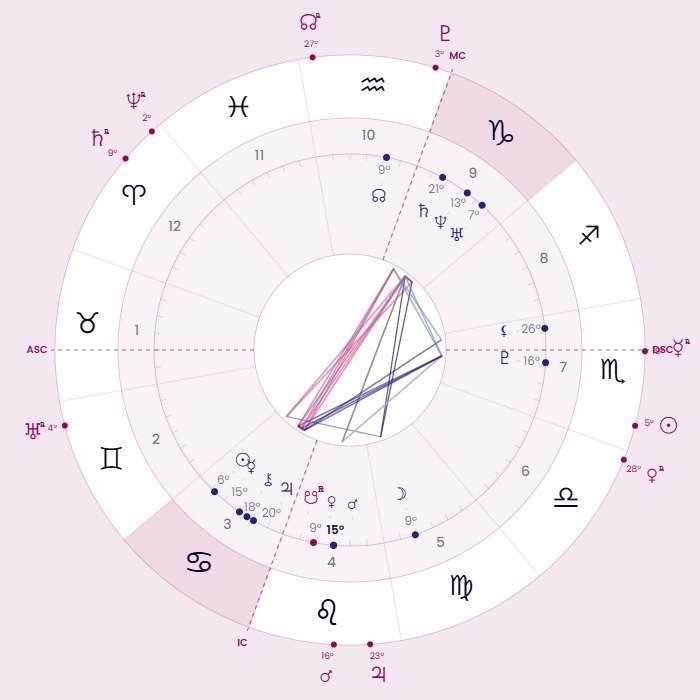
Maya and Theo, the sample couple on my free chart page, show how it works. Maya’s Venus sits at 6 degrees Gemini and Theo’s at 23 degrees Libra. Counted the shorter way, across Cancer and Leo, the midpoint lands at 15 degrees Leo, a sign neither of their Venuses is in. That is typical. A composite often puts planets in signs and houses that neither person has, which is part of why the relationship can feel like a third presence in the room.
The composite Ascendant is the midpoint of the 2 Ascendants. Maya was born with 16 degrees Taurus rising and Theo with 23 degrees Taurus, so their composite Ascendant sits at 20 degrees Taurus. I read composites in whole sign houses, the same way I read birth charts, so Taurus becomes the composite 1st house, Gemini the 2nd, and so on around the wheel.
Composite charts drawn elsewhere can show a different rising sign. Some software takes the midpoint of the 2 Midheavens and then calculates an Ascendant from it for a location, which can move the composite Ascendant by a sign or more. Both methods are legitimate, so if you compare your composite across 2 sites, check which one each site uses first.
Composite Chart vs Synastry Chart
Synastry lays one birth chart over the other and reads the contacts between them, such as your Moon on their Saturn or their Venus in your 7th house. It is directional, so it can say who stirs what in whom. A composite has no direction. It describes the relationship as a single thing, the way a birth chart describes a single person.
The 2 charts come from the same birth data, so they often repeat each other. When they do, you see one theme from 2 perspectives, and the perspectives can describe it differently. Between Maya and Theo, Maya’s Uranus trines Theo’s Sun within 1 degree, and Maya’s Sun trines Theo’s Uranus too. Person to person, that reads as easy, with each one making the other feel freer to be themselves. In the composite, the Sun opposes Uranus. The relationship as a whole carries the same Sun and Uranus theme as tension, a pull between a steady shared identity and a need to keep reinventing itself.
Both readings hold. Maya and Theo might enjoy each other’s independence and still argue about how much the relationship can change before it stops feeling like theirs. When you find a theme in your own charts that appears from both perspectives, you have more context to consider, and often a clearer sense of why the same subject keeps coming up.
A composite can also show something synastry never mentions. In the composite, Maya and Theo’s Venus and Mars sit together at 15 degrees Leo, a tenth of a degree apart, even though there is no Venus to Mars contact between their birth charts. The conjunction exists only at the level of the relationship. A composite Venus conjunct Mars describes a relationship where affection and desire move together, and the pairing that Venus and Mars synastry looks for between 2 people shows up here inside the shared chart.
How to Read a Composite Chart
A composite reads like any birth chart, with one adjustment in voice. Every placement is about the relationship, so the subject of each sentence is you and the other person together. Begin with the points that sum up the whole, then move to the planets that carry the relationship’s feeling and its friction.
The Composite Ascendant and Sun
Your composite Ascendant shows how the relationship meets the world and how other people experience you as a pair. The composite Sun, by sign and house, names what the relationship is organized around, the part of life where it feels most like itself.
For Maya and Theo, Taurus rising gives the relationship a steady, unhurried presence, with a strong pull toward comfort and things that last. Their composite Sun in Cancer in the 3rd house may put daily conversation, shared routines and small exchanges at the center, so the relationship builds its sense of home out of talk.
The Composite Moon
Your composite Moon is what the relationship needs in order to feel safe, and how it handles a bad day. A composite Moon in Virgo in the 5th house, which is where Maya and Theo’s falls, might find comfort in useful, practical care and in making things together, with a habit of fixing whatever feels off.
If 1 birth time is unknown, the composite Moon can be off by up to about 3.5 degrees, half of the noon Moon’s possible error, because the composite averages a known position with a guessed one. With both times unknown, the error can reach the full 7 degrees.
Composite Venus and Mars
Composite Venus is what the relationship values and enjoys. Composite Mars is how it acts, competes and fights. Their aspects to each other, and to Saturn and Pluto, are where much of a romantic composite lives, and the synastry compatibility contacts between the 2 birth charts usually fill in the detail.
The Venus and Mars conjunction in their composite also squares Pluto in Scorpio in the 7th house, within about 1 degree. That gives the relationship real intensity, and moments where closeness and control are hard to tell apart. A difficult aspect in your composite marks where the relationship has to work, and how that work goes is up to the 2 people in it.
Composite Saturn
Composite Saturn shows where the relationship takes on responsibility and where it can feel heavy or tested. Its house often says which part of shared life asks for commitment, whether that is money in the 2nd, home in the 4th or reputation in the 10th. A strong composite Saturn can describe a relationship built to last that sometimes forgets to have fun.
Stelliums in the Composite
A stellium, 3 or more planets in one sign or house, concentrates the relationship’s energy. The 3rd house of their composite, in Cancer, holds the Sun, Mercury and Jupiter, so talk, siblings, neighborhood and daily movement carry more of the relationship than usual. The stellium meaning and calculator finds the same concentration in a birth chart.
Their composite also puts Saturn, Uranus and Neptune together in Capricorn. That cluster says more about their generation than about the couple. Uranus and Neptune move so slowly that 2 people born a few years apart have them in nearly the same place, so the midpoints land close to where both of them already have them, and Saturn joins the group here because their 2 Saturns sit in neighboring signs. Read outer planet stelliums in a composite as background unless they touch the Sun, Moon or an angle.
The Composite North Node by House
The composite North Node points to what the relationship is growing toward, and its house shows where that growth happens. In Maya and Theo’s chart the North Node in Aquarius sits in the 10th house, which might point the relationship toward shared public work or a role the 2 of them play together in a wider community. The North Node by sign guide covers each sign’s direction in a birth chart, and the same meanings carry over to a composite once you make the relationship the subject.
The fastest way into your own composite is to open it beside your synastry and look for the themes that appear in both. Read the rising sign and Sun first, then check whether any composite aspect repeats a contact between your 2 birth charts.
Composite Charts for Friendship, Business and Family
A composite works for any relationship with 2 birth charts behind it. The chart stays the same, and what changes is which placements carry the most weight.
In a romantic composite, the Moon, Venus, Mars and the 5th, 7th and 8th houses do most of the talking. In a friendship, Mercury, Jupiter and the 3rd and 11th houses carry more, since friendship runs on conversation, shared interests and the people around it, which friendship synastry reads from the contact side. In a working relationship, look first at Mercury, Saturn and the 10th, 6th and 2nd houses, where the composite shows how you and a colleague decide, deliver and handle money.
A parent and child composite needs the most care. The relationship has a built-in imbalance of power and age, and a midpoint chart averages both away, so what you get is the shared atmosphere of the home you make together. Read it next to parent and child synastry, which keeps the direction the composite drops, and give the composite Moon and Saturn the most attention.
The Limits of a Composite Chart
A composite is a portrait of the relationship, and only of the relationship. A composite Sun in Aries belongs to a relationship that likes to start things, whatever the 2 people’s own Sun signs are. If you catch yourself reading your composite as a verdict on one person, go back to that person’s birth chart, which is where individual character lives.
How long a relationship lasts, and whether it is a good idea, sits outside what the composite can answer. Plenty of lasting relationships have demanding composites, because the hard aspects are where a relationship builds something. Read your composite as a description of the shared pattern, alongside the synastry and both birth charts, and it can tell you a great deal.
The chart also depends on birth times. Without both times there is no composite Ascendant, no Midheaven and no houses, and the Moon becomes approximate. The planets by sign and most of the composite aspects stay reliable, which the guide to reading synastry without a birth time covers in more detail.
Composite Chart FAQ
What is the difference between a composite chart and a Davison chart?
The composite is made from the midpoints of each pair of planets, so it is a calculated chart with no real moment behind it. A Davison chart, named for the astrologer Ronald Davison, finds the midpoint in time and place between the 2 births and casts a real chart for that moment. The 2 often agree on broad themes and differ in detail. The midpoint composite is the more widely used of the 2, popularized by Robert Hand’s 1975 book Planets in Composite, and it is the method behind the composite wheel on my free chart.
Can you make a composite chart without a birth time?
Yes. Without a birth time, that person’s chart is set for noon where they were born. The composite planets by sign and most of their aspects stay reliable, the composite Moon can be off by a few degrees, and the composite Ascendant, Midheaven and houses drop out, because they depend on both birth times.
Does a difficult composite chart mean the relationship will fail?
A composite full of squares and oppositions belongs to a relationship with a lot of friction and a lot of energy, and many long relationships carry exactly that. A hard composite shows you where the relationship has to work, and your synastry can show which of you feels that pressure most.
What does a stellium in a composite chart mean?
A stellium in a composite concentrates the relationship’s energy in one sign or house, so that area of life becomes central to what you do together. Check whether the planets involved are personal ones, the Sun through Mars, or slow ones shared by everyone your age. A stellium of personal planets says much more about the couple.
Is the composite chart more important than synastry?
They carry equal weight because they answer different questions. Synastry tracks what happens between 2 people and who stirs what in whom, and the composite reads the relationship itself. Your clearest reading comes from both, especially where a theme shows up in each.
Where can I get a free composite chart?
My free synastry chart includes the composite wheel for any 2 birth dates, alongside the synastry wheel and each person’s own houses, with the composite’s closest aspects listed below. Begin with its rising sign and Sun, then look for a theme that repeats in the synastry.