
What Is Synastry in Astrology? How to Read a Synastry Chart
One person wants to settle the argument before bed. The other needs 24 hours alone before they can say anything useful, and after 3 years each of them has decided the other one does not care.
Synastry is the astrology of 2 charts at once. It compares 2 birth charts to see where their planets meet, what each person brings out in the other, and where the relationship keeps finding the same charge.
Most people start with Sun sign compatibility, and it is a reasonable first layer. A Taurus Sun and a Scorpio Sun do sit opposite each other in the zodiac, and that opposition means something. It gives you very little information about how 2 people handle comfort, conflict, commitment or power, though, and those questions ask for the Moon, Venus, Mars, Saturn, the angles, and the houses where each person’s planets land.
A chart gets clearer once you find the contact that already sounds like your relationship. The free synastry chart puts 2 birth charts on 1 wheel. Start with the closest planet pairing, then ask whether it describes a pattern you already recognize between you.
How to Read a Synastry Chart: Start With the Relationship You Are Reading
The same Saturn contact can feel binding in a marriage, parental in a family, demanding in a business partnership, or like an old obligation between siblings. Relationship type changes the stakes of every aspect, which makes it the first thing to settle.
Romantic synastry often brings the Moon, Venus, Mars, the 5th house, the 7th house and the Descendant into focus. Saturn can matter just as much once the question moves from attraction to commitment, obligation, and what each person expects the relationship to hold.
Parents and children do not meet as equals, so every contact reads with the direction of power in mind. A parent’s planets can describe part of the emotional climate, the rules and the expectations a child grows up inside. The child’s planets can show what this particular relationship asks of the parent, including reactions no other person has brought out in them. Parent and child synastry goes through that in detail.
Friendship shows up in the conversations that keep going, the joke 2 people have been making for 10 years, and the person who knows which side you are on before you explain it. Mercury, the Moon, Jupiter and the 11th house often describe that kind of bond. Sibling and family charts bring in the 3rd and 4th houses, along with the roles people learned early, like the responsible one, the funny one and the child who stayed out of the way.
A business partnership brings in Saturn, Mercury, Mars and Jupiter, and the 2nd, 6th and 10th houses. One partner may move fast when a decision needs making while the other wants evidence, a budget and time to think, and the chart can show where that difference repeats, especially when Mars and Saturn are closely involved.
Before you decide what any contact means, read each person’s own chart first. A Saturn contact to the Moon lands differently for someone whose natal Moon already carries close Saturn, Pluto, Uranus or Mars contacts, and for someone whose Moon is held by easier aspects or a strong ruler. The contact stays unclear until you know what each person carries before the relationship begins pressing on it.
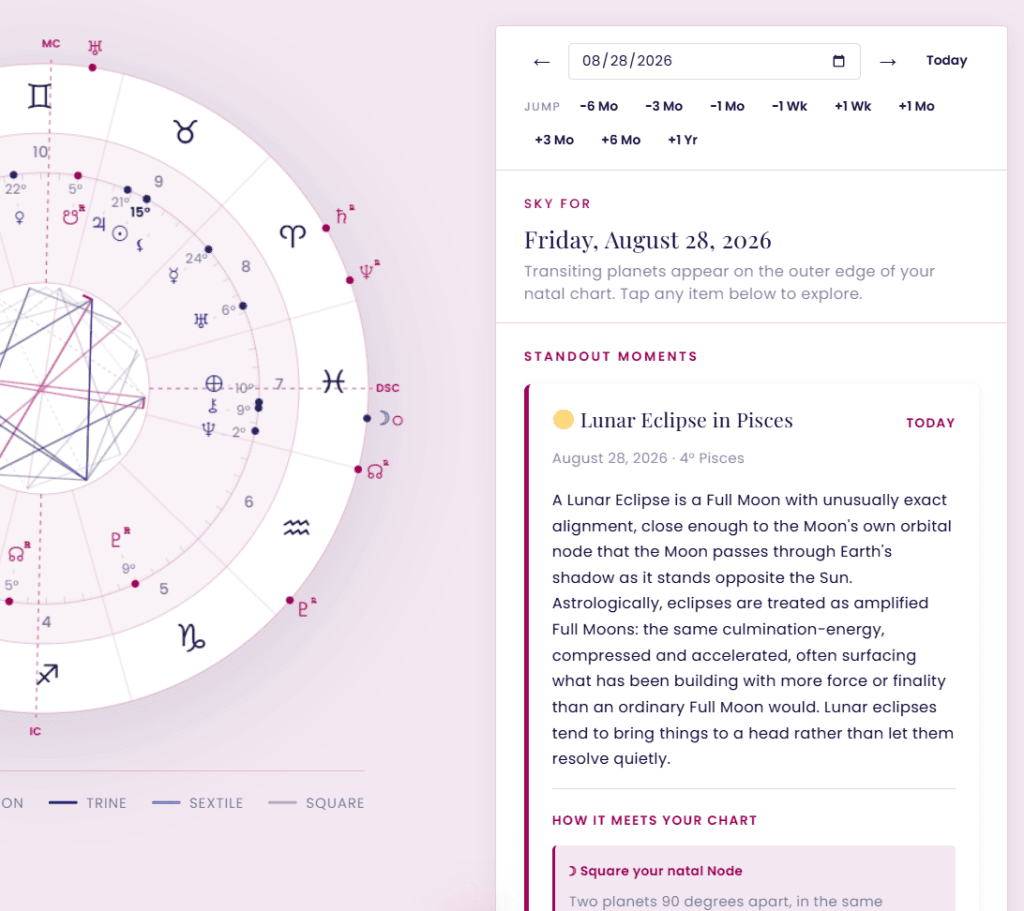
Your Beautiful Birth Chart shows your placements by sign and house and every aspect with its orb, so you can see what you carry before you compare it with someone else’s.
Synastry Aspects: Start With the Closest Contacts
Start by looking at the geometric relationships between one person’s planets and the other person’s planets. When one person’s Mars sits about 1 degree from an exact opposition to the other person’s Saturn, those planets form an opposition, and that relationship is an aspect.
Orb is the distance from exact, and the closer the angle, the more central the contact usually is. This site counts 8 degrees for conjunctions, oppositions, trines and squares, 6 for sextiles and 5 for quincunxes, the same orbs the birth chart page uses. A loose Venus and Mars contact may describe part of the attraction without carrying the relationship on its own. An exact Saturn and Moon contact may keep appearing in the same sensitive place, who needs reassurance, who feels responsible, who withdraws, who decides the feeling has gone on long enough.
Direction matters as much as exactness. Your Saturn on their Moon and their Saturn on your Moon are 2 different contacts. If your Saturn lands on their Moon, you may experience yourself as the person trying to hold things together, while they experience you as the person whose approval feels expensive.
Maya and Theo are fictional, and their chart comes from the same engine that generates the free synastry chart. Maya sits on the outer ring, Theo sits on the ring inside it, and the lines through the center join planets in contact. The chart also switches to either person’s houses, which changes where each planet lands.
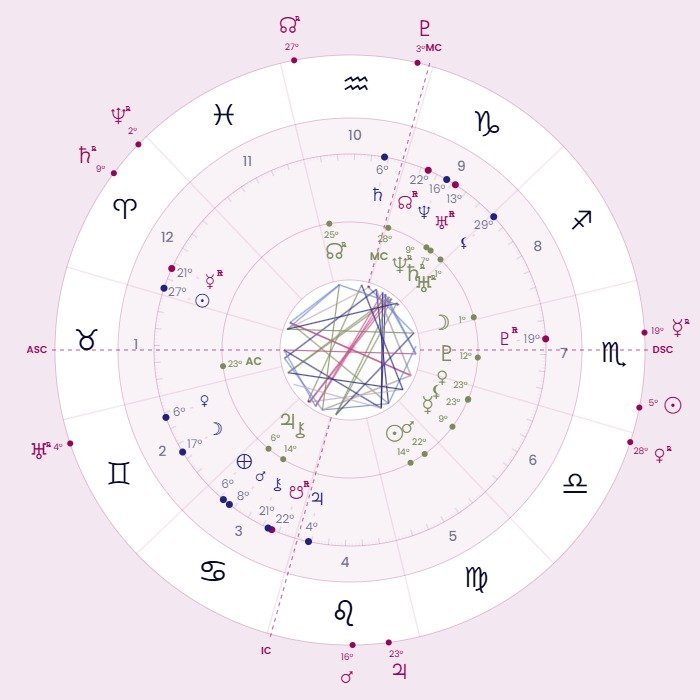
The closest contact on their wheel is Maya’s Mercury quincunx Theo’s Mars, within a third of a degree. A quincunx joins signs with no shared element or modality, so it asks for adjustment between ways of operating that do not come naturally to each other, and with Mercury and Mars involved, conversation turns easily into action, irritation or a debate about what should happen next.
The place to begin reading them is Maya’s Mars opposite Theo’s Saturn, just over 1 degree from exact, because it is close, it sets action beside restraint, and the same 2 planets come up again in the house overlays below. Maya’s Mars describes how she initiates, asserts herself and goes after what she wants. Theo’s Saturn describes where he takes responsibility, sets limits and worries about consequences. She may experience his caution as a brake, while he may experience her drive as pressure on something he is already carrying, and their opposition keeps putting her need to act beside his need to prepare.
What makes a contact keep happening in a relationship is a combination of exactness, repetition and sensitive placement. A contact that is close, touches an angle or a chart ruler, and gets hit again by a second or third planet carries more of the relationship than a single loose aspect. When 3 planets from one chart all contact the same planet or angle in the other, that part of the chart is carrying a great deal of the relationship.
Start with the Sun, Moon, Ascendant, Descendant, chart rulers, Venus, Mars and Saturn, especially when the contacts are close or repeated. Mercury and Jupiter often show how the relationship thinks, talks, learns and grows. Bring in the Nodes, Chiron and the outer planets when they are exact, repeated, or tied to personal planets and angles.
Pluto and Node contacts often get called fated in synastry writing. Close contacts can feel unusually consequential, familiar, consuming or hard to dismiss, though the rest of both natal charts and the relationship itself decide how that intensity is lived. The North Node by sign guide gives context for the Node in each person’s natal chart, and Saturn conjunct Sun covers the natal symbolism of that contact, which can help before you look at how Saturn from 1 chart meets the Sun in another.
Synastry House Overlays: Where Their Planets Land in Your Chart
An aspect describes what happens between 2 planets. The house describes where in your life you keep feeling it.
Maya’s Mars lands in Theo’s 3rd house, so her drive shows up in how they talk, the daily messages, the errands, the way a conversation keeps going after it should have ended. Theo’s Saturn lands in Maya’s 9th house, so his caution reaches her beliefs, her plans and the places she wants to go. Each person’s planets land in the other’s houses, which is why a comparison always has 2 sets of overlays.
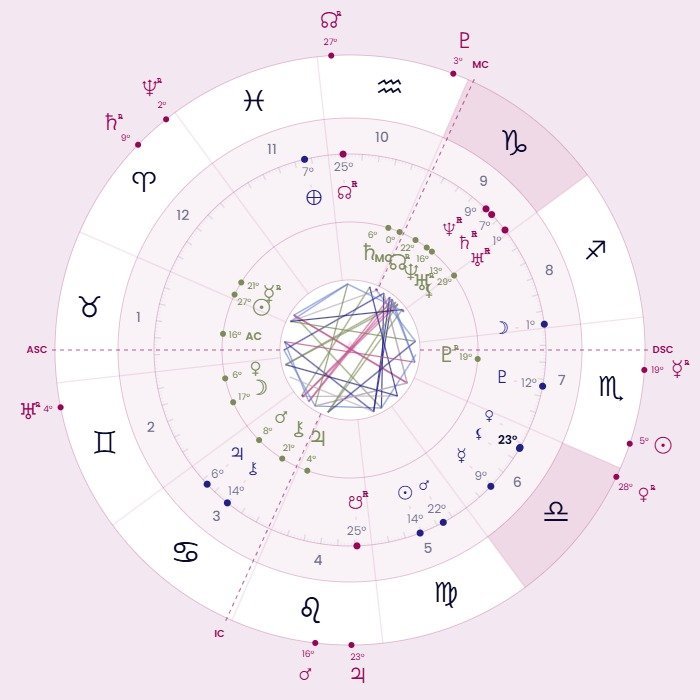
Houses here are whole sign. Start from the other person’s rising sign, count each sign as one full house, and each planet falls in whichever house its sign becomes. Whole sign houses explained covers why, and whole sign vs Placidus covers what changes under Placidus, where a planet near a boundary can fall in a different house.
The 7th and 8th houses come up often in relationship readings because they speak to partnership, intimacy, shared resources and trust, and the Descendant, which the Descendant page explains, falls in the 7th. Overlays reach every area of life, though. Your Venus in their 3rd house lives in shared jokes and daily messages, and a business partner’s Jupiter in your 10th can show up in how you are seen in public.
The Composite Chart: Reading the Relationship Itself
Some relationships have a feeling that belongs to neither person alone. You can be calm and capable everywhere else and turn evasive, combative or private with one specific person.
A midpoint composite is built from the midpoints between the 2 natal charts, and it gives the relationship its own planetary positions, angles and houses, provided both birth times are reliable. Synastry follows the contact between 2 people. The composite chart follows the pattern created when they come together.
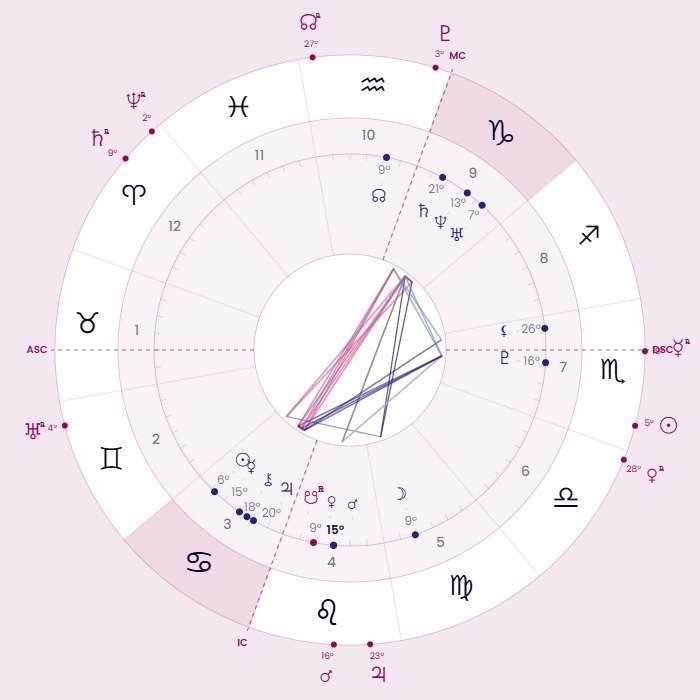
Maya and Theo’s composite Ascendant is in Taurus, which can give the relationship a strong need for steadiness and something tangible to hold onto. The composite Sun in Cancer in the 3rd house may make daily conversation, shared memories and small exchanges central to how the relationship creates belonging, so the 2 placements meet in a relationship that tries to build steadiness out of talk.
What You Can and Cannot Read Without a Birth Time
If you do not know whether someone was born at 6:14 AM or 6:14 PM, do not build the reading around their Ascendant landing on your Moon.
Without a birth time, the chart is set for noon where the person was born. With the date and place known, the Sun and the slower-moving planets usually remain reliable by sign, and many of their aspects stay close to their birth-time positions. The Moon needs caution because it moves about 13 degrees a day, so a noon Moon can sit up to about 7 degrees from its real position, and Mercury or Venus may need a second look when a very tight aspect depends on the birth time. What drops out for that person is the Ascendant, the Midheaven, the houses and every overlay into their chart. If the other person’s birth time is known, their houses still show where the unknown-time person’s planets land, and the composite angles and houses become unreliable. The free chart marks each of these and explains what happens without a birth time.
What a Synastry Chart Cannot Tell You
A synastry chart can describe why a relationship feels charged, familiar, difficult or hard to leave. It cannot tell you whether someone will treat you well.
Is synastry accurate?
Synastry is a symbolic reading of 2 charts, and it is useful when it describes a pattern you can recognize in the relationship and gives you more precise language for it. A chart earns your trust when it helps you see the relationship more clearly, and you can put it down when it asks you to explain away what is happening in front of you.
Can synastry tell you if a relationship will last?
Some charts show bonds that feel heavy, binding or hard to move on from, and none of them can make a relationship healthy or make 2 people stay. A difficult aspect does not excuse cruelty, control or harm, and an easy one does not make a harmful relationship safe.
The best use of synastry is seeing the pattern clearly enough that you stop calling the same problem by 6 different names. Open the free synastry chart, and start with the contact that already sounds like your week.