
Whimsical Animal Art: Paintings With Personality
Whimsical animal art shows animals with personality, humor or a touch of make-believe, often in bold color with a prop or setting that tells a little story. For me, that has meant a leopard wearing a bow, a dog with a very serious expression, a bird posing beside a rose topiary. The animal is still recognizable, but it has a point of view, or opinions maybe?
No matter what I do, I paint whimsy, so I have decided to lean into it. I call it whimsy grown up, or whimsy taken seriously: the joy, the rounded shapes and the color stay, and the painting still holds its own on a wall next to an antique.
What Makes Animal Art Whimsical?
If you’ve ever looked at a painting of an animal and thought, “oh, she knows exactly what she’s doing,” that’s whimsy. A few things usually get it there:
- An expression. A raised brow, a side-eye or a dead-serious stare. You can read the mood from across the room.
- A prop or a little costume. A bow, a collar, a pedestal, a pot of roses. Suddenly the portrait has a story.
- Color that makes no apologies. A pink leopard? A periwinkle dog? Absolutely. Nobody needs a field guide on their wall.
- Simple shapes. Rounded forms and confident outlines turn an animal into a character.
- Pattern. Stripes, spots and florals stacked around the animal, like the best printed fabric.
My one rule: keep a straight face. The funniest paintings are the ones that don’t look like they’re trying to be funny.
My Whimsical Animal Paintings
Committed to the Look
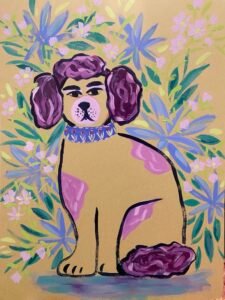
She’s not like the old Staffordshire dogs that sit on mantels, and she’s committed to the look. Look at that fancy cut: plum curled ears, a topknot, lilac patches and a periwinkle collar with tiny red tulips. And then that face. Heavy brows, totally deadpan, a little grumpy. She did not ask for your opinion on her hair.
She comes straight from the china spaniels people have kept on their mantels for almost 200 years. I have one on a side table at home, and it has the exact same worried eyebrows, so I think she came by it honestly. I wrote all about Staffordshire dogs and how to decorate with them, if you’re curious.
Showing Up
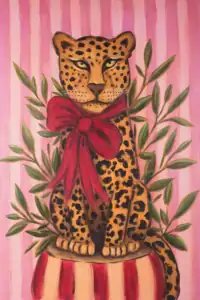
This is Showing Up, and she means it. She’s perched on a red and cream striped pedestal in a giant red bow, with pink stripes all around her, looking like a circus star who has decided she’s also royalty. Honestly, fair.
At 24×36, she’s a big personality for a big wall: an entry, a dining room, over a sofa. Her colors are a perfect example of the 60-30-10 color rule too, mostly blush pink, a good amount of leopard and just a little red.
Stop and Smell the Roses
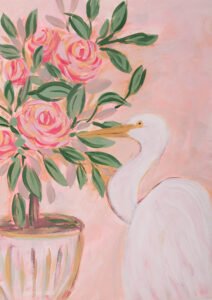
Wading birds are some of my favorite shapes to paint, with those long necks doing all the talking. In Stop and Smell the Roses, an egret leans in toward a pink rose topiary like she stopped in the middle of an errand just to take a sniff. We could all probably do a little more of that.
There are more birds over here, and my butterflies have the same playful spirit in a smaller size.
How to Decorate With Whimsical Animal Art
Here’s the secret: whimsical art looks its most grown-up next to something serious. A few ways I’d use it:
- Pair it with something traditional. Antiques, blue and white porcelain, a skirted table. The contrast makes the whole room feel collected over time.
- Give it room to breathe. One character per wall. A big animal over a console or sofa can carry a whole room on its own.
- Borrow a color. Pull the red from a bow or the periwinkle from a collar into a pillow or a lampshade, and the painting looks like it belongs there.
- Try a pair. Two animals facing each other on either side of a mantel, a bed or a doorway. Staffordshire dogs have been doing it forever for a reason.
- Don’t save it for the nursery. It’s great in a kid’s room, sure, but it’s even more fun in a living room, an entry, a powder room or your office.
If you love mixing playful pieces with classic ones, you’d probably like my posts on grandmillennial wall art and how to mix color and pattern like an artist.
Frequently Asked Questions About Whimsical Animal Art
What is whimsical animal art?
It’s art that gives animals personality, humor or a little make-believe, usually through expressions, props, bold color and simple shapes.
Is whimsical art only for kids’ rooms?
Not at all. It’s wonderful in living rooms, entries, dining rooms and offices, especially next to traditional furniture and antiques.
How do I keep whimsical art from looking too cute?
Look for confident brushwork, a limited palette and a bit of deadpan humor. Then frame it well and give it space, like you would any original painting.
What animals work well in whimsical art?
Dogs, leopards, birds, monkeys, horses and butterflies are all classics, partly because they show up so often in traditional decor like Staffordshire figurines and chinoiserie.
What size whimsical animal art should I buy?
One large piece, like a 24×36, makes a statement over a sofa or console. Smaller pieces look best grouped together or hung as a mirrored pair.
If a little whimsy is calling your name, come take a look at my original paintings, or browse Studio Steals for smaller pieces at a gentler price.