
How to Read Your Astrology Chart for Beginners
I love that you’re here and wanting to learn how to read your astrology chart.
If you’ve ever pulled up your birth chart and immediately thought, “What am I even looking at?” you are definitely not alone.
All those zodiac signs, planetary symbols, numbered houses, degrees, and colorful lines can make an astrology chart look incredibly complicated when you’re first starting out. I remember looking at my own chart and having absolutely no idea where to begin.
The good news is that you do not have to understand everything at once.
Learning how to read a birth chart starts with a few basic pieces: the planets, zodiac signs, houses, and aspects and understanding how they work together. Once you know what each piece represents and where to look for it, that intimidating astrology wheel starts making a whole lot more sense.
In this beginner’s guide, I’ll walk you through how to read your astrology chart step by step, so you can begin understanding what your own birth chart is capable of showing you.
If you’re staring at a chart you pulled somewhere on the internet and thinking “respectfully… no,” Your Beautiful Birth Chart™ does the translating for you.
How to Read Your Astrology Chart
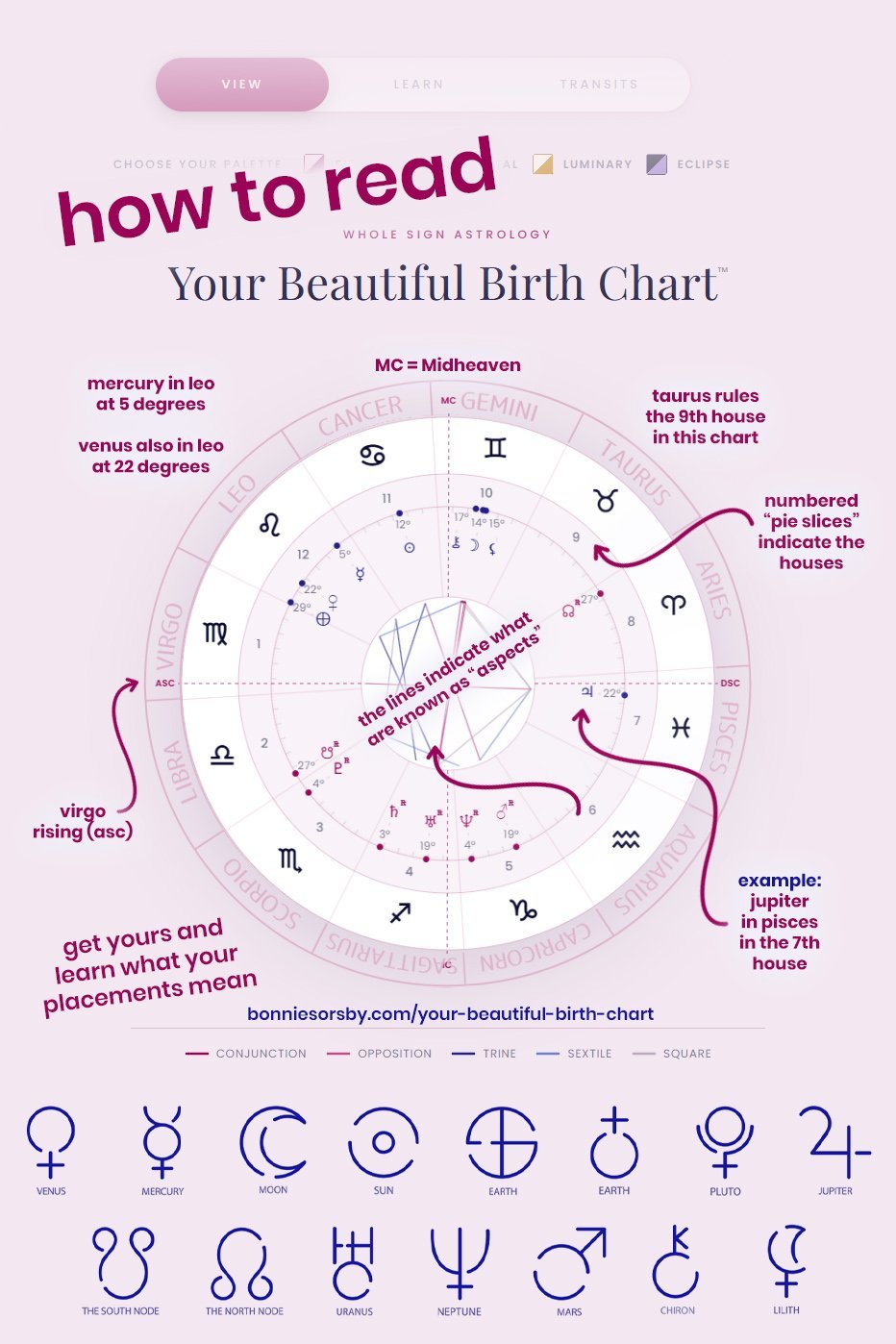
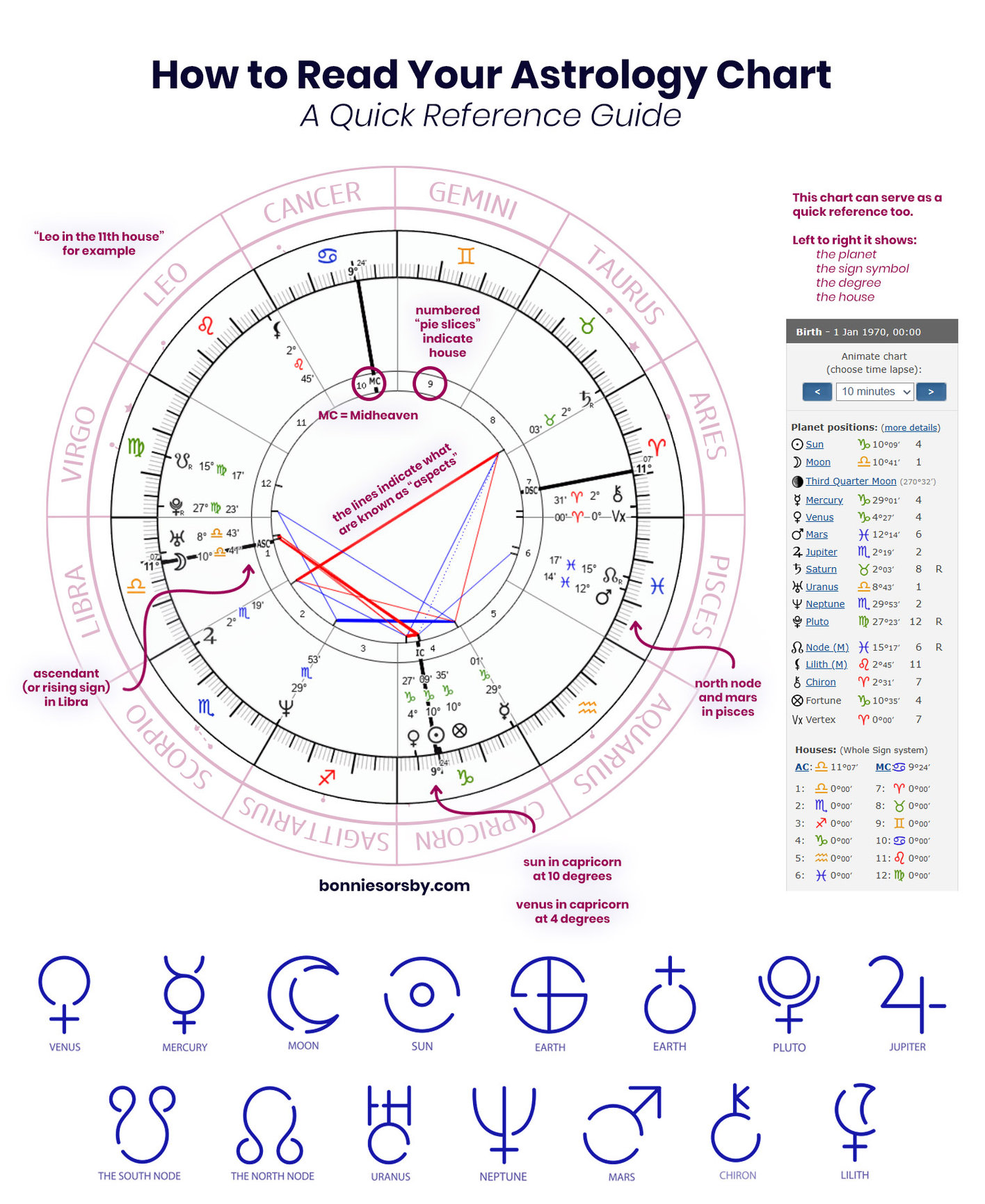
To help you get started, I created a quick-reference guide that walks you through the basics of reading your chart using the Whole Sign house system, one of the simplest and clearest ways to learn astrology.
The reference guide above is designed to be saved. Keep it on your phone and pull it up alongside your chart while you are learning, and the symbols stop needing to be memorised. It labels the rising sign, the house numbers, the aspect lines and every planetary glyph in one image.
Whether you’re brand new to astrology or just want a visual that makes everything click, this guide is designed to be easy, digestible, and empowering.
What Is a Birth Chart?
A birth chart is a map of the sky at the exact moment and place you were born. It shows where every planet stood against the twelve signs of the zodiac at that minute, and which area of your life each one landed in. Two people born on the same day in different cities get different charts, because the sky turns about one degree every four minutes.
That is why birth time matters so much. Your rising sign changes roughly every two hours, and the rising sign is what sets the house structure underneath everything else. Without a time you can still read your planets and signs, and you will recognize a great deal of yourself in them. What you lose is the houses, the layer that tells you where all of it plays out.
How to Read a Birth Chart Wheel for Beginners
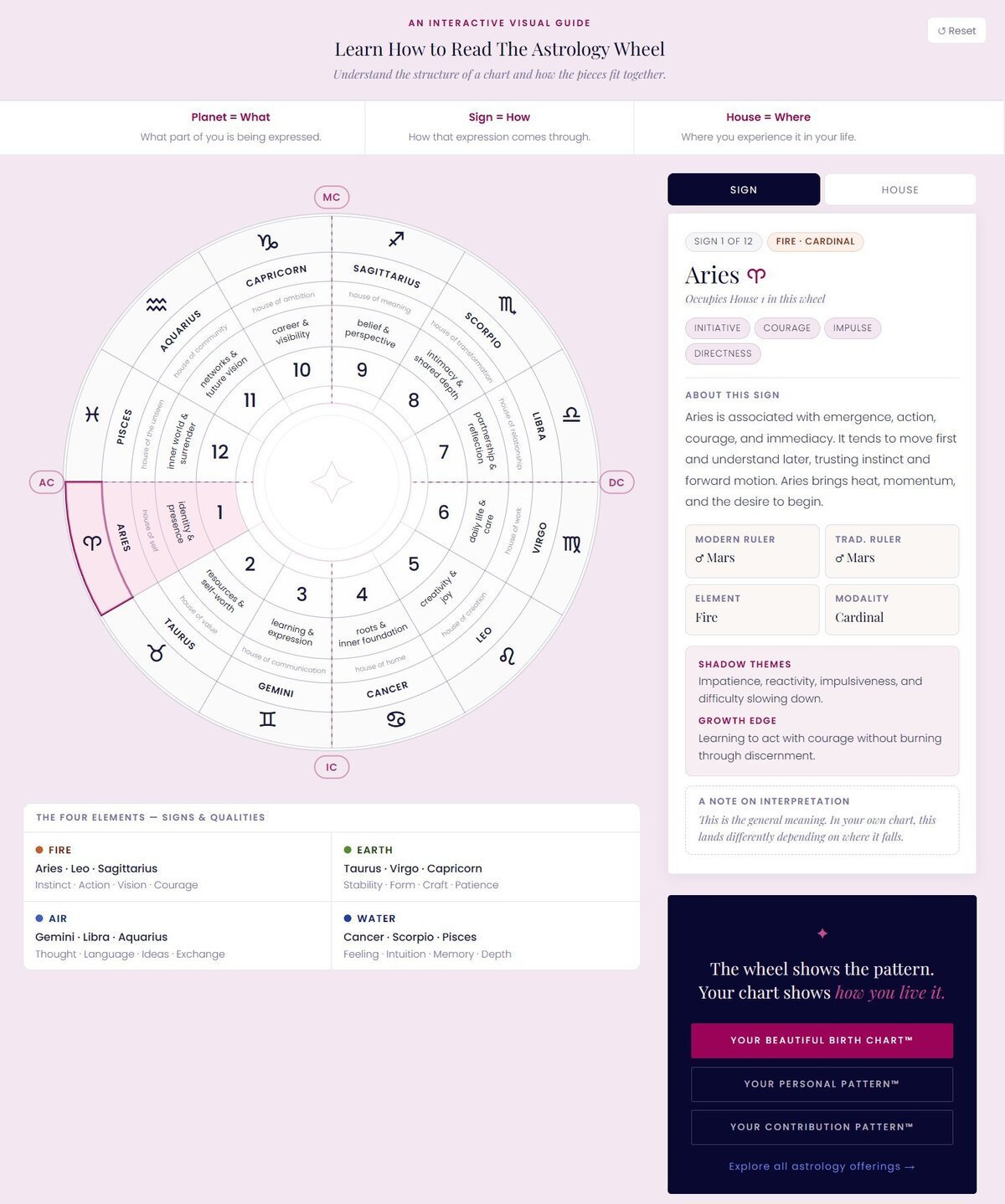
Now, let’s cover how to read a birth chart wheel. The round chart (called a natal or birth chart) is divided into 12 houses, each representing a different area of your life… like identity, relationships, creativity, or career.
Layered around the outside are the 12 zodiac signs, which flavor the energy of each house.
In the Whole Sign house system, each house starts at 0° of a zodiac sign. So if your rising sign is Libra, then Libra rules your entire 1st house, Scorpio rules your 2nd, and so on. It’s clean, consistent, and beginner-friendly… especially when you’re first learning.
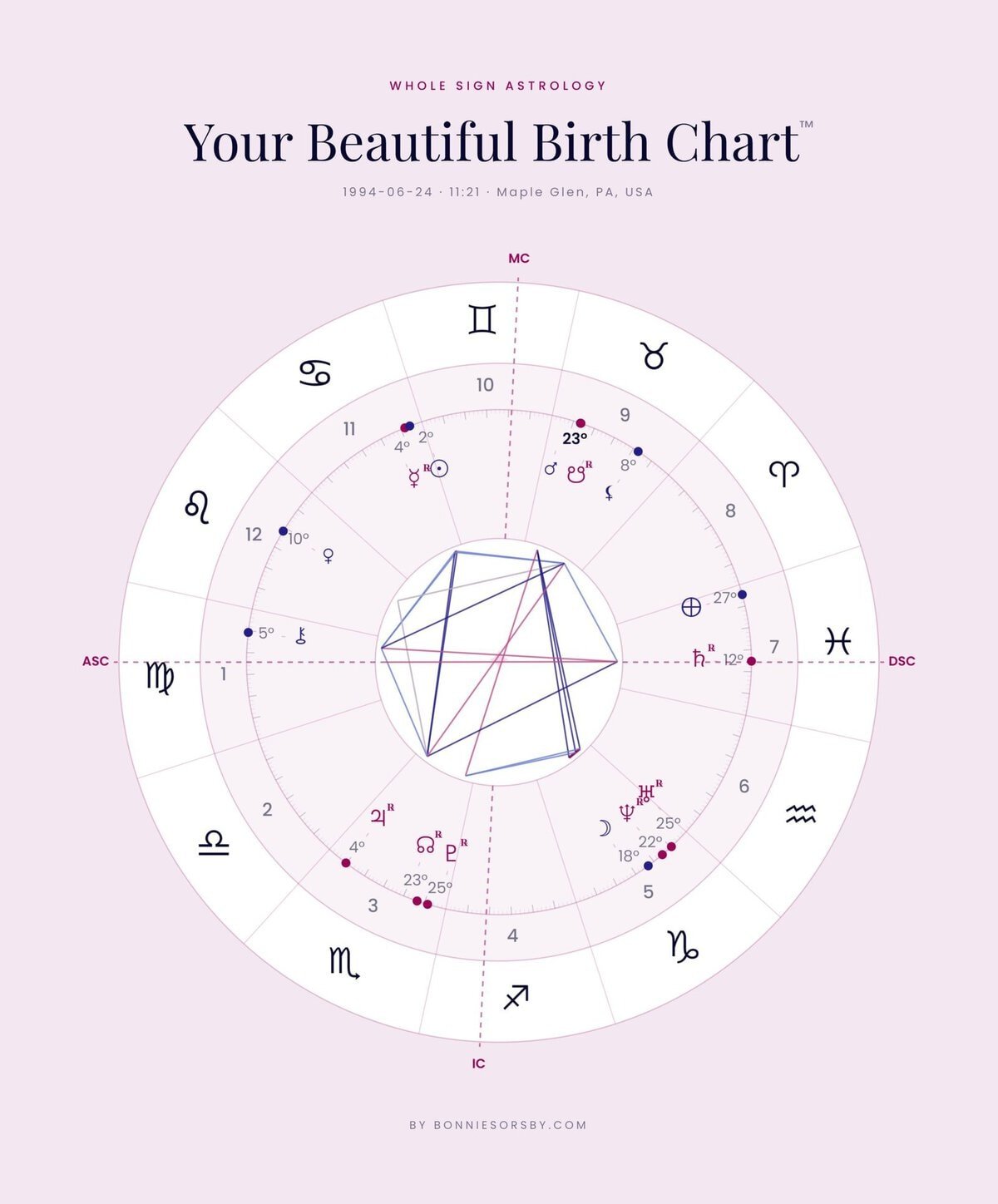
Yay! Free Charts are here.
These beautiful, aesthetic charts make it easier than ever to learn how to read astrology charts.
Get Your Free Natal Chart
A Simpler Way to Learn Astrology
If you’re feeling like you need to memorize all of this before it clicks… you don’t.
Most people get stuck trying to hold too many pieces at once, signs, houses, planets, meanings, and it starts to feel overwhelming fast. But astrology makes a lot more sense when you can see it all working together. If the overwhelm has you tempted to hand the whole thing to a chatbot, this is what AI astrology readings get right and where they invent things.
That’s exactly why I created an interactive version of this.
Instead of trying to piece it together in your head, you can explore the chart visually, moving through the signs and houses, seeing how each one functions, and getting a feel for how the system works as a whole.
It’s a much easier way to start connecting the dots.
→ Explore the interactive astrology guide here
See Today’s Astrology in Real Time
Understanding transits conceptually is one thing. Seeing how they show up day to day is where it starts to click.
Since writing this guide, I built a live daily astrology page that maps the current sky in real time. It pulls in the current planetary positions and breaks them down in a way that’s easier to follow without needing to piece everything together yourself.
It’s not meant to replace learning your chart. If anything, it helps you start recognizing patterns as they’re happening.
→ You can explore the daily astrology here
Whole Sign vs. Placidus: What’s the Difference?
And a million other systems, actually… but let’s keep it simple to get started. Many astrology apps use Placidus by default, which calculates houses based on your exact degree of rising sign, resulting in houses of varying sizes. Sometimes a planet might fall into one house in Placidus, but into a different house in Whole Sign.
There’s no right or wrong here, it’s just a matter of what resonates.
👉 Personally, I’ve found Whole Sign to be the most accurate system for me, especially when I’m looking at themes around home, creativity, and life path. I still reference Placidus sometimes for added nuance, but Whole Sign gives me a clearer, more intuitive structure to work with.
You might also enjoy this blog post on Whole Sign vs Placidus.
A Quick Breakdown of the Planets, Signs, Houses, and Aspects
With your chart in hand and my guide beside you, you’ll start to recognize how each piece fits together:
1. Planets = What’s happening
Each planet represents a different part of your personality.
- Sun = identity
- Moon = emotions
- Venus = love and beauty
- Mercury = thoughts and communication
2. Signs = How that energy expresses itself
For example, Mars in Leo acts very differently than Mars in Pisces.
3. Houses = Where that energy shows up in your life
Is Venus in your 2nd house? That might mean your values are tied to beauty, pleasure, and self-worth.
4. Aspects = How your planets interact with each other
Those red and blue lines in the middle? They show the conversations between different parts of you… some harmonious, some a bit tense (but often motivating).
5. Transits = What’s activating your chart right now
Your birth chart is the blueprint.
Transits are the current sky interacting with that blueprint.
The planets are always moving. As they travel through the zodiac, they form new angles to your natal placements. When that happens, certain themes in your life get louder.
For example, if Saturn is currently moving through your 10th house, you might feel pressure or responsibility around career. If Jupiter crosses your natal Venus, relationships or finances may expand.
Transits don’t change who you are.
They activate parts of you that were already there.
That’s why two people can experience the same transit completely differently. The outcome depends on the pattern it’s landing in.
Astrology isn’t just transits.
It’s the pattern you’ve been living inside all along.
If you want to see yours clearly, Your Personal Pattern™ is the place to be.
Curious about all of the astrology offerings? Find those here.
Astrology Symbols and What They Mean
The glyphs are the part that makes a chart look impenetrable, and they are the fastest thing to learn because there are only a handful. Each one is an archetype before it is a symbol, and the shorthand below is a starting point. My planets page goes considerably deeper on each.
| Glyph | Planet | Meaning |
|---|---|---|
| ☉ | Sun | identity, vitality, what you are here to become |
| ☽ | Moon | emotional needs, instinct, what makes you feel safe |
| ☿ | Mercury | how you think, speak, learn and process |
| ♀ | Venus | what you value, how you love, what you find beautiful |
| ♂ | Mars | drive, desire, anger, how you go after what you want |
| ♃ | Jupiter | growth and belief, and it expands whatever it touches |
| ♄ | Saturn | structure, limits, and the work that only time can do |
| ♅ | Uranus | disruption, independence, where you break the pattern |
| ♆ | Neptune | imagination and dissolution, where the edges blur |
| ♇ | Pluto | power and depth, what gets stripped down and rebuilt |
| ☊ | North Node | the direction of growth, what you are moving toward |
| ☋ | South Node | what already comes easily, often too easily |
| ⚷ | Chiron | the old wound, and the skill that grows from tending it |
| ⚸ | Lilith | the part of you that refuses to be managed |
How Do You Read a Chart Listing, Left to Right?
Every placement in a chart listing reads in the same order: the planet, then its sign, then the degree, then the house. Once that clicks, the wall of symbols stops being a wall.
Take a line reading Mars, Scorpio, 18 degrees, 4th house. Mars is the function you are looking at, the part of you that wants, pushes and defends. Scorpio is the register it operates in, so that drive runs deep and private and gives very little away. The fourth house is where it plays out, meaning home, family, and the foundation underneath everything else. Read together, this is someone whose fight lives in their family life, whose wanting is held close, and whose sense of home has probably cost them something to build.
The degree is the exact position inside that sign, from 0 to 29. You can set it aside while you are learning. It starts to matter later, when you begin following which transits are touching which placements and when.
How to Interpret Your Astrological Chart
The order that makes a chart readable is planet, then sign, then house. The planet tells you which function you are looking at. The sign tells you how that function behaves. The house tells you where in your life it shows up.
Take Mars. Mars is drive, appetite, the way you go after something you want. In Libra, that drive moves through consideration and negotiation, weighing everything before acting. In the 10th house, it plays out in your career and your public reputation. Read in that order and you get something specific: a person whose ambition works through relationship and diplomacy, in full view of other people.
Do that for each planet and the chart stops being a diagram and starts being a description.
Then Read Your Chart Ruler, Both of Them (if applicable)
Once the placements make sense on their own, your chart ruler is the next layer. Your rising sign has a ruling planet, and wherever that planet sits becomes a kind of control room for the whole chart. When several of those signals keep pointing at the same planet, that’s how you find your dominant planet. Whatever house it occupies sets the terms for everything else.
I read both the traditional and the modern ruler, always. Scorpio rising gives you Mars and Pluto. Aquarius rising gives you Saturn and Uranus. They say different things and both are true, and holding both is usually more accurate than picking a side.
Aspects Come Last
This is the order I read every chart in, my own included, and it is the order I teach, because the alternative is holding ten planets in your head at once and giving up somewhere around aspects.
Here is that order running on the chart in my reference guide above.
This chart has Virgo rising, and that single placement builds the entire house structure. In whole sign, your rising sign becomes the whole of the first house, and every sign after it takes the next house in order, all the way around the wheel until all twelve are filled. Virgo rising puts Libra on the second house, Scorpio on the third, and carrying on around from there, Taurus ends up ruling the ninth. Nothing is split across two houses, and no sign is left without one.
Mercury sits in Leo at 5 degrees, and Venus is in Leo too, at 22 degrees. The same sign means the same area of life, so both are operating in the same territory and both carry a Leo flavor: warm, expressive, wanting to be witnessed. With Virgo rising, Leo falls in the twelfth house, the most private ground in the chart. So the mind and the heart are both doing their real work somewhere nobody else can see, and whatever gets expressed in public has usually been through a long private rehearsal first.
Jupiter is in Pisces in the seventh house, and Jupiter expands everything it touches. In Pisces it expands through empathy, imagination, and a willingness to dissolve the line between yourself and someone else. In the seventh house all of that lands on partnership. Relationships are where this person grows, where their generosity is most visible, and where the same generosity occasionally runs well past the point of being good for them, because Pisces has never been interested in boundaries and Jupiter has never been interested in moderation.
That is the work. You take each piece on its own terms, understand what the archetype genuinely is, and then combine them until they describe a person instead of a list. It is synthesis, and it is a craft. The order only keeps you from getting lost while you learn it. If you want to go slower and work through it placement by placement, my guide to birth chart interpretation takes the same approach at a gentler pace.
Aspects are the final layer, and they are where it opens up. If you like going straight to the bottom of the rabbit hole, this is the part that rewards you: which planets are in conversation, which are locked in tension, which never speak to each other at all.
A chart is readable without aspects. It becomes precise with them.
What Do the Lines in the Middle of a Chart Mean?
The lines crossing the center of the wheel are aspects. They show the angles between planets, and the angle describes the kind of conversation those two archetypes are having with each other. Color tells you the flavor at a glance, and five are worth knowing when you start:
| Aspect | Angle | What it does |
|---|---|---|
| Conjunction | 0 degrees | two planets sitting together, fused into a single voice |
| Opposition | 180 degrees | two planets facing off, a tension you swing between |
| Trine | 120 degrees | easy flow, a talent so natural you may never notice it |
| Sextile | 60 degrees | opportunity, available whenever you reach for it |
| Square | 90 degrees | friction, which is where most of the growth comes from |
What Do the 12 Houses Mean in a Birth Chart?
The numbered wedges in the wheel are the houses, and they answer the question of where. A planet tells you which function is at work and its sign tells you the style it runs in. The house tells you which area of life all of that shows up in, which is why two people can share a placement entirely and live it out in completely different parts of their lives.
In whole sign, your rising sign becomes the first house and every sign after it takes the next house in order, all the way around until all twelve are accounted for.
Each house is a subject in its own right. I have written at length on the 2nd house, which governs money and self-worth, and on the 8th house, which handles everything held jointly with other people. The table below is the short version of all twelve.
| House | What it covers |
|---|---|
| 1st | identity, body, how you come across, the way you arrive somewhere |
| 2nd | money you earn, possessions, self-worth, what you treat as valuable |
| 3rd | thinking, speech, learning, siblings, your immediate surroundings |
| 4th | home, family, roots, the private base underneath everything |
| 5th | creativity, romance, children, play, self-expression for its own sake |
| 6th | work, daily routine, health, service, the texture of an ordinary day |
| 7th | partnership, marriage, close collaborators, open opposition |
| 8th | shared money, intimacy, debt, inheritance, power between people |
| 9th | belief, meaning, higher education, long distance travel |
| 10th | career, public standing, reputation, what you are known for |
| 11th | friendship, networks, community, the future you are heading toward |
| 12th | solitude, rest, dreams, what runs below your own notice |
When Your Chart Does Not Feel Like You
Sometimes the order works perfectly and the chart still reads like a stranger. That usually comes down to the system underneath it.
House systems place your planets differently. A planet sitting in your 10th house in Placidus can land in your 9th in whole sign, and the whole story changes. If your chart feels slightly off, that is the first thing worth checking, and I have laid out the difference in whole sign vs Placidus.
The zodiac itself is another layer. Tropical and sidereal are measured from different starting points, which moves signs for a lot of people. That comparison lives in tropical vs sidereal astrology.
People genuinely resonate with different systems, and the useful question is which one describes the life you have lived.
How to Pull Up Your Chart Using Whole Sign Houses
Whole sign is the oldest house system and also the easiest way to learn.
Then you can venture off and get more creative/inquisitive if you choose.
To follow along with this guide, I recommend pulling your free birth chart here.
My Guess? You’re Not Afraid of Depth…
If you’re reading this, I know you’re not about surface-level anything.
You’re here to understand yourself more deeply.
To connect the dots. To trust your own inner knowing.
That’s why I created a free guide to support you on that path:
The 10 Astrology Secrets That Changed My Entire Approach to Business
Is a Horoscope Chart the Same as a Birth Chart?
Yes. Horoscope chart, natal chart and birth chart all describe the same thing, the map of the sky at your moment of birth. Horoscope in this sense means the whole chart, which is different from the daily sun sign column that borrowed the word.
A rashi chart is a different matter. That comes from Vedic astrology, which uses the sidereal zodiac, measured against the fixed stars. Western astrology uses the tropical zodiac, measured against the seasons. The two have drifted about 24 degrees apart over the centuries, so most people find their sun sign moves back one sign in a rashi chart. Both systems are internally consistent and each is complete on its own terms. Everything on this page uses the tropical zodiac, which is what I work in, and I have written a fuller comparison of tropical and sidereal astrology if you want the history behind the split.
What Does My Birth Chart Mean?
Your chart is a description of how you are put together. It shows the archetypes you arrived with, the way they interact, and the patterns they produce once life starts applying pressure. It describes your defaults, and defaults become choices once you can see them clearly.
Where your Mars sits describes how you naturally pursue what you want, whether that is directly, patiently, obliquely, or through other people. Knowing it is what lets you choose differently when the default is working against you. Most people find the chart gives them language for something they had already noticed about themselves and never managed to name, and that is usually the moment it stops reading like a horoscope and starts being useful.
Birth Chart Reading FAQs
Can you read a birth chart without a birth time?
Yes, with one real limitation. You can read every planet by sign and every aspect between them, which is a great deal of the chart. What you lose is the houses and the rising sign, the layer telling you where each placement plays out in your life. If you can find your time on a birth certificate, it is worth the trouble of digging it out.
What should you look at first in a birth chart?
Start with the rising sign, then the Sun and Moon. The rising sign sets the house structure for everything else, so it changes the meaning of every other placement in the chart. Sun and Moon give you identity and emotional needs, which is most of what people came to find out anyway.
How long does it take to learn to read a birth chart?
Reading your own chart at a basic level takes an afternoon once someone shows you the order. Getting fluent enough to read a stranger cold takes considerably longer, because that depends on having watched the same placement play out across many different lives, which is the part no book can hand you.
What is the difference between a birth chart and a natal chart?
They are two names for the same thing, the chart cast for the moment you were born. Natal chart is the older term and birth chart is the more common one now.
Why does my birth chart look different on different websites?
Almost always the house system. Placidus is the default on most sites and divides the houses by time, so signs can stretch across two houses or disappear from the cusps entirely. Whole sign gives each sign one house. Same planets, same degrees, different frame, and a placement can appear to move house between the two.
Do I need to memorize the symbols to read my chart?
No. Every chart tool labels the placements in text alongside the wheel, and the glyphs become familiar through use. Most people know them within a few weeks of looking at their own chart regularly.
Final Thoughts on learning astrology
Astrology is an undeniably powerful self-discovery tool. It is a way of expanding your understanding of who you truly are.
Whether you stick with Whole Sign, explore Placidus, or try something else entirely… let your intuition lead.
This is your chart, your life, your language to uncover.
And this guide? Just the beginning ✨
You might also enjoy this blog post The Complete Guide to Astrology Houses, Signs, Planets, Aspects, and Transits
How to Read Your Astrology Chart Video
Interested in learning to read transits?
Meaning, understanding how current planetary movements could affect you personally?
You’ll enjoy this video of mine on YouTube: How to Read Astrology Transits
join my free facebook group: for those called to create, guide, and grow with intention
Ready to Read Your Own Chart?
You can do every step of this by hand, and plenty of people do. Your Beautiful Birth Chart removes the lookup work, showing your placements by sign and house, the aspects between them, and the transits moving through right now, so your time goes into reading the chart.
Learning to read it yourself is the point. Once you can, you have somewhere to go every time the question comes back.